By Cyrus Khadivi, regional vice president of sales, LoopNet Inc./Ten-X For a Dallas multifamily investor considering where to allocate the next deployment of capital, the process and ultimate solution may be more complex than simply seeking the next acquisition. Looking ahead to 2027, the options could range from competing for additional assets in Dallas, pursuing lower-cost alternatives in other parts of the market, making larger investments in properties currently in their portfolio or simply keeping cash on hand until a better deal comes along. No matter what strategy the investor chooses, the deal execution will follow an extended period during which Texas multifamily owners have dealt with increasing debt rates, slowed rent growth in oversupplied markets and higher operating costs. Deals continue to happen, but investors are evaluating them with more attention to underlying fundamentals. According to a new survey among U.S multifamily investors conducted by LoopNet Inc., about a third of survey participants are planning to focus on upgrades to add value to their portfolios and increase rents in the coming year. An equal number plan to keep extra money to weather market downturns, and roughly a quarter of investors plan to make no portfolio changes at all. In …

Texas Market Reports
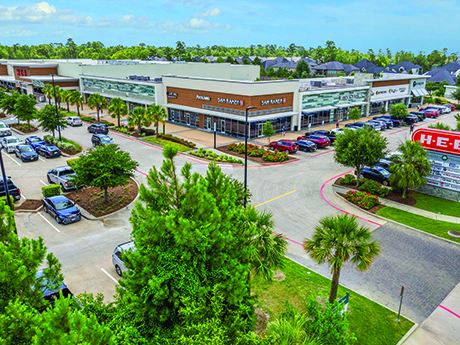
By Rafael Weiss, CEO of Sytes Everybody knows that Texas is among the country’s leaders in demand for quick-service restaurant (QSR) and coffeeshop space. That’s not the story. The story is where inside Texas that demand is actually concentrated, and it isn’t where most landlords are looking. According to Sytes’ analysis of active tenant requirements as of August 2026, Texas accounts for roughly 12 percent of every active QSR and coffee site requirement in the country right now — more than any other state, with Florida second and California third. That part is old news to most people in this business. What’s not old news: a full quarter of that Texas demand isn’t in Dallas-Fort Worth (DFW), Houston, Austin or San Antonio. It’s within the ring roads, the border corridor and towns that didn’t have a QSR conversation five years ago. Where Demand Actually Lies Here’s the breakdown of active Texas QSR and coffeeshop requirements by market, based on what tenants are posting right now, not closed transactions from 18 months ago. These figures are again based on Sytes’ analysis of active tenant requirements as of August 2026. That last line is the one worth sitting with. A quarter of all …
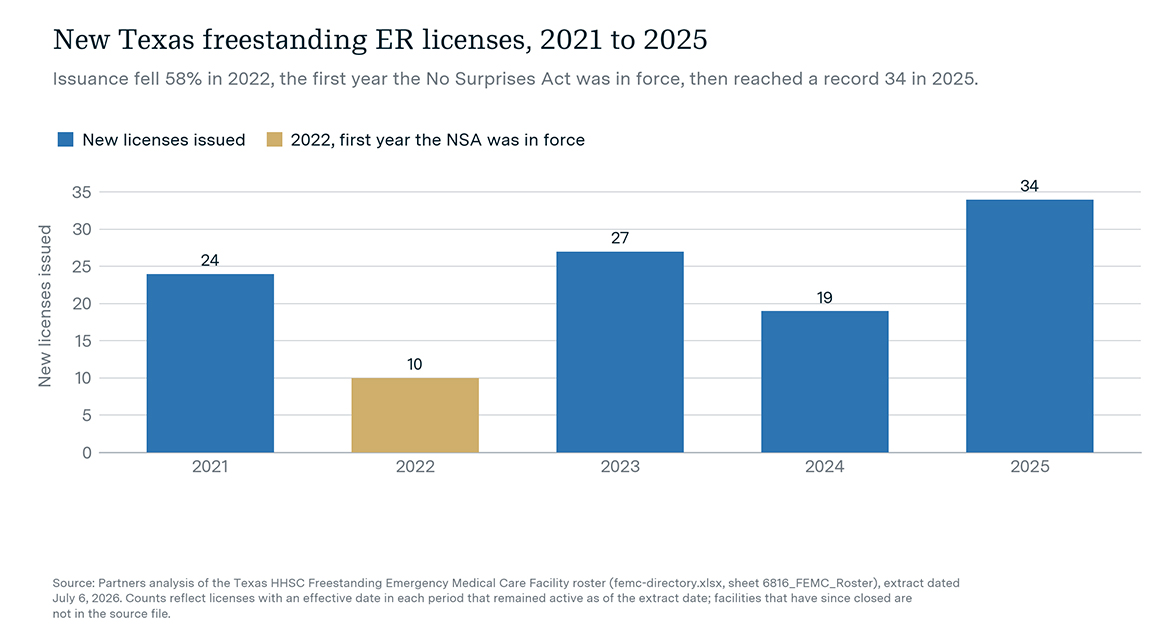
By Sean Anderson, senior associate, Partners Real Estate When Congress passed the No Surprises Act (NSA) in December 2020, the goal was straightforward: protect patients from the exorbitant, unpredictable bills that had become synonymous with emergency care and rein in some of the pricing power that out-of-network physicians and freestanding facilities had come to enjoy. On paper, the law delivered. By requiring that out-of-network emergency treatment be billed at the same rate a patient would owe for in-network care, the NSA eliminated an estimated 10 million surprise bills in just the first nine months of 2023 and pushed down the overall cost of emergency room (ER) procedures across the board, according to the second annual report to Congress from the U.S. Department of Health and Human Services. For patients, it was an unambiguous win. For the physician groups and real estate operators that had built business models around emergency medicine, however, the law landed as a direct hit to the bottom line. Out-of-network reimbursements initially fell by roughly 40 percent, according to an FTI Consulting analysis of the provider side of the law, and bankruptcy filings for healthcare operators hit their highest level in five years, tripling from 2021 to …
By Taylor Williams On some level, they knew this was coming, right? They just thought it would be over by now. Indeed, the expression, “survive till ’25” has proven insufficient as a barometer for when the multi-year slowdown in multifamily rent growth and valuations — inevitable consequences of the record-high sales prices and record-low cap rates that were achieved in 2021 and 2022 — would eventually fizzle out. Unprecedented supply growth in recent years, catalyzed by historically low interest rates and insatiable demand and taken to perhaps the highest of highs in Texas, has, unsurprisingly, generated cyclical pain in subsequent years. True, that pain is submarket-specific and is likely on its way out, but that doesn’t change the fact that it’s tough sledding for many multifamily owners right now. “Multifamily has had almost everything possible thrown at it in the past few years: interest rates rising, rental rates flatlining due to supply growth and operating expenses going up across multiple categories, from payroll to insurance to repairs/maintenance,” says John Griggs, co-CEO and co-founder of Texas-based developer Presidium. “Everything started flipping the wrong way at the same time. Some of those variables may correct in our favor, but it’s now been …
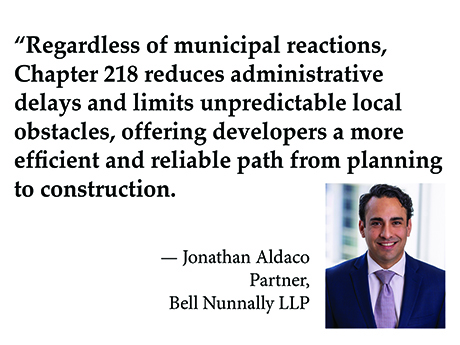
By Jonathan Aldaco, partner at Bell Nunnally LLP For decades, multifamily developers across Texas have faced a frustrating reality: after investing significant time and capital in projects, multifamily developments can spend months — or even years — sidelined in layers of procedural red tape before construction even begins. And while some projects eventually move forward, some never do. Senate Bill 840 (now codified as Chapter 218 of the Local Government Code) rewrites the playbook on this trend. Designed to address the shortage of housing in metropolitan areas across Texas, this new law streamlines approvals and lowers regulatory hurdles by allowing mixed-use and multifamily housing by right on commercial property. Only nine months into its implementation, Chapter 218 has made one point clear: The rules governing multifamily development in Texas have changed. Off the Sidelines, Into the Game As a threshold matter, Chapter 218 only applies to municipalities with a population of more than 150,000 that are wholly or partly located in a county with a population of more than 300,000. This means that cities like Dallas and Fort Worth and other municipalities in the metroplex like McKinney, Irving, Arlington, Frisco and Plano are impacted by Chapter 218. In total, this …
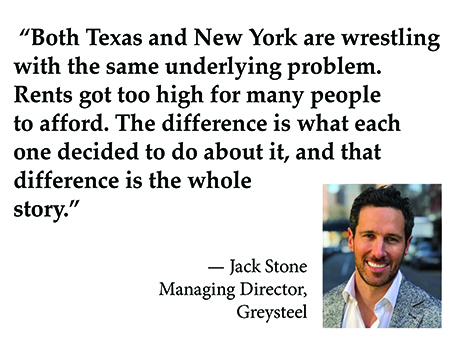
By Jack Stone, managing director, Greysteel In the last week of June, two things happened in the American multifamily market that belong side by side: New York City froze rents, and the Dallas Fed confirmed that Texas is drowning in apartments. One of those scenarios involves a market correcting itself. The other is a market being told to stop. In New York City, the Rent Guidelines Board voted seven to one to freeze rents on roughly 1 million rent-stabilized apartments, including zero percent increases on one- and two-year leases, the first two-year freeze in the board’s history. That action impacts about a quarter of all housing inventory in the city and roughly 40 percent of its rental units. In Texas, markets have kept doing what they’ve been doing for two years: bleeding. Both states are wrestling with the same underlying problem. Rents got too high for many people to afford. The difference is what each one decided to do about it, and that difference is the whole story. Texas is in pain, and the pain is honest. The Dallas Fed put numbers to it this spring. A pandemic-era construction boom, cheap money and aggressive bank lending dumped a historic wave …
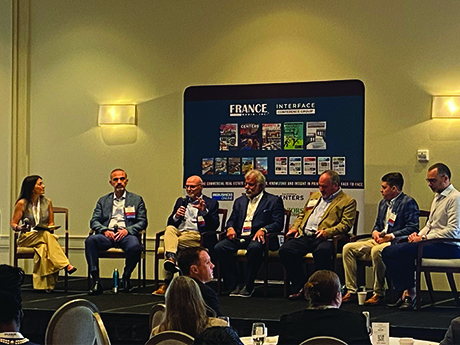
By Matthew Auchincloss With prices of construction materials perpetually up across the board and labor shortages persisting, multifamily developers have long been searching for new ways to improve efficiency both in pre-planning and in actual construction. That’s unlikely to change any time soon. But the quest for elevated efficiency has recently taken a number of different forms, according to Nikolas Fowler, a multifamily project executive at Birmingham, Ala.-based general contractor Hoar Construction. “What you’re starting to see is more use of off-site construction, whether it’s traditional volumetric modular or panelized or bathroom pods or some of the other things that are out there today,” says Fowler. “As more and more people realize the advantages of those systems and we have more and more challenges with labor, you’re going to continue to see people looking for new innovative ways to make those projects pencil out.” Editor’s note: InterFace Conference Group, a division of France Media Inc., produces networking and educational conferences for commercial real estate executives. To sign up for email announcements about specific events, visit www.interfaceconferencegroup.com/subscribe. Construction is historically not a very innovative industry. According to research from McKinsey, construction is the second-least digitally updated industry for the modern era; the first is agriculture and hunting. “One didn’t change for thousands of years, the other didn’t …
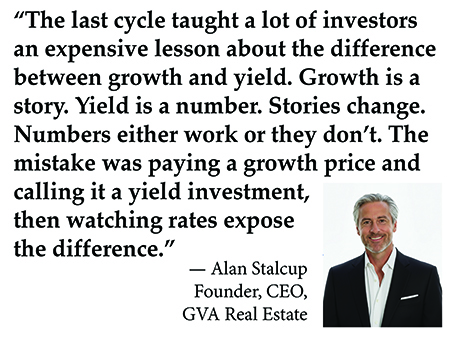
By Alan Stalcup, founder, CEO, GVA Real Estate Austin’s apartment inventory grew 33 percent from 2020 to 2025, according to data from Marcus & Millichap — the fastest rate in the country. In addition, data from CoStar Group and the U.S. Census Bureau show that vacancy is sitting at 14 percent, roughly double the national average. That’s what happens when every investor in America chases the same story at the same time. Austin isn’t a bad market. It’s a great city. But the math doesn’t work right now. When vacancy is 14 percent and new supply keeps getting added, buyers aren’t buying yield; they’re buying a prayer. The opportunities in Texas didn’t disappear; they moved. And they moved to places most investors aren’t looking. The Places Nobody’s Watching The Rio Grande Valley has between 1.4 and 1.5 million people, according to Census data. That’s not a small market. It’s a large, underfollowed one. McAllen, Harlingen, Brownsville — these cities have real population bases, stable renter demand and almost no institutional competition. Rents sit around $700 per month. GVA has been pushing $240 increases — roughly 30 percent — with light improvements. Not gut renovations or repositionings of assets, just new …
By Rives Taylor, principal, global resilience research lead, Gensler Texas is experiencing rapid growth in data center development as part of a broader push to support artificial intelligence (AI) ventures that have transformed digital infrastructure into a magnet for capital. As noted in Gensler’s recent Design Forecast, these assets demand abundant land, power and connectivity, making the region a natural fit for long-term growth in digital and industrial real estate. However, these facilities also require reliable access to significant water resources to support cooling systems that are essential for maintaining uninterrupted operations. As development increases, so do the needs for resources, and Texas lacks a consistent policy requiring operators to report essential metrics such as water use, energy consumption or cooling loads. This lack of transparency limits the ability of policymakers, communities and design professionals to fully understand the environmental impact of one of the state’s fastest-growing industrial sectors. With rising pressure on water supplies and power systems, the need for clearer reporting standards and more forward‑looking design approaches is becoming increasingly urgent. A recent white paper by the Houston Area Research Center (HARC), found that “without modernized planning and policy updates, the state faces a collision between finite water …
By Taylor Williams There’s nothing free in this world, not even a full-blown, multi-year resurgence in brick-and-mortar retail real estate. The ferocious revival of physical retail in the post-COVID era, headlined by fewer national bankruptcies, record rental and occupancy rates and renewed investor interest, has slowly but surely been stymied and hamstrung by macroeconomics. Despite real ingenuity and entrepreneurship among today’s operators, the business of leasing retail space in high-growth markets remains fraught with potential deal-killers that go beyond supply-demand dynamics that are favorable to landlords. For Texas retail brokers who specialize in tenant representation — men and women who genuinely love helping businesses grow, expand and serve their communities — that means taking on fresh challenges day in and day out. It means navigating pitfalls that have a way of consuming the two most valuable commodities on the planet: time and money. It means perfecting the art of self-motivation, of having ananticipatory mindset and thinking multiple steps ahead. It means embracing the hustle. Since venturing out on his own following a 12-year career at Weitzman, Matthew Rosenfeld, founder and president of Dallas-based brokerage firm The Rosenfeld Company, has lived and breathed these realities. Rosenfeld’s shop has been open for …
Newer Posts