

By Matt Hunter, Hunter Real Estate
Milwaukee’s office market, like many others across the country, is in flux. Rising costs, shifting tenant demands and looming debt maturities are all testing the market’s strength. But out of that pressure comes reinvention, and Milwaukee is proving it’s up for the challenge.
High-quality, well-located, amenity-rich office buildings are more important than ever. They’re essential to attracting and retaining top talent. Office buildings don’t just serve the tenants that occupy them, they grow the tax base, support local businesses, drive housing demand and help build a more vibrant and economically resilient city.

One of the most defining features of Milwaukee’s current office market is what’s not happening: there’s virtually no new construction. With high interest rates, continually increasing construction costs and economic uncertainty, ground-up office development has largely stalled. This has created a limited supply of modern, Class A office space, just as tenants are placing greater emphasis on quality.
That supply-demand imbalance is driving increased competition for top-tier buildings and putting upward pressure on rents in this high-end segment. Tenants want less space but better-quality space, and they’re willing to pay a premium for it. This is a significant opportunity for landlords of well-located and updated assets to attract new tenants to their buildings.
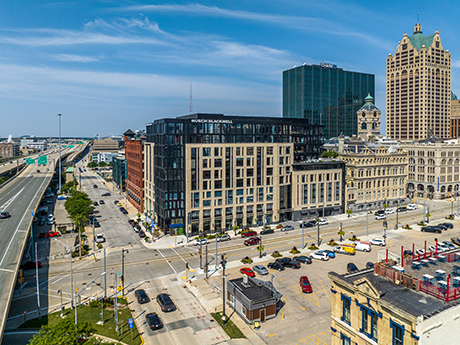
The Huron Building, located at 511 N. Broadway in the city’s historic financial district, and R1VER located in the Harbor District just south of downtown at 210 W. Becher St., are two prime examples of assets that are exceptionally well-positioned to capitalize on these market conditions.
The Huron Building offers Class A finishes, modern amenities and a prime location in the heart of downtown Milwaukee with immediate access to I-794 and the popular, historic Third Ward.
Meanwhile, R1VER stands out with its integrated, mixed-use waterfront development that combines high-quality office space with residential, retail and lifestyle amenities. Its focus on creating a live-work-play ecosystem puts it directly in line with what modern tenants and employees are demanding.
Both projects reflect where the Milwaukee office market is heading toward experience-driven, flexible and well-amenitized environments.
Cost challenges
Leasing office space in Milwaukee has become more expensive across the board. Construction costs are up dramatically, inflating both new development and tenant improvement budgets. Labor shortages, elevated materials pricing, and at times, slow permitting protocols make projects more expensive and slower to deliver.
Even furnishing a new space has become cost-prohibitive for some tenants. Tariffs and increased demand for hybrid-flexible layouts have driven up furniture costs significantly. When paired with today’s elevated borrowing costs, the economics of leasing space are more complex than ever. Landlords must invest more to attract tenants, while tenants are navigating longer decision cycles and higher all-in occupancy costs.
This “flight to quality” trend continues to define tenant behavior in Milwaukee. Demand is concentrated on Class A buildings, particularly those offering strong amenities such as fitness centers, spec suites, high-tech training rooms, rooftop gathering spaces and private boat slips.
Tenants are downsizing but raising their standards. They’re looking for high-end finishes, best-of-class amenities and walkable neighborhoods. Buildings that haven’t kept up or that lack meaningful capital investment are falling further behind. The quality gap is growing wider.
As older, vacant office buildings struggle to attract and retain tenants, many are being reconsidered for adaptive reuse. Conversions into residential, hospitality or industrial space are increasingly viable and, in many cases, necessary. With housing demand in the city still far outpacing supply, office-to-residential conversions offer a path forward for some of these underperforming assets.
But these projects don’t come easy. Zoning hurdles, outdated infrastructure and complex financing structures can stall even the most promising conversion plans. Public and private collaboration will be essential. Incentives like historic tax credits and fast-track permitting can help bridge the feasibility gap.
Milwaukee’s office market also faces a ticking clock: a wave of office loans will mature over the next few years. With valuations down, vacancies up and interest rates still elevated, many owners will struggle to refinance. Assets that are underwater or facing occupancy issues are especially vulnerable.
Milwaukee’s office market is being reshaped by necessity and that’s not a bad thing. Stakeholders who lean into quality, flexibility and innovation will be well-positioned both now and in the future. Resilience is no longer just about weathering market cycles, it’s about rethinking what office space can and should be.
We’re optimistic about what’s ahead and believe this is a turning point defined by creativity, collaboration and real momentum. The future of office in Milwaukee is not just functional; it’s dynamic, integrated and essential to the city’s broader success.
Matt Hunter is founder and CEO of Hunter Real Estate. This article originally appeared in the November 2025 issue of Heartland Real Estate Business magazine.