

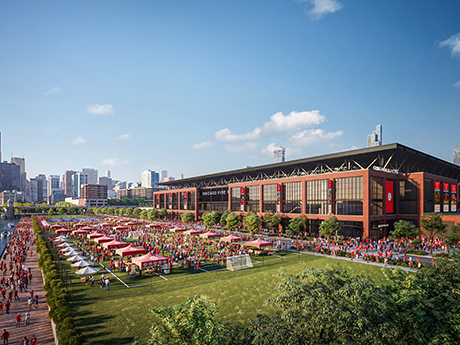
While the health of the retail market along the Magnificent Mile continues to recover incrementally with a rebound in foot traffic following a prolonged downturn, Chicago’s neighborhoods and suburbs are bustling with leasing activity. In fact, limited retail supply in the suburbs and throughout most of the city’s neighborhoods is one of the biggest challenges facing the market, according to Michael Flinchbaugh, an associate director with Chicago-based Bradford Allen. He says the dynamic has pushed up rents, leading to more national retailers entering corridors that have historically been occupied by local stores.
“Groups that are not as well capitalized are struggling to find affordable space for lease,” says Flinchbaugh.
The Loop, on the other hand, is sitting at a vacancy rate around 30 percent, according to Flinchbaugh. He says the hope is that the number of office-to-residential conversions slated to occur in the next two to three years will bring retailers back to the submarket as it becomes more of a live-work community. The Loop is located south of the Chicago River, while the Magnificent Mile is situated on the city’s Near North Side. Long known for its high-end shops, hotels and restaurants, the one-mile section of Michigan Avenue referred to as the Magnificent Mile recorded a vacancy rate of 28.8 percent in the third quarter, according to Chicago-based retail brokerage and advisory firm Kirsch Agency. That figure is down from 33.5 percent in 2024.
The Mag Mile has struggled with a number of issues since the onset of the pandemic, including a lack of foot traffic and crime issues. In recent years, luxury retailers have flocked to Chicago’s Gold Coast neighborhood, adding to the vacancies along Michigan Avenue. The Gold Coast is a historic district that is part of the Near North Side area and is bounded by North Avenue, Lake Shore Drive, Oak and Clark streets.
Despite negative net absorption of 1.7 million square feet year to date through the second quarter, Chicago’s overall market vacancy rate hit a near 30-year record low of 4.9 percent, according to the latest data from JLL. The brokerage firm states that the supply-constrained environment is characterized by historically tight inventory and a limited development pipeline. Retail projects under construction in the second quarter totaled 758,218 square feet, a decrease from 1 million square feet the same period a year ago, according to Lee & Associates.
“Inventory is extremely limited in the primary neighborhoods,” emphasizes Nicole Cardot, a vice president with Chicago-based Baum Realty Group LLC. “That said, new development is constrained, so existing stock of premium retail becomes more valuable. Inventory feels a lot tighter this year versus previous years, especially for small-shop spaces in primary markets.”
Neighborhood Hot Spots
Neighborhood expansion is still the focus for retailers, says Cardot, adding that brands coming from out of state are mainly interested in the Gold Coast or West Loop.
“Rents are increasing steadily, especially in competitive markets such as West Loop, the Southport corridor and Lincoln Park,” says Cardot. “In primary markets, landlords will have multiple offers, so they are able to hold firm on their positions.”
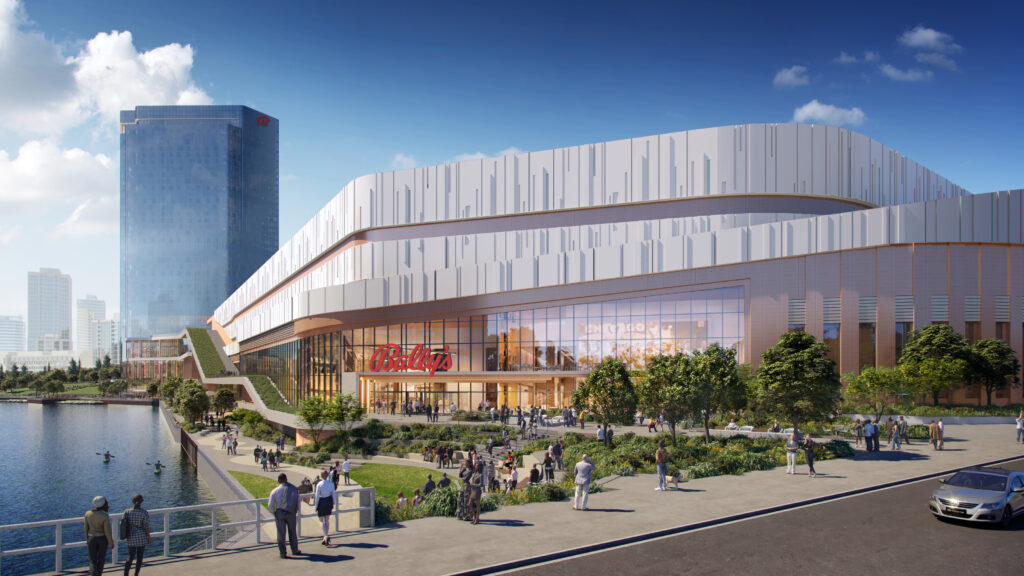
The Bally’s Chicago casino is slated to open in 2026 along the Chicago River.
Flinchbaugh says rents in the Gold Coast are the highest they’ve ever been, with most deals getting signed at with most deals getting signed at $300 per square foot or more. Rents have also spiked on Randolph Street in Fulton Market, reaching the $90 to $100 per-square-foot range. For context, the overall market’s average asking rate was $21.91 per square foot triple net in the second quarter, according to Lee & Associates.
A lack of available space is particularly noticeable in areas such as the Southport corridor between Addison and Roscoe streets, which has zero vacancy, according to Flinchbaugh. The Armitage area between Sheffield Avenue and Halsted Street maintains a 4 percent vacancy rate.
“With the exception of Fulton Market, the lack of traffic from low office occupancy is still hurting restaurants and retailers in Chicago’s central business district,” says Rick Scardino, a principal with Lee & Associates of Illinois. “For now, the suburbs continue to be a safer bet.”
Chicago’s office vacancy rate in the central business district has continued to rise since the onset of the pandemic, reaching 26.5 percent in the third quarter of this year, according to CBRE. The brokerage firm notes that the vacancy rate for Class B buildings has risen nearly 20 percentage points to 33.3 percent since the third quarter of 2020. Class A properties have experienced a rise of less than six percentage points in that same period.
Wayne Caplan, a senior vice president with SVN Chicago Commercial, says many retail tenants downtown successful due to high real estate taxes in Cook County and overall operational costs. In addition, crime levels and office vacancy still negatively impact the retail sector.
The City’s Potential
Despite lamenting downtown’s retail woes, sources are still optimistic about the city’s future retail scene.
Submarkets that have struggled to make a comeback post COVID such as the central business district, as well as other past hotbeds like River North, have recently experienced an uptick in leasing activity and increased demand, says Scott Reinish, a senior vice president with Colliers Chicago who has recently taken on leasing assignments in the Lincoln Square and Belmont Cragin neighborhoods. He says there is a consistent demand for smaller footprints ranging from 1,500 to 3,500 square feet.
A prominent example is Japanese fashion brand Uniqlo, which plans to open a store at 600 N. Michigan Ave., four years after shuttering its previous location on the Magnificent Mile. In June, Spanish fashion retailer Mango announced it would debut a store on Michigan Avenue, and in April, a Harry Potter experiential shop opened below the Omni Hotel Chicago at 676 N. Michigan Ave.
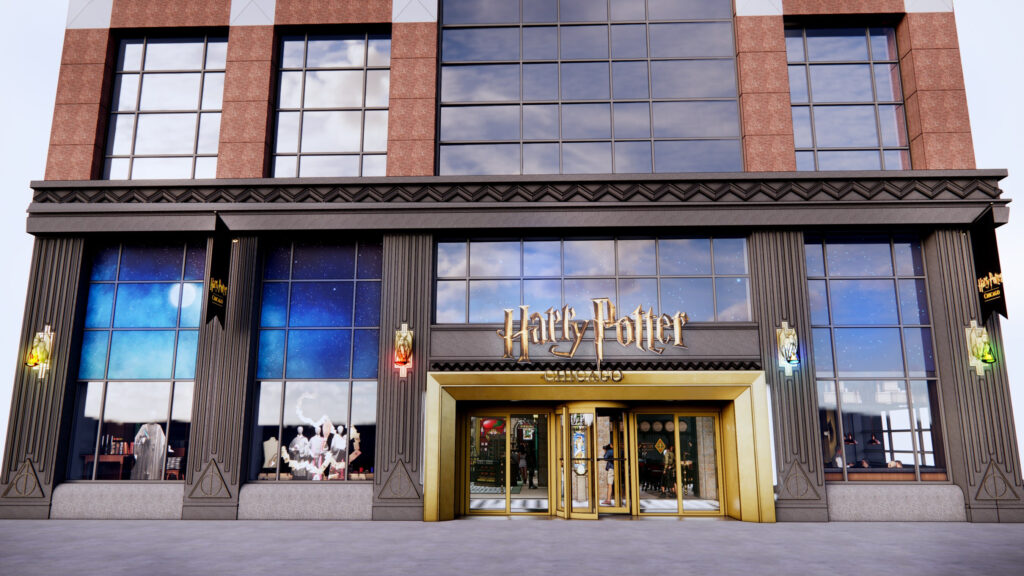
In April, a Harry Potter experiential shop opened below the Omni Hotel Chicago along Michigan Avenue. The store is filled with an array of themed areas, merchandise, props and a Butterbeer Bar.
“There is a great amount of opportunity still along Michigan Avenue,” says Flinchbaugh. “The traffic the street sees is still unmatched and will no doubt attract retailers looking for flagship locations.”
Caplan’s firm recently represented Raygun, a regional apparel and collectables retailer, in its new lease at 1 N. State St. in the Loop.
“Raygun was able to take advantage of a recovering — but not recovered — State Street landscape and wanted its second store in Chicago to be in this downtown area near tourism, hotels and schools,” says Caplan. “While business travel has not come back to pre-COVID levels, tourist travel remains strong. Raygun wanted a store location that was accessible to these retail traffic sectors.”
In 2024, the Windy City welcomed an estimated 55.3 million visitors, according to the City of Chicago. From June through August 2025, hotels in the central business district filled over 3.5 million room nights, a 4.3 percent gain over 2024 and surpassing the previous record set pre-pandemic in the summer of 2019. Leisure travelers occupied 2.5 million hotel rooms, up 11.2 percent compared with 2024.
A large swath of retail space was taken off the market when Universal Destinations & Experiences selected Chicago for the second location of its year-round immersive horror experience, Universal Horror Unleashed.
The entertainment venue will transform a vacant 114,000-square-foot commercial building at 700 W. Chicago Ave., directly across from the new Bally’s casino that is slated to open in 2026. Legislation expanding gambling in Illinois to include land-based casinos was passed in 2019, and the city council approved the Bally’s project in 2022.
Suburban Activity Stays Hot
Chicago’s suburbs are experiencing plenty of expansion activity from daycares, indoor play areas, pickleball, restaurants, healthcare and fitness tenants, according to Brad Belden, a senior vice president with Colliers Chicago. He says most of these users are more regional or local and not household names yet. Caplan agrees with Belden’s assessment, noting that his firm recently completed leases with medical and dental tenants as well as local restaurants, nail and hair salons, fitness concepts, daycares and home design stores.

UrbanStreet Group broke ground on a 30-acre retail district at Veridian in the Chicago suburb of Schaumburg. The Veridian project involves the transformation of the former Motorola campus. The first phase of the retail district will include 100,000 square feet of walkable retail and international cuisine, anchored by a 26,000-square-foot The Fresh Market grocery store along with 321 apartment units.
Scardino has represented a couple new market entrants in the personal care category. These tenants include Hammer & Nails, a luxury barber shop and grooming experience for men, and Woodhouse Spa.
Coffee competition in the market is hot despite the upcoming closure of dozens of Starbucks stores in the metro area, says Scardino. At the end of September, Starbucks announced that it would close several hundred underperforming company-operated stores across the country as part of a broader $1 billion restructuring effort. Expanding retailers in the coffee segment include 7 Brew, Scooter’s, Biggby and Dutch Bros.
Car washes are another actively growing segment in the market. Brands such as Buddy Bear, Driven and Tommy’s Express are making headlines for their growth, says Scardino.
Only time will tell if continued inflation will inhibit retailer expansion plans. The annual inflation rate in August was 2.9 percent, based on the Consumer Price Index, an increase from July’s figure of 2.7 percent.
“The continual rising cost of goods changes consumers’ shopping behavior by reducing discretionary spending and driving demand toward value-oriented and necessity-based retailers,” says Autumn Psaros, a senior vice president with Naperville-based Caton Commercial Real Estate Group. “This puts more pressure on and reduces profit margins for mid-tier and discretionary retailers,” continues Psaros, “which leads to more cautious expansion strategies and, in some cases, store closures or lease renegotiations.”
— Kristin Harlow
This article was originally published in the November 2025 issue of Shopping Center Business magazine.