

By Taylor Williams
“Economic development is the process of improving the economic well-being and quality of life for a community or nation through strategies like job creation, infrastructure development and advancements in education and health.”
That’s the first sentence of the AI-driven overview that results from a simple Google search of the term “economic development.” And admittedly, that’s a very good start.
Economic development is rooted in economics, a field that embodies the study of business, industry, jobs and wealth. The Google definition also pays tribute to the behind-the-scenes infrastructural work that is required to jumpstart and sustain most business endeavors, particularly regarding commercial real estate. And lastly, it covers what which may be the most important, end-all goal of economic development work: elevated quality of life for the people who live in, work at and patronize those commercial establishments.
It’s that last part of the definition that appears to represent a growing niche and focal point within the spectrum of economic development work in Texas. Quality-of-life initiatives can be manifested in an array of
commercial settings: housing, entertainment, food-and-beverage, hospitality. And as economic development professionals embrace many different roles — ambassadors of their communities, liaisons with developers and business owners, researchers and data, gatekeepers of incentives — at their core, they remain stewards of a unique brand of high-quality living that can only be found in their specific communities.
In this piece, we examine the challenges and progress of those efforts through the lens of five Texas cities that have ridden the Texas wave of growth and now find themselves tasked with taking things to the next level — by delivering the highest quality of life possible.
Bonham
As part of North Texas, Bonham, located about 75 miles northeast of Dallas, lies directly within the hotbed of explosive population growth and the semi-unavoidable rise in housing costs that tends to accompany said growth. Being able to comfortably afford a home is a key ingredient in the recipe for high quality of life, and William Myers, Bonham’s director of economic development, believes that his community still offers some of the most affordable housing options in the region.
“Our median home prices and rents remain well below those in neighboring Collin and Grayson counties,” says Myers. “This extreme affordability has made Bonham increasingly attractive to families, young professionals and retirees seeking quality housing and small-town character within easy commuting distance of the Sherman, McKinney and DFW employment centers.”
“Bonham is prioritizing new and infill housing development, investing in infrastructure improvements and maintaining a developer- and builder-friendly environment that encourages new construction and creates diverse housing options to meet a range of needs,” Myers continues. “We are also focused on attracting family-friendly restaurants, destination retail and experiential entertainment concepts that enhance our residents’ quality of life while appealing to our expanding regional visitor market.”
Quick-service restaurants, coffee shops, breweries, wineries, boutique retailers — Myers says all are welcome in Bonham. To accommodate these new businesses, Bonham has undertaken a multitude of adaptive reuse projects of 19th and 20th century buildings in its downtown area. In addition to retail and food-and-beverage (F&B) uses, some of the redeveloped spaces can also support office or loft-style apartments.
If initiatives to expand housing and retail/restaurant options are direct investments in quality of life, then installing and/or upgrading the underlying infrastructure of the buildings themselves represents an indirect investment in the elevated lifestyle. In 2023, Bonham completed an $18 million overhaul of aging water and sewer systems, and Myers says the community is prepared to build upon that work.
“Bonham is preparing to invest an additional $20 million in water line upgrades within the next six months that will be supported by funding from the Texas Water Development Board,” he says. “In addition, Bonham is encouraging the use of Public Improvement Districts and Tax-Increment Reinvestment Zones to facilitate aggressive infrastructure and quality-of-place investments through the city and [among] our development partners, reflecting our community’s proactive approach to sustainable growth.”
Edinburg
As part of the Rio Grande Valley (RGV), Edinburg’s local economy is driven by cross-border trade and industrial development and leasing activity associated with those operations. But like the broader economy of Texas as a whole, the regional economy of the RGV has diversified in recent years.
Growth within the educational and healthcare sectors has been focal points of that regional broadening. According to Raudel Garza, executive director of the Edinburg Economic Development Corp., the University of Texas Rio Grande Valley (UTRGV) now has an enrollment exceeding 30,000 students, a Division I football program and three major hospitals as part of its network. Garza and his team are consequently looking to deliver the best living experiences possible for those students, faculty and working professionals, who inevitably encompass a range of demographics.
“We’re focused on attracting businesses that complement our strong retail and dining base, including sit-down restaurants, family-friendly entertainment venues and sports-themed establishments,” he says. “We’re also looking for retail brands that fill gaps in apparel, home goods and daily needs.”
Garza says that 40 percent of Edinburg’s existing inventory of for-sale homes is priced between $100,000 to $199,000, with another 34 percent of that product being priced between $200,000 and $299,000. There are also multiple single-family home developments under construction in the area.
“We support residential growth through infrastructure investments, such as new water and sewer systems, that make new housing development possible,” he says. “This approach helps maintain affordability while ensuring Edinburg can keep pace with demand as more people choose to call it home.”
Other infrastructural projects underway in Edinburg that are ostensibly designed to make daily work and life a bit more comfortable and convenient include:
• A new, 268-space downtown parking garage
• A new elevated water tower with a capacity of 1 million gallons to increase service for operators of industrial and commercial businesses
• New hangars and an “aeronautical industrial corridor” at the South Texas International Airport at Edinburg, which can accommodate Gulfstream IV and business executive aircraft
• Continued investment in drainage improvements and similar infrastructure, including those projects linked to the planned State Highway 68
Industries in Edinburg that are growing most quickly include healthcare, advanced manufacturing, logistics and other skilled trades. Supporting those industries such that they find staff to meet demand and sustain growth is, in and of itself, an investment in the community’s quality of life. That notion is not lost on Garza and his team.
“Through collaborative initiatives such as internship programs, career fairs and customized workforce training, we help connect local talent with emerging opportunities,” says Garza. “Our goal is to maintain a competitive workforce while providing residents with clear pathways to career advancement.”
Irving
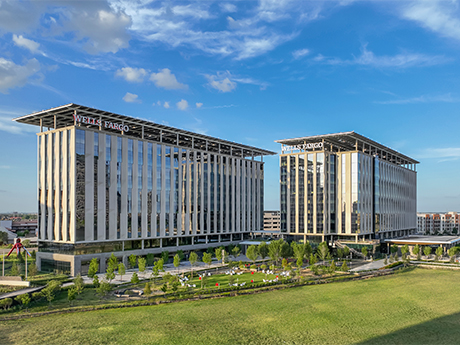
Perhaps the biggest news to come out of Irving recently is the formal opening of Wells Fargo’s 850,000-square-foot regional headquarters campus. As such, the city is highly engaged in elevating its F&B and entertainment sectors to ensure that those employees have ample options on days when they come into the office.
“We are actively seeking retail, restaurant and entertainment concepts that complement our Class A office environment, corporate campuses and dynamic mixed-use districts,” says Diana Velazquez, vice president of development at the Irving Economic Development Partnership.
“Our ideal tenants include chef-driven and upscale restaurants and modern experiential entertainment — from immersive art exhibits and interactive museums to tech-forward gaming venues — as well as boutique fitness and wellness studios, specialty retail shops, and high-quality grocery stores. We are especially interested in neighborhood-focused brands that contribute to walkability and serve both our residents and daytime workforce.”
As part of its commitment to enhancing quality of life, the Irving Economic Development Partnership is revitalizing older buildings via adaptive reuse projects. Like most endeavors of this nature, these projects aim to maintain the original charm and character of the community without sacrificing future growth.
“Our Heritage District showcases innovative adaptive reuse projects that breathe new life into historic mid-century buildings,” says Velazquez. “We’ve seen legacy storefronts and older assets transformed into vibrant destinations for local F&B and creative retail [users]. Recent examples [of these activities] include the conversion of historic properties into a Pilates studio, the addition of new townhomes and the introduction of fresh retail concepts, all of which honor the district’s character while supporting modern uses.”
In terms of housing, Velazquez says that the city is actively working to maintain affordability by “leveraging targeted reinvestment zones and public-private partnerships.” In addition, she says, the city has tasked itself with “streamlining development reviews, which reduce holding costs for builders and help keep a variety of housing options more accessible to a wider range of residents.”
In addition, as the [partial] home of Dallas Fort Worth International Airport, Irving has experienced robust industrial growth in recent years as the airport has expanded its commercial cargo operations. Now, the goal is to continuing attracting the next generation of industrial users.
“Irving–Las Colinas has experienced significant expansions in advanced manufacturing, aerospace and aviation, as well as packaging and logistics,” says Velazquez. “These sectors, alongside our established strengths in corporate operations and facility remodels, are driving significant job creation and space absorption.”
“In the fiscal year 2024–2025 alone, our economic development initiatives supported nearly 2,000 new jobs, facilitated over 3.7 million square feet of new commercial space and attracted more than $500 million in capital investment,” she concludes. “These trends underscore the area’s appeal to both new and existing employers, reflecting a healthy and sustained demand for industrial and commercial real estate.”
Lancaster
The growth story of Dallas-Fort Worth over the past decade has been phenomenal with regard to suburbs in all cardinal directions. Yet it’s fair to say that certain northern suburbs have had outsized levels of corporate office (re)locations and housing development. Suburbs in other directions, including the south, have thus emerged as more affordable options.
Situated due south of Dallas, Lancaster, a city of about 42,000, has historically benefitted from immediate
proximity to highly trafficked corridors and the industrial-based economy of South Dallas. That connection remains visible today via the 2023 opening of a 1.2 million-square-foot bottling plant for bottled water provider Niagara.
Karl Stundins, Lancaster’s assistant director of economic development who leads the department’s research and business initiatives, points to the recent debut of a manufacturing facility for McKinley Packaging as evidence of the city’s vibrant industrial sector. Stundins also says that “the next wave of growth will include several data centers.”
Stundins notes that “housing bargains” can still be found in Lancaster. But even with the community subject to the shifts in affordability that are happening throughout North Texas, residents now have access to a more vibrant social and entertainment scene, he says.
“The Lancaster downtown [area] has seen tremendous transformation in the past two years,” Stundins explains. “Stewarding Space purchased about a third of the buildings in the downtown square, quickly renovated them and brought in high-quality restaurants like La Calle Doce and HUG BBQ, as well as retail shops. The Kyoto Brew owners took a long-vacant, tiny building and transformed it into a comfy coffee, tea and matcha spot by day and a romantic bar featuring craft cocktails by night.”
“From the human-scaled, restaurant-based downtown rejuvenation to a safe, small-town feeling, living in the area offers residents great value,” concludes Stundins.
Tomball
In Tomball, located on the northeastern outskirts of Houston, economic development professionals cite the community’s growing population of young residents, strong highway and interstate connectivity and newly upgraded public spaces and streetscapes as factors that should attract new businesses.
In terms of those businesses that are strongly associated with lifestyle, the community is seeking “experience-driven” retail and dining concepts. These concepts may include fast-casual and chef-driven restaurants, boutique retailers and entertainment uses such as small live music venues, craft breweries/distilleries and family-friendly recreation outlets.
Kelly Violette, executive director of the Tomball Economic Development Corp. (TEDC), concedes that her community is experiencing upward pressure on housing prices. TEDC has adopted a four-point plan to keep housing affordability in check.
Tomball’s housing strategy focuses on diversifying housing types, leveraging existing infrastructure, preserving historic neighborhoods and fostering partnerships and incentives that maintain long-term affordability even as the city continues to grow,” she explains.
Violette says that this broader endeavor starts with maximizing the use of vacant infill sites.
“The plan encourages residential infill — development of vacant lots within existing neighborhoods — as a means to use existing utilities and infrastructure efficiently,” she says. “By focusing on infill and revitalizing the community’s core, Tomball seeks to curb sprawl, strengthen established neighborhoods and make better use of public investments.”
TEDC is also focused on expanding “missing middle” housing — duplexes, townhomes, small-scale multifamily complexes and patio homes — for certain segments of the population, such as young families and senior citizens. Violette says that this type of residential product “creates attainable options at varied price points and tenure, for sale or lease.”
Lastly, the organization promotes adaptive reuse wherever possible. With regard to housing, the city identifies regulatory barriers, such as zoning or code conflicts, and considers introducing an adaptive reuse overlay district. Alternatively, the city may opt to treat adaptive reuse projects as a distinct land-use type to streamline the process.
But the repositioning and revitalizing of quaint historic buildings in Tomball isn’t confined to housing. One of TEDC’s more exciting adaptive reuse projects centers on Tomball Legacy Square which is a redevelopment of the former First Baptist Church complex in downtown Tomball. Violette says that TEDC acquired the multi-building property with the goal of “transforming it into a vibrant arts and cultural destination that will serve as a community anchor and regional attraction.”
“This project reflects the city’s growing emphasis on placemaking, cultural enrichment and downtown revitalization,” says Violette. “By investing in adaptive reuse rather than new construction, Tomball is preserving a meaningful piece of its history while creating new opportunities for residents, visitors and local businesses. Once completed, Tomball Legacy Square will become a cornerstone of downtown Tomball’s continued evolution into a lively destination for arts, entertainment and community gatherings.”
— This article first appeared in the November 2025 issue of Texas Real Estate Business magazine.