

ATLANTA — For many multifamily professionals, 2025 is a year to forget.
Paul Berry, president and chief operating officer of Mesa Capital Partners, said that U.S. multifamily investment sales are on track to close out the year at $125 billion, which represents a 25 percent decline from an average pre-COVID year and a little more than a third of 2021’s total (a torrid $354 billion).
Andrew Zelman, senior vice president of Southeast investments at Boston-based GID Multifamily, said that owners are doing “everything they can to hold out for a profit.”
Editor’s note: InterFace Conference Group, a division of France Media Inc., produces networking and educational conferences for commercial real estate executives. To sign up for email announcements about specific events, visit www.interfaceconferencegroup.com/subscribe.
“As simplistic as this is, sellers will avoid transacting at less than peak values at any cost,” said Zelman, who added that owners are essentially kicking the can down the road by recapitalizing their assets or stopping and starting the marketing process if their pricing expectations aren’t being met.
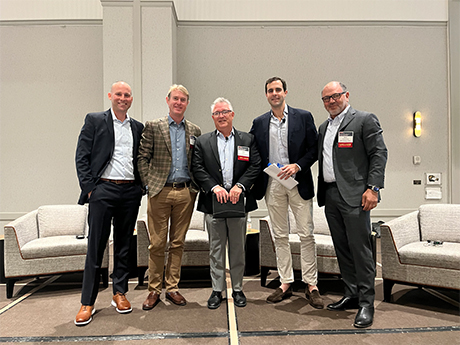
Zelman’s comments came during the opening panel on Tuesday, Dec. 2, at the 2025 InterFace Multifamily Southeast conference, which was held at the InterContinental Buckhead in Atlanta. Co-hosted by France Media’s InterFace Conference Group and Multifamily & Affordable Housing Business magazine, the two-day event attracted a little more than 300 attendees. Berry moderated the panel, which comprised multifamily investors active throughout the Southeast.
Recouping capital amid headwinds
Zelman explained that sellers today are holding out for peak pricing because the cost of owning multifamily properties has become more expensive in recent years. For one, the cost to develop is at an all-time high as construction materials pricing remains volatile and costs for land and labor remain elevated. Budgets are also strained on the operations side with costs for staffing, maintenance, marketing and technology all on the rise.
“In order to make a profit today at today’s values, you either need a legacy basis from probably somewhere between 2015 and 2017 or you need a legacy construction budget from pre-COVID before costs ran up by 20 percent,” said Zelman.
Seth Greenberg, CEO and chief operating officer at Atlanta-based ECI Group LLC, said that buyers have also been reluctant because they’ve been waiting for better debt, despite the five interest rate cuts by the Federal Reserve in 2024 and 2025, with another one likely at the Federal Open Market Committee (FOMC) meeting later this month.
“People are going to have to face the music and not just hope for a better day, because hope isn’t a business plan,” said Greenberg.
Beyond capital markets issues, buyers have also been wary of multifamily acquisitions as rent growth has remained subdued around the country, especially in the Southeast where the region’s top markets welcomed record levels of new supply in the past few years. For instance, Zelman said that GID’s Atlanta portfolio has experienced a 7 percent decline in effective rents between 2023 and 2025.
Davis Finnen, managing director and investment manager at Greystar, said that the U.S. multifamily market is currently experiencing “a reversal of the established trends” from the past few years.
“We saw strong rent growth in a lot of the Sun Belt markets [during the pandemic], which experienced a supply wave after that,” said Finnen. “If you look across the Sun Belt now, very few markets are seeing positive rent growth.”
“We’ve got a supply problem in the Southeastern markets,” added Graham Carpenter, managing partner at Penler, which invests heavily in the region, especially its home city of Atlanta. “On average, our acquisitions are 20 to 30 percent below peak values.”
Carpenter added that peak pricing is being achieved in some coastal markets in the Western United States and the Northeast that weren’t inundated with new supply during the early COVID years.
Berry asked the panelists if the Southeast region has reached the theoretical bottom of the current cycle in terms of sluggish rent growth and thus pricing. Most panelists agreed that the trough is already in the rearview.
“Our tracking in our target markets suggest that pricing was off about 35 percent discount-to-peak pricing but now we’re 30ish percent, so I’d say we’re slightly off the bottom,” said Carpenter.
“We have a BI [business intelligence] dashboard so we can see rent movement in real time, and some assets are really struggling while some are starting to pop, which has been encouraging,” added Zelman.
Finnen said that Greystar has had a “huge recovery” in terms of rent collections across its multifamily portfolio compared with the early years of the pandemic, which gives him optimism about the upcoming year.
“The rebound has been great, but we’re not back to positive rent growth across our portfolio,” said Finnen. “Rent growth isn’t there yet, but it feels like we’ll turn that corner.”
Is a rebound coming?
The investment panelists were confident that the U.S. multifamily market will achieve high-water marks for pricing in the near future. Greenberg told an anecdote about how his father would always advise him to enjoy current pricing levels because “they won’t ever happen again,” citing previous high cyclical points in 1996, 2001 and 2012. Greenberg added his father wasn’t alive to tell him so again in 2021.
“Whether we get back to positive rent growth and peak pricing in the second or third quarter of next year, it will eventually happen; it’s just a question of when,” said Greenberg, who added that he can’t wait for his firm to start budgeting for rent growth and stop budgeting for concessions.
Finnen concurred, saying that the supply-driven dynamics should reach equilibrium with so few starts in the development pipeline compared with previous years.
“It’s going to take time for those units to be absorbed, but we are long-term believers in the Southeast,” said Finnen.
His firm, Greystar, plans to be very active next year. During the panel’s closing remarks, Finnen said the Charleston-based owner-operator plans to be a net seller in 2026, selling 55 apartment communities, acquiring 49 communities and then breaking ground on another 39 new ground-up developments.
While the panel largely centered around supply issues in the multifamily sector, the panelists had a differing view on the renter-demand picture. Carpenter said that the “demand is there,” citing the large delta in affordability between homeownership and renting. He also noted that young adults are waiting longer than ever before to start families.
Greenberg said that it’s important to be nimble in case the U.S. multifamily market experiences an unforeseen demand shock in the coming years.
“We’ve talked about supply mostly because we’re assuming demand is a constant,” said Greenberg. “Manufacturing is slowing, low-end consumers are getting stressed and there’s always another shoe that can drop, which could be a contraction in employment. That is the other side of the coin we can’t forget about as we’re plotting when the good times are going to return.”
— John Nelson