

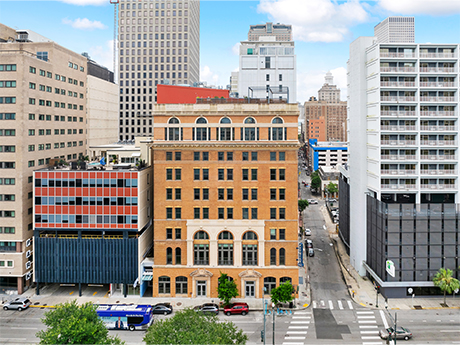
One cannot talk about, analyze, nor understand the New Orleans Central Business District (CBD) office market without a corresponding discussion of the entire CBD, not just the office building submarket. This is especially true when we look at the evolution of the New Orleans CBD since the late 1980s, and, more specifically to this article, since Hurricane Katrina.

The New Orleans CBD office market is still the largest office submarket in this region. The submarket contains approximately 10.3 million rentable square feet. The balance of our submarkets (East Metairie, West Metairie, Kenner, Elmwood, West Bank, New Orleans East and the Northshore) contain a total of 8.6 million rentable square feet.
More importantly, the CBD remains home for most of New Orleans’ “corporate” tenants, virtually all the region’s major law firms and financial institutions. That is the good news.
However, the CBD has been transformed over the past 30+ years — and especially for the past two decades after Hurricane Katrina — from a traditional office-centric CBD to a mixed-use downtown area. The supply of office space in the CBD has shrunk from 70 buildings and 16.5 million rentable square feet in 1991, to 50 buildings and 13.8 million rentable square in 2005 to approximately 23 office buildings containing approximately 10.3 million rentable square feet today. This reduction has been a result of a handful of largely macro factors.
The decrease in total downtown office building supply is not due to CBD office tenants moving to new offices in the suburbs. In fact, there have been no new major office buildings built in suburban New Orleans since 1989. Supply, and for the most part, occupancy levels in the suburbs have been level over the past three decades. Concurrently, major corporations, financial institutions and related businesses have been (i) merging, resulting in a need for less office space; (ii) desiring more efficiency and less overhead, so not requiring as much office space; and (iii) relocating to major markets rather than growing in tertiary markets like New Orleans. The result is that overall office demand is down and, correspondingly, there is excess supply.
The good news for New Orleans is that, corresponding with this lack of new office demand, the New Orleans hospitality industry was growing along with the desire for more urban living. So, as office demand weakened, there was growing demand for new hotel rooms and apartments in and around the CBD. As a result of less office demand, New Orleans had a significant supply of under-utilized, historic office buildings and other structures that were ripe for redevelopment for these alternative uses.
The final factor was, and is, the availability and the financial benefits of both state and federal Historic Tax Credits. The availability of these tax credits, which can amount to 20 to 40 percent of a project’s total renovation costs, coupled with the availability of historic buildings and real demand for additional apartments and more hotel rooms, has resulted in the evolution of the New Orleans CBD from a traditional office-centric district to a vibrant, 24/7, mixed-use downtown.
The New Orleans CBD continues to have a significant office market but since Katrina, the CBD and adjacent Warehouse District have added more than 4,200 residential units and 4,600 hotel rooms, the majority of which were in redeveloped office buildings or other historic, functionally obsolete structures.
Since Katrina, following is a partial summary of some of the office buildings that have been converted to alternative uses:
1010 Common Building: 500,000± rentable square feet; Under construction; dual hotel concept
Whitney Bank Building: 350,000 square feet; Plans for hotel concept
Saratoga Building: 145,000 square feet; 155-unit apartment building
Stone Pigman Building: 56,772 square feet; Converted into high-end boutique hotel
NOPSI Building: 200,000 square feet; Converted into 210-room hotel
UNO Tower, 1600 Canal Street: 130,000 square feet; Converted as dual-branded hotel
Oil and Gas Building: 93,000 square feet; Converted to an 182-room Hilton Canopy
Pythian Building: 135,000 square feet; Converted to 69-unit apartment building, food hall, event venue, and office space
World Trade Center: 670,000 square feet, Converted to Four Seasons Hotel and Residences; 395 hotel rooms; 80 residential condos
600 Carondelet Building: Converted to a 234-room Ace Hotel
Hibernia Bank Building: 235,000 rentable square feet; Converted to 176 mixed-income apartments
Latter & Blum Building: 121,500 rentable square feet; Converted to 105-unit apartment building
This significant shift in the New Orleans CBD illustrates how office markets can and must adapt in the face of long-term factors such as corporate consolidation, relocations to larger metros and changing space utilization patterns. I am steadfast in my commitment and belief in the future of our city. It is important now, more than ever, to continue to invest in our community, and these acquisitions iterate future growth in the downtown area.
While the office footprint has contracted, the office market remains significant — but is no longer the defining feature of Downtown New Orleans. Instead, the district is becoming diversified, and the city’s future rests on the ability for Downtown to sustain this mixed-use environment, attract investment across multiple sectors including bringing new white-collar jobs to the city and continue to develop with the changing needs of the city.
— By Michael Siegel, SIOR, president and director of office leasing at Corporate Realty. This article was originally published in the October 2025 issue of Southeast Real Estate Business.