

By Barry B. Scherr, co-founder of the Sundar Corporation
The biggest real estate opportunity of our time is to re-establish human connection as an essential part of everyday life.
Developers everywhere are trying to understand what comes next. After decades of escalating amenities, bigger gyms, curated rooftops, spas, lounges, wellness centers, coworking labs, landscaped lawns, and multisensory lobbies, the industry has reached a plateau. The arms race for “more” has begun to feel like diminishing returns.
What people are seeking now is not another feature, but another feeling: less isolation disguised as privacy, and more meaningful human presence; fewer transactional touchpoints, and more belonging woven into everyday experience.
The market is signaling a shift: the true differentiator has become intention over amenities. We are not lacking infrastructure, we are craving a new way to approach place, purpose, and the role of real estate itself.
The Impossible Equation of Modern Life
Society today asks us to do it all. Work full time. Commute long distances. Raise families. Stay fit. Stay connected. Cook meals. Sleep. Recharge. And somehow flourish.
The truth is stark: the structure of modern life is impossible to sustain. And the way we’ve built our real estate is partly to blame.
For decades, homes, offices, shopping centers, and cities have been optimized for efficiency and transaction. But human beings don’t thrive in transactional environments; we thrive in relational ones. Since most real estate today prioritizes speed over connection, it amplifies the stress of modern life. We’re using 20th century classically linear ideas for 21st century quantum reality challenges.
From Campfires to Piazzas
For most of human history, survival meant togetherness. Communities gathered around fire not only for warmth and safety, but for food, stories, protection, and belonging. Those daily rituals of being together weren’t incidental, they were formative. They shaped our physiology, our culture, and our sense of identity.
Over time, belonging and survival began to require a physical presence. At age-old crossroads, villages formed. Marketplaces emerged. The piazza, the forum, the square — these were more than just places of trade, they were communal engines of progress and wealth creation. They became civic hearts where commerce, politics, culture, and art converged.
But with the rise of industrial age, which engendered automobiles, malls, and eventually digital commerce, that continuity fractured. The design of our built environment shifted from relational to transactional. Spaces optimized for speed and scale stripped out the connective tissue of daily life.
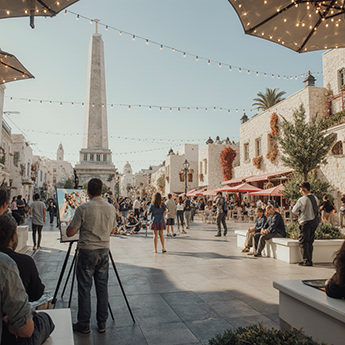
Why is it that, after hundreds of years of continuous use, piazzas are vibrant, full of life and busier than ever?
The Cracks in the System
This shift from relational to transactional built environments carries profound costs. A car-centric, screen-saturated lifestyle has left us hurried, fragmented, and isolated. The places intended to connect us — offices, malls, civic centers — often feel like corridors to pass through rather than commons to dwell in.
The pandemic of 2020-22 laid this bare. Commutes evaporated. Offices emptied. Homes reclaimed their role as sanctuaries. People rediscovered time for family, fitness, cooking, and reflection. For a moment, society glimpsed what life might feel like when real estate worked with us instead of against us.
That glimpse is now a demand. The next generation of consumers is not inspired by repetitive, car-centric, transactional life. They are seeking spaces that accommodate a bigger emotional and experiential bandwidth.
The Culture of Connection
The lesson is clear: real estate is not neutral. It provides the foundation for daily life. If that foundation fragments, life feels incoherent. If it coheres, life feels sustainable, even joyful.
We are at the beginning of a new paradigm: a Culture of Connection. The crises we face — loneliness, lifestyle diseases, housing stress, climate disruption — cannot be solved with transactional frameworks. They require spaces aligned with human physiology, where belonging is not an afterthought but the organizing principle.
Imagine a development not as a set of boxes, but as a living, interdependent civic organism organized around a central gathering place — a piazza: a place where food, wellness, commerce, and culture intersect. Where design slows us down long enough to see one another. Where being together is as natural as breathing.
The missing idea in today’s urban planning is that every neighborhood, every town, and every city needs a central meeting point — the heart of the city — public space owned by everyone and no one — a shared experience.
This is more than nostalgia, it is necessity.
From Transactional to Quantum Human Interaction
The opportunity before us is nothing short of revolutionary: moving from transactional real estate to what might be called Quantum Real Estate — spaces that generate field effects of interaction, coherence, and connection.
These environments don’t just house activity; they elevate it. They foster the cross-pollination of human experience that has always been the foundation of thriving communities. And they align directly with what today’s consumers are demanding: walkability, wellness, social interaction, and coherence. When we create spaces where people gather regularly and with ease, we not only improve lives, we create extraordinary and enduring value.
A New Language of Commercial Real Estate
We are in the midst of a dramatic shift from the old, limited language of retail real estate to a new quantum reality of interpersonal connection that drives higher foot-traffic.
Old Language: Branded outlets, generic food courts, big box retail. Lack of central gathering, resting, walking areas. Layouts dominated by cars and parking. Everything separate.
New Language: Human-scale design. Walkability. Flex-space. Wellness. Sustainability. Cafés, markets, concerts, and culture. Ease of being together — a new commercial/community paradigm. A synergistic field effect of being together cultivated by Quantum Real Estate.
The driving motivation for building the new world is simple: being together. And when we create spaces where people enjoy extended visits on a regular basis, the return on investment will be extraordinary — because the return is both financial and human.
A New Real Estate Formula
The cultural consciousness shaping this era is moving toward human wellness, emotional connection, and personal transformation. Consumers are ready. The demand is here. What’s missing is an understanding of how to fill this need. It’s time for a new real estate formula structured around our intrinsic need for belonging, for being together.
Spaces that bring people together do more than create value. They create human infrastructure that will last for generations — a true Culture of Connection.
This article was originally published in the November 2025 issue of Shopping Center Business magazine.