

DENVER — The U.S. retail real estate sector is continuing to move forward — but with caution. While the industry’s fundamentals remain relatively healthy, retailers and investors are evolving their strategies and adapting to shifting consumer behaviors, according to Integra Realty Resources (IRR), a commercial real estate valuation services firm based in Denver. IRR’s 2026 Retail Report explores the trends shaping the transformation of retail real estate, and where the sector is headed next.
Consumer spending has shifted, largely because of macroeconomic machinations like inflation and slower job growth. Higher-income earners still have the ability to spend, but price-conscious consumers are increasingly trying to maximize value for their dollar at discount grocery and convenience stores.
IRR notes that the retail sector posted 1.7 million square feet of positive net absorption nationally, which outpaced new construction more than twelvefold at 214,00 square feet. In the third quarter of 2025, the national vacancy rate slightly declined, coming in at 10.4 percent. Anthony Graziano, CEO of IRR, emphasizes that while leasing is healthy, store closures are masking the improvement.
“E-commerce pressure, retailer bankruptcies and ongoing drugstore consolidation have released significant space back into the market, and until that churn settles, vacancy will look more stagnant than the underlying demand suggests,” says Graziano.
Retailers that have shuttered stores in the past 12 months include Macy’s, Walgreens, CVS, Dollar General, Claire’s, Kohl’s, Advanced Auto Parts and Carter’s, among others.
To combat uneven trends across leasing and rent growth, retailers are focusing more on value-driven strategies like convenience, fitness, food-and-beverage and experiential offerings that initiate consumer engagement compared to traditional retail formats.
“Demand is shifting rather than disappearing,” says Graziano. “Like most asset classes right now, it’s a tale of two markets. High-quality, well-located centers are outperforming, while older product is being repriced.”
Although IRR reports that Los Angeles, San Francisco and Cincinnati are listed in the “recession” phase of their current retail life cycles, Graziano emphasizes that retail fundamentals still remain sound nationwide.
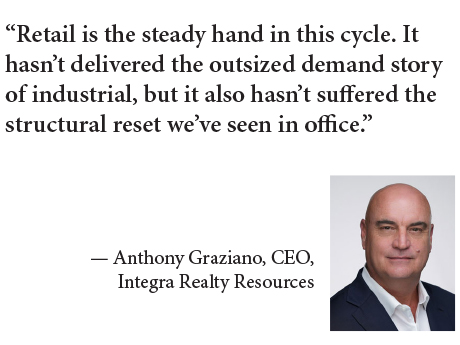
“Much of the softness is concentrated in urban cores that are still adjusting to lower office occupancy and shifting consumer patterns. These are localized recalibrations, not signs of a broader national oversupply problem,” he says. “Retail is the steady hand in this cycle. It hasn’t delivered the outsized demand story of industrial, but it also hasn’t suffered the structural reset we’ve seen in office.”
Only four markets — Tacoma, Seattle, Raleigh and Fort Worth — are developing more than 2 percent of their existing retail inventory share, which is largely due to sustained population growth that supports retail expansion tied to new residential corridors, according to IRR. The report notes that Tacoma maintains a 5.24 percent rate of development under construction, while the Raleigh market upholds a rate of 3.2 percent.
“Even in these markets, development remains measured compared to prior cycles. We are not seeing speculative excess, which is why fundamentals remain stable nationwide,” says Graziano.
As market cycles shift, retailers and investors alike are continuing to adapt their strategies by prioritizing speed and maximizing smaller footprints, all while appealing to the consumer’s needs. Pop-up shops are becoming more prominent, and retailers are leveraging short-term leases to drive more foot traffic.
Overall, the retail real estate sector is expected to remain stable in the near term, with vacancy rates projected to rise slightly to 10.5 percent by year-end, accompanied by modest increases in asking and effective rents.
“A projected move to 10.5 percent next year isn’t a reversal — it’s stabilization in what remains a mixed but steady sector,” says Graziano. “Even as consumer sentiment softens in some retail categories, the fundamentals, driven by constrained supply and targeted leasing, point to continued stabilization nationwide.”
— Abby Cox