

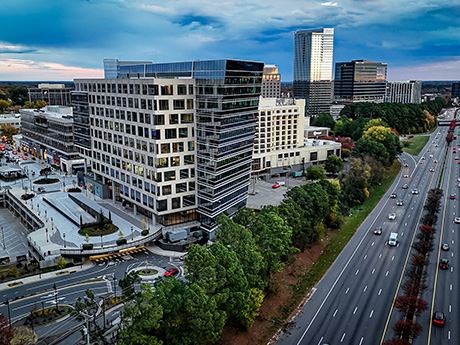
The Raleigh/Durham office market is not yet in full recovery mode; however, the latest data suggests something just as important: stabilization. Compared to many U.S. office markets still experiencing significant stress, Raleigh-Durham is holding its ground — and in several respects, outperforming national trends.

Currently, the combined Raleigh-Durham office market totals approximately 118.7 million square feet, with Raleigh making up roughly two-thirds of the inventory and Durham the remainder. Together, they form one of the Southeast’s most dynamic and resilient office regions.
Vacancy elevated, improving
While higher than pre-pandemic norms, vacancy is trending better than many peer markets. Raleigh’s vacancy rate currently sits around 11.1 percent, while Durham’s vacancy rate is approximately 9.8 percent, according to research from CoStar Group. Combined, this market boasts a blended office vacancy rate of roughly 10.7 percent, well below the 14.1 percent national average.
Over the past 12 months, Raleigh recorded positive net absorption of approximately 574,000 square feet, while Durham experienced negative absorption of about 480,000 square feet. Combined, the market landed near equilibrium, which sends an encouraging signal that the market is no longer sliding backward, even if growth remains uneven.
The area’s post-pandemic growth is shaped by hybrid work models, changing space needs and a growing trend of flight to high-quality environments rather than tenants expanding their overall footprint.
Looking forward, potential repurposing of properties could drive down the overall leasable square footage. One example is 5601 Six Forks Road where developers are considering demolishing three office buildings to construct a multifamily project.
How tenants are using space
Tenant behavior across this market has clearly shifted. Companies are leasing smaller spaces, with Raleigh’s average lease size hovering around 4,200 square feet. Decisions are less about square footage and more about experience, flexibility and long-term value.
The strongest demand continues to favor trophy and Class A properties, particularly those located in walkable, mixed-use settings with access to restaurants, shops, service retailers and amenities. Downtown Durham and Raleigh’s North Hills area have benefited from this trend as have other modern mixed-use submarkets.
Older office buildings, especially those without the ability to modernize, will continue to face leasing challenges. This growing divide between high-quality and legacy assets is one of the defining characteristics of the current market cycle.
Concessions matter
On the surface, asking rents remain relatively stable. Raleigh’s average asking rent is approximately $32 per square foot, while Durham’s averages $29.23 per square foot, producing a combined market average nearing $31 per square foot. Annual rent growth ranges from 1.6 percent to 2.1 percent, outperforming the national average of roughly 0.8 percent.
However, effective rents tell a more cautious story. Landlords across this market are offering higher concessions — free rent periods and increased tenant improvement (TI) allowances — to remain competitive. These incentives have softened effective rent growth and lengthened deal timelines, particularly for larger or second-generation spaces.
Limited new supply
Possibly one of the strongest positives for the Raleigh-Durham office market is the lack of new construction. Raleigh currently has approximately 478,000 square feet under construction, while Durham has just 46,000 square feet underway. Combined, this represents less than 0.5 percent of total market inventory.
More importantly, the majority of Raleigh’s active construction is preleased or owner-occupied, meaning very little speculative space is coming on line. Durham, meanwhile, has seen office demolitions and conversions reduce overall inventory. On a combined basis, the market has experienced virtually flat net supply growth over the past year.
This disciplined supply environment has provided meaningful protection, positioning the market well as demand gradually improves.
Selective, active investors
Sales activity across the combined market totaled just over $1 billion over the past year. Average pricing across the region is roughly $221 per square foot, though pricing varies widely based on asset quality and location.
A notable trend is the rise of owner-occupant buyers, particularly in Durham, where they accounted for a majority of transactions. Investors remain active but cautious, closely underwriting long-term demand assumptions, interest rates and capital costs.
Looking ahead
The Raleigh-Durham office market is not yet booming — but it is finding its footing. Net absorption appears to have stabilized, new supply is tightly controlled and vacancy remains well below national levels. While challenges may remain, especially for older office properties, the region’s long-term fundamentals remain strong.
Population growth, a highly educated workforce and continued strength in technology, healthcare and education all support a positive long-term outlook. Over the next 12 to 24 months, performance is expected to remain uneven, with modern, well-located assets leading the way.
For tenants, landlords and investors alike, Raleigh-Durham stands out as a market defined less by distress and more by thoughtful repositioning and steady recalibration.
— By Kim Mills, senior advisor and principal, SVN Raleigh. This article was originally published in the January 2026 issue of Southeast Real Estate Business.