

The commercial real estate industry has spent the past two years bracing for the next wave of loan losses as elevated interest rates collided with loan maturities. Instead of a wave of payoffs, many loans are still working through extensions and modifications while asset values are being deliberated.
Lenders know how to model foreclosure risk. Bankruptcy risk? That’s where the real losses hide. A Class A asset with Class C governance is a Class C risk.
Foreclosure risk can be modeled. Expected losses predicted. Timelines are known by state. Recovery assumptions can be debated. Cash flows stress tested and ultimately approved by a committee. Even when outcomes are unpleasant, they are at least visible, quantifiable and expected.
Bankruptcy is different — and far more dangerous for lenders. The gap between foreclosure and bankruptcy is where some of the largest loan losses are being created, and painful lessons learned.
Counterintuitively, bankruptcy risk runs higher in non-judicial states like Georgia, where 60-day foreclosures create incentive for borrowers to file. In longer-timeline states like New York, foreclosures can stretch 18 months, giving borrowers the luxury of time.
Those foreclosure timelines are generally well known and accepted by both sides, which makes outcomes predictable. Bankruptcy timelines vary wildly based on the facts of each case, may drag for years while assets deteriorate, and often result in a third-party receiver taking control of the property.
The Critical Distinction
Foreclosure, at its core, is an enforcement process. State law dictates timelines, remedies are defined and there’s a clear path to asset control. While no lender enjoys enforcing remedies, foreclosure follows a path that can be anticipated and priced.
Bankruptcy is a process you enter with no exit ramp and the court in full control.
The moment a bankruptcy filing occurs, the automatic stay freezes lender enforcement, and asset-level decisions move into a court-supervised process. The result: grinding timelines, mounting legal bills and vanishing certainty. Most importantly, expedient control over an asset disappears precisely when it’s needed most.
This is the distinction many lenders miss: foreclosure is an outcome you can see coming while bankruptcy is a black box.
Many loans are originated with only covenants protecting against bankruptcy because no loan originator wants to believe their borrower would file bankruptcy to stop enforcement. That works as a strategy for many deals, but certainly not all. Multiple lenders have recently learned this lesson the hard way, discovering only after a bankruptcy filing that their “low-LTV, high-quality” loans lacked the one protection that mattered most and may change the end outcome.
When Governance Gaps Become Craters
Distress rarely announces itself. Instead, property managers receive conflicting instructions, lending reports arrive incomplete and tenants sense instability when their tenant improvement packages can’t be paid. Critical asset-level decisions are delayed, and value leaks from the property as entity-level distraction prevents value creation at the asset level.
This governance gap matters most during modifications and extensions, and these moments are framed as temporary relief. When a lender grants time without upgrading governance, borrower optionality increases. Bankruptcy shifts from theoretical threat to a practical strategy.
Once bankruptcy is triggered, there is no undo button. The leverage dynamics have already changed. If bankruptcy triggers “bad-boy carveouts” or recourse, those consequences cannot be undone.
Why This Pattern Is Accelerating
This pattern is accelerating across both balance sheet and private credit lending. Not because either lender type was reckless at origination, but because speed and flexibility were critical to win the financing at the time, and the risk that was deferred is now surfacing.
Traditional banks operated with standardized loan documents and maintained long-term borrower relationships that created reputational discipline. Independent directors and bankruptcy-remote structures were table stakes in CMBS lending since the 1990s because they could not rely upon the relationship with the borrower and needed some assurances against bankruptcy. In both cases, governance protections weren’t optional, they were engineered into the structure.
Private credit optimized for speed over standardization, often using bespoke documents that assumed governance protections without explicitly engineering them into every deal. Some platforms adopted CMBS best practices; others prioritized ease of execution over structural discipline.
As market stress continues, these structural assumptions are being tested. What sophisticated lenders are now realizing is that the combination of borrower and documents, not the underlying quality of the asset, determines outcomes. Two loans secured by identical properties can produce wildly different recoveries based solely on governance architecture. The difference is rarely visible at origination but becomes clear only after distress sets in.
Importantly, this is not about bad actors or aggressive sponsors. In many cases, voluntary bankruptcy filings occur because the structure allows it, not because the borrower intended to abuse the process from day one, even when it triggers full recourse to borrowers. The structure creates the strategy.
What Smart Lenders Are Doing Now
The lenders adapting fastest are not waiting for defaults to force the issue. They’re using moments of negotiation, particularly modifications, as opportunities to recalibrate control.
Best practices are evolving to accommodate the realities of continued distress and to adapt to borrower defaults. Structural limitations around bankruptcy filings are treated as standard risk management, not as punitive measures. They remain a cost-effective protection for lenders and an expanding standard within private credit and securitizations.
Sophisticated lenders are now proactively mitigating bankruptcy risk by requiring additional lender protections as a condition of any loan modification, embedding structural vetoes to prevent voluntary filings and tying the release of reserves or additional capital to governance upgrades, often through springing independent manager provisions triggered by payment defaults.
Framed correctly to borrowers, these governance changes are not aggressive. They only come into play under the most extreme circumstances and have no impact on day-to-day property operations. If a lender is granting a concession, time, capital or flexibility, it’s reasonable to ensure that future outcomes aren’t dictated solely by borrower discretion.
The Window Is Closing
The cleanest moment to address bankruptcy risk is before distress escalates. Once liquidity evaporates and trust erodes, structural fixes become exponentially harder to implement. By then, leverage has already shifted and both sides have taken positions to protect their own interests.
The irony is that lenders believe they’re being cooperative by keeping governance minimized and not planning for the worst outcomes. In reality, they’re deferring a confrontation that will eventually occur under far worse circumstances.
The biggest losses in this cycle will not come from assets that have declined in value. They will come from assets that were legally available to decline in value, because the structure allowed it.
The Bottom Line
Risk in today’s commercial real estate market cannot be defined by what might happen to a property. It must be defined by what a borrower can choose to do with it.
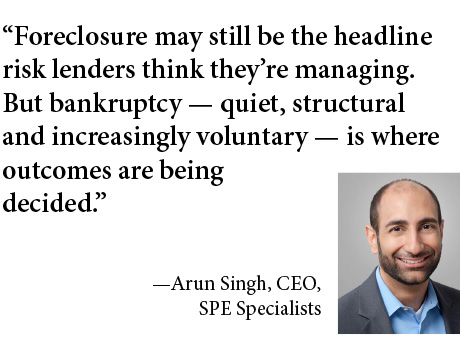
Foreclosure may still be the headline risk lenders think they’re managing. But bankruptcy — quiet, structural and increasingly voluntary — is where outcomes are being decided.
The lenders that emerge strongest from this cycle will not be the ones that modeled credit risk the best. They will be the ones that engineered against bankruptcy risk entirely before it became an option on the table.
Protection in this market means controlling the structure before distress arrives. By the time bankruptcy is triggered, the borrower has already exercised their option and the lender has already lost their seat at the table.
— By Arun Singh, CEO of SPE Specialists