

By Taylor Williams
AUSTIN, TEXAS — A successful real estate strategy for both developers and operators looking to penetrate Austin’s airtight retail market must involve both a long-term growth plan and a site selection process that primarily targets suburban areas.
Austin’s sizzling pace of population growth has slowed in the past year or two, but the state capital remains highly undersupplied in terms of housing. Land and other development costs have become frightfully expensive within the urban core, and like other Texas markets, Austin is emerging from a multifamily building boom within its urban core and first-ring suburbs.
In addition, vacant, quality retail space within those areas of Austin is a rare commodity. Earlier this year, the Austin-American Statesman, citing data from Weitzman, reported that Austin had a marketwide retail vacancy rate of just 3 percent at the end of 2025. And according to a first-quarter 2025 report from Partners Real Estate, Austin’s retail occupancy rate has not dipped below 95 percent at any point in the past decade.
Editor’s note: InterFace Conference Group, a division of France Media Inc., produces networking and educational conferences for commercial real estate executives. To sign up for email announcements about specific events, visit www.interfaceconferencegroup.com/subscribe.
As such, in both their perpetual chase of rooftops and their push to be players in one of the country’s most dynamic markets, retail owners and tenants must, for lack of a better term, start from the outside and work their way in. Such a strategy requires banking on the belief that the growth story of Central Texas is still in its early innings — that major waves of new housing are coming to the region.
It’s a risky gamble, especially given the well-documented struggles of many Central Texas municipalities to meet the infrastructural needs of new residents and businesses. For developers and operators whose investors are on tight schedules and expect semi-immediate returns, expanding into Austin may not be a feasible proposition. But for those with time, patient capital and unshakeable confidence in their projects and concepts, the reward may just be worth it in the long run.
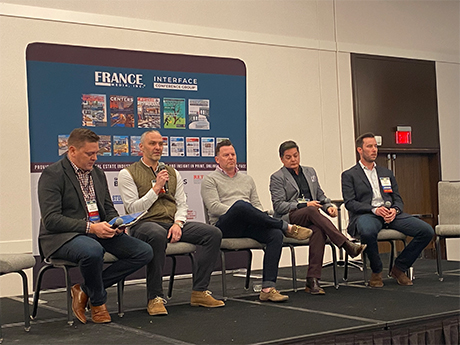
At the annual InterFace Austin Retail & Mixed-Use conference, a quartet of developers whose firms are active in Austin tiptoed around the question of how best to penetrate the market while sharing some of their experiences in doing so. The event took place on Feb. 24 at the Hyatt Regency hotel near the downtown area and drew about 250 industry professionals.
Ryan Rosche, vice president at BRR Architecture, moderated the developer panel and kicked off the discussion by painting a statistical picture of the Austin retail market’s barriers to entry. Rosche identified the market’s occupancy rate as “hovering between 96 and 97 percent” and stated that the retail development pipeline for 2026 spanned “about 1.5 million square feet, while the metro continues to add 58,000 residents per year.”
Adam Zimel, principal at Endeavor Real Estate Group, a local owner-operator, described the market as “under-retailed” despite strong supply gains in recent years — a nod to the growth potential that is taking shape in second- and third-ring suburban communities.
“In the past five years or so, we’ve added about 7 million square feet of [retail] product per year, so as a market with more than 60 million square feet, we’ve been looking at 1 to 2 percent growth [as a percentage of inventory] every year,” said Zimel. “We’re 96 percent occupied and have strong housing growth and in-migration, but we have less retail per capita than most other Sun Belt markets.”
Specifically, Zimel said that retail space per capita in the greater Austin area was about 44 square feet, whereas other Sun Belt markets typically average about 65 square feet of retail space per head. Based on the current population, Zimel said that Austin would need to add about 21 million square feet of new space to be in line with those other market averages. He also conceded that suburban markets make the most sense as landing zones for that product and noted that the bulk of Endeavor’s development pipeline is concentrated in those areas.
Evan Dyer, principal of retail development at Hunington Properties, said that many tenants are still pushing hard to expand in the Austin area because “they can see that growth happening.” He cited one of Hunington’s tenant partners, 7-Eleven, as an example of an operator that sees major potential in the region, just not necessarily in prime locations.
Dyer also talked at length about retail development prospects in the northern suburb of Georgetown, where both single-family and multifamily residential development are still happening and more national and regional retailers are planting their flags. Centers anchored by San Antonio-based grocer H-E-B have been especially successful in bringing in new uses, Dyer noted.
His analysis of this submarket touched on the importance of trusting in the future growth, especially with regard to operators that are not intimately familiar with the Austin market.
“The initial view of this corridor, from a lot of brokers and users themselves [who are] from outside of Austin is ‘this is green,’” Dyer said. “And we tell them, ‘don’t leave, because in two years when we’re done, you’re going to wish you were here.’ And if those brokers or users are coming in from somewhere else and are used to different pricing or dynamics, they’re going to miss the boat. So now is the time to get in.”
Felipe Castillo, partner at Austin-based developer PlaceMKR, immediately seconded that notion, stating that, “a theme of Austin is that we’re typically looking 12 to 18 months ahead.” Castillo acknowledged that certain suburban nodes do still look and feel very “green” to the untrained observer, but also cited multiple projects that have already established a blueprint for success, provided the developers have the proper foresight.
Blake Berg, senior vice president of development and construction at Houston-based DC Partners, spoke to the importance of developers staying true to their visions and development practices as a means of cracking into high-barrier-to-entry markets. He espoused the belief that trusting in the authenticity and originality of projects would prevail, macroeconomic disruptors notwithstanding.
“There’s been so much volatility in the past five years, from COVID to supply chains to interest rates to an election cycle. You have to react somewhat to the market, but the worst thing a developers can do is have volatile swings on what their thesis is,” Berg said. “Even if you’re a merchant developer building to sell, if you develop your project with a lifelong mindset and get really good at your craft, you have to believe in that vision and what your competitive advantage is.”