

AUSTIN, TEXAS — By any objective, outside-looking-in metric, the Austin industrial market is currently overbuilt, but brokers who are on the inside looking out say that the narrative is more nuanced than the numbers suggest.
According to CBRE’s fourth-quarter 2025 market report, the marketwide vacancy rate was 20.4 percent at the end of last year, which represented a 10.9 percent increase from the third quarter of 2025. Approximately 3.4 million square feet of new space was delivered in the fourth quarter as part of 9.5 million square feet of new construction that came on line year-to-date, per CBRE, while fourth-quarter net absorption was less than 500,000 square feet. Qualitatively, the report concluded that the year-end vacancy rate was “an all-time high,” while 2025 was “one of the busiest years for development in market history.”
The Austin industrial market has traditionally differed from those of its sprawling Texas counterparts — Dallas-Fort Worth (DFW) and Houston — which have seen numerous massive projects built and absorbed over the past decade. Industrial deals and projects in the state capital have historically trended smaller, though that has changed somewhat in recent years as two tech giants — Tesla and Samsung — have planted massive manufacturing operations in the region.
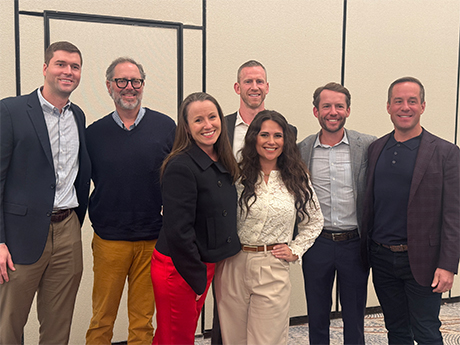
Still, regardless of the product type, Austin has had its share of industrial overbuilding in the post-COVID era. A flurry of projects that were capitalized by the combination of dirt-cheap interest rates and historic demand have come on line over the past two to three years. And while the vacancy rates are what they are, local professionals who spoke at the annual InterFace Austin Industrial conference that took place on Feb. 24 stressed that the outsized supply gains should not constitute cause for alarm. More than 200 industry professionals gathered at the Hyatt Regency Austin to attend the event.
DeLea Becker, founder of Beck-Reit Commercial Real Estate and moderator of the brokerage panel, began the discussion with the assertion that the Austin market was not done with its supply gains. She said that the panelists typically agreed that at the time, there was somewhere between 6 million and 8 million square feet of industrial space still under construction in the market, including speculative and build-to-suit projects. Before pivoting to a broader discussion on supply-demand dynamics, panelists took a moment to identify the submarkets and product types in which new development has been most concentrated.
“For the most part, it’s been mid-size, rear-load buildings between 100,000 and 300,000 square feet,” said Matt Jacobs, director of the industrial advisory division in Cushman & Wakefield’s Austin office. “The majority have been built along the [State Highway] 130 corridor, from Georgetown down to San Marcos, and the biggest glut of supply has been in the northeast [submarket]. But for the most part, if you’re putting together a survey for a tenant, you’ll have a lot of options for buildings of that size.”
John Colglazier Jr., partner and managing director at Partners Real Estate, then added the type of context that investors value when looking at deals in oversupplied markets.
“When you look at the statistics in their entirety, they can [make the market] look worse than it really is on the ground,” he said. “To the spreadsheet guy who just looks at the numbers — you have to look at it on the map. There are pockets that are overbuilt, and there are pockets that are underserved. But in underwriting deals right now, it’s taking that granular level of explanation to convince debt and equity.”
“You have to be able to look at an area and say, ‘we don’t have a half-million-square-foot [building] in that whole general area,’” Colglazier added. “You have to be able to identify holes in the market. It’s not 2021 and 2022 where everything was a hole and it was ‘build it and fill it.’ Everything is more deliberate, thoughtful and target-driven — and that’s universal right now, not just in Austin.”
Sam Owen, managing partner and director in the Austin office of Stream Realty Partners, immediately seconded this analysis and explained that a different lens is needed to understand the Austin industrial sector today versus five to six years ago.
“When you look at the CoStar [reports], the vacancy numbers aren’t great, and a lot of capital providers are not in Austin, which was viewed as a smaller market until 2020,” he explained, augmenting his analysis with some year-by-year delivery figures. “We’ve added a lot of space in a relatively short period of time. But for the most part, all [the space] that was built between 2020 and 2023 is leased, accounting for 20 million square feet of new tenants in the market.”
Owen conceded that Austin still hadn’t attracted mega brand names like Amazon, Home Depot and FedEx, all of which leased millions of square feet in DFW and Houston over the past decade. But he emphasized the fact that the Austin market is simply less mature and has one of the lower per-capita ratios of industrial space among major U.S. markets.
“We need more space; we just don’t need it all at this one point in time,” he concluded. “But when you only have one building in the entire area that’s bigger than 500,000 square feet, that’s an interesting point that needs to be made.”
Colglazier then said that San Antonio had experienced similar overbuilding, but with regard to large-scale product. That created a period of oversupply within that segment of the market, but as tends to be the case with real estate, time solved the problem.
“Six months ago, developers were saying they never should have built a half-million-square-foot building in San Antonio,” Colglazier said. “But now there’s only two still standing and three or four deals rolling through town. So it’s funny how quickly things can change, and a lot of that can be attributed to the fact that we didn’t have the duality of oversupply and lack of demand. We just had oversupply.”
Ace Schlameus, senior managing director and co-lead of the industrial division in JLL’s Austin office, then spoke to subcategories of product and deal profiles that interest investors in the region. Notably, his analysis represented a shift from several years ago, when investors frequently targeted multi-tenant properties with low weighted average remaining lease terms (WALTs). The logic at the time was to buy buildings in which leases were originated at below-market rates and raise those rents to market levels within the first couple years of ownership.
“Investors are not looking for vacancy at all right now,” Schlameus said. “Two to two and a half years ago, they were looking for an average WALT of about 12 months because rents were going up so fast. It’s very different today; investors want product that is stabilized, highly leased and [backed by] good credit [tenancy]. Distribution and manufacturing are the main drivers.”
“Capital continues to want to be in Austin, but it’s hesitant due to the [over]supply,” concluded Ryan Whalen, a partner and leasing/investment specialist at Live Oak, an Austin-based development, investment and brokerage firm. “So we’re trying to identify opportunities, and there are not a lot of value-add opportunities because as supply has grown, we’ve lost some pricing power and the ability to come into shorter-WALT projects and immediately push rents. So you’re seeing some core buyers look at new projects in Austin that are stabilized, have credit tenants and length of lease term.”