

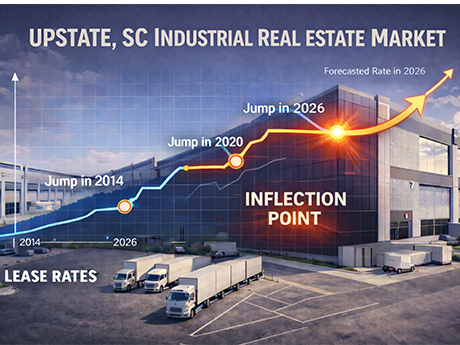
The Upstate South Carolina industrial market is at an inflection point — an expected condition in a maturing and evolving market. Similar transitions have occurred in prior cycles and have consistently required lease rates to adjust more rapidly than traditional annual market escalations. These adjustments are driven by a combination of factors, including supply and demand dynamics, construction costs, capital markets and broader economic conditions.

Currently, construction costs are the primary constraint impacting new deliveries. The post-COVID development surge resulted in over 30 million square feet of speculative industrial construction, a portion of which has yet to be fully absorbed.
Today, we are approaching pre-COVID metrics with roughly 6.4 million square feet of speculative inventory (delivered or under construction) and an overall vacancy rate of approximately 7.3 percent. At this level, certain submarkets are at the point where additional speculative inventory will be required to meet tenant demand.
The challenge lies in pricing. Much of the existing vacant space was delivered under a materially different construction cost structure, resulting in lease comps that do not reflect today’s construction and land costs. While incremental rent growth has occurred, it has not fully bridged the gap between legacy pricing and the economics required to justify new development.

This dynamic is not new. Following the Great Recession, the Greenville-Spartanburg (GSP) market was widely viewed as tertiary, with limited Class A speculative development. At the time, triple-net lease rates of approximately $4.25 to $4.50 per square foot were required to support new construction, while average prevailing market comps remained in the $3.50 to $3.75 per square foot range. The market faced a familiar question: would tenants adapt to the new cost structure, or would development stall?
The answer became clear around 2013 and 2014. The first post-recession, single-tenant industrial projects broke ground and leased during construction at the higher rate threshold. Subsequent projects followed with similar success, signaling that the market had recalibrated. This cycle of growth continued through approximately 2020.
The COVID-19 pandemic then triggered an unprecedented industrial development boom. Supply chain disruptions fundamentally altered occupier behavior, increasing the need for domestic inventory and redundancy. Lease rates escalated rapidly — averaging from the low-$5 per square foot range to the low-$6 range — as tenants prioritized speed, certainty and proximity to labor and infrastructure. Despite initial skepticism, the market again adapted. Land values and construction costs surged, tenant demand reached historic highs and cap rates compressed to record lows.
This environment ultimately led to overbuilding as market conditions normalized and absorption slowed. Tenant decision-making became more selective, with a focus on core submarkets and highly desirable locations. Secondary or “next exit” developments faced greater challenges as occupiers exercised increased optionality.
Entering 2026, much of that excess inventory has been absorbed, and the market finds itself at another inflection point — consistent with prior cycles observed in 2014 and 2020, aligning with a recurring six-year cycle of the market. New construction economics now suggest that average triple-net lease rates in the low-to-mid-$8 per square foot range will be required, up from the mid-to-high-$7 range. Once again, the question emerges: will the market adapt, or will industrial development pause?
Given the Upstate’s sustained population growth, right-to-work environment, quality of life, strong logistics infrastructure and relative cost advantages compared to larger primary markets, the expectation is that the market will adapt. Historically, industry participants have adjusted to inflection points — whether driven by land pricing, construction costs, capital markets or lease rates — and there is little indication this cycle will be different.
Looking ahead, new speculative development will require a more granular and disciplined approach than in prior cycles. Market evaluation must extend beyond broad submarket trends to include micro-market analysis: identifying the ideal tenant profile, understanding specific demand drivers, and aligning building design accordingly. Comprehensive analysis is essential to ensure that new product meets the needs of an evolving and diverse tenant base.
For example, the southern Greenville/Anderson submarket’s current speculative inventory stands at approximately 300,000 square feet, with roughly 950,000 square feet under construction — the lowest level of inventory seen since before COVID. Notably, the majority of space under construction consists of shallow-bay product designed for smaller users in the 25,000- to 50,000-square-foot range. There are currently no viable options in this submarket for 150,000- to 200,000-square-foot, rear-load users.
Similarly, the overall market supply of bulk/cross-dock buildings has been significantly depleted due to significant absorption over the past 12 months. The entire Upstate is close to dipping below 1 million square feet of cross-dock inventory for the first time since 2019.
As the Upstate industrial market enters its next growth phase, a clear opportunity exists for the development of both rear-load and cross-dock product. While recent construction has favored shallow-bay and small-user formats, meaningful gaps in supply are beginning to emerge in certain micro markets.
Addressing this product deficiency with well-located, thoughtfully designed projects will be critical to sustaining market momentum, supporting tenant demand and enabling the next wave of industrial growth in the Upstate.
— By Clay Williams and Grice Hunt, shareholders at NAI Earle Furman. This article was originally published in the March 2026 issue of Southeast Real Estate Business.