

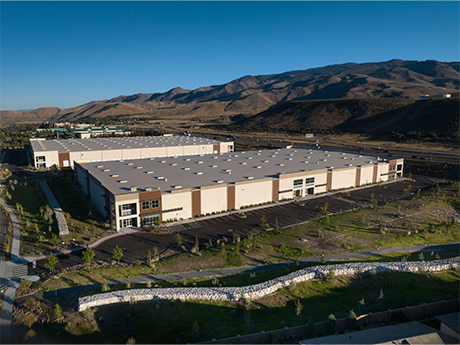
— By Joel Fountain of Dickson Commercial Group —
After several years defined by rapid expansion and record development, Northern Nevada’s industrial market closed 2025 showing clear signs of stabilization. Vacancy leveled off, leasing momentum returned and capital markets activity began to pick back up. All told, these indicators point to a market that’s entering a more balanced phase.

One of the most notable shifts has been the normalization of vacancy after an unprecedented wave of new supply. Direct vacancy hovered around 11 percent throughout 2025, suggesting the market has reached a temporary equilibrium between supply and demand. While elevated compared to the sub-3 percent vacancy levels seen during the pandemic-driven surge, continued positive absorption helped keep the market stable as it digested several million square feet of recently delivered product.
In terms of region, submarket performance varied considerably. Central-West, Airport and South Reno tightened meaningfully during the year, with combined vacancy falling from 10.4 percent in late 2024 to 6.1 percent by the end of 2025. These areas benefited from limited new construction and steady demand from regional service users and smaller distribution tenants. Conversely, the North Valleys and the I-80 East corridor, which accounted for roughly 83 percent of new speculative deliveries, experienced rising vacancy, climbing from 11.6 percent to 14.7 percent as newly completed Class A buildings hit the market.
Leasing activity also gained momentum as the year progressed. Fourth-quarter gross absorption surpassed 3 million square feet for the first time since mid-2023, pushing total annual gross absorption to 8.3 million square feet, roughly 1.1 million square feet above the trailing three-year average. Net absorption also rebounded significantly, finishing the year at 723,651 square feet after a challenging 2024 that recorded 4.3 million square feet of negative net absorption.
Sublease absorption was robust early in the year, highlighting several of the largest transactions. This, naturally, improved direct vacancy absorption during the second half of the year with reduced sublease inventory available. Overall, roughly 1.5 million square feet of positive sublease absorption accounted for a large portion of the year’s leasing activity, highlighted by an 815,000-square-foot sublease transaction at Victory Logistics District in Fernley.
Smaller-bay industrial products remained particularly resilient. In Sparks alone, 52 leases were completed, with more than 70 percent falling between 5,000 and 30,000 square feet. That activity reflects continued demand from contractors, local service companies and light-manufacturing users seeking functional space at more attainable Class B rental rates.
Investment activity also showed renewed momentum toward the end of the year. Fourth-quarter transaction volume reached $152.7 million, the second-highest quarterly total of 2025. A notable sale included Dalfen Industrial’s disposition of a three-building, 810,217-square-foot Sparks portfolio to Westmount Realty Capital for $88.5 million. This equated to roughly $109 per square foot at a 5.46 percent cap rate. As this deal illustrates, institutional buyers continue to target stabilized multi-tenant assets at mid-5 percent cap rates.
On the development side, the pipeline has slowed substantially. After delivering 5.4 million square feet in 2025 — much of it within the Tahoe-Reno Industrial Center — there is only 115,000 square feet under construction so far in 2026. With new starts largely paused and absorption improving, vacancy is expected to trend downward over the next 12 to 18 months.
For investors and users alike, Reno’s long-term fundamentals remain compelling. Its location along the I-80 corridor, proximity to Northern California and business-friendly environment continue to position it as one of the most efficient distribution markets in the Western United States.
— By Joel Fountain, Principal, Dickson Commercial Group. This article was originally published in the March 2026 issue of Western Real Estate Business.