

Walk through almost any office today and you will likely see a familiar scene: employees sitting at their desks wearing headphones, speaking into laptops and participating in video calls. Some are presenting to colleagues working remotely. Others are joining quick internal check-ins or connecting with clients across the country.

Individually, these conversations are part of the normal rhythm of modern work. Together, they can create a surprising amount of background noise.
This reality is one of the biggest forces reshaping office design.
For years, workplace design emphasized openness. Walls came down, benching systems replaced private offices and large collaboration areas were introduced to encourage interaction. But as hybrid work has become the norm, organizations are recognizing that offices must support a wider range of activities than they once did.
Employees still come to the office to collaborate and connect. At the same time, many arrive with schedules filled with focused individual work and virtual meetings that require quiet and concentration.
As a result, workplace design is evolving. Instead of choosing between open offices and private offices, organizations are focusing on balance, creating workplaces that support focus, collaboration and connection within the same space.
Privacy returning to offices
One of the most noticeable shifts in office design is the renewed demand for privacy.
In many offices, the challenge is not a lack of collaboration space but the opposite. When multiple people take calls from open desks throughout the day, background noise quickly becomes a distraction for the entire floor.
To address this, companies are incorporating more enclosed spaces throughout the workplace. Phone rooms, small huddle rooms and enclosed meeting areas are becoming essential components of modern office layouts.
These rooms give employees a place to step away for a video call, hold a focused discussion or concentrate on work that requires deep attention.
S. Tipton Studio recently addressed this challenge in the design of a 7,500-square-foot corporate headquarters. The workplace includes several private phone rooms that allow employees to participate in virtual calls or confidential conversations without disrupting nearby work areas, maintaining the openness of the larger office environment while still providing spaces for focused communication.
Acoustics a core priority
Adding enclosed rooms is only part of the solution. Acoustic performance has become one of the most important and often overlooked aspects of workplace design.
Small design decisions can make a significant difference in how sound travels throughout the office. Walls that extend to the building deck rather than stopping at the ceiling grid help prevent noise from transferring between rooms. Layered interior glazing systems provide better sound control than traditional single-glazed office fronts.
Behind the walls, details such as multiple layers of drywall, sound isolation membranes, air gaps, offset studs, putty pads at electrical outlets, sound boots in ductwork and upgraded door seals further limit noise transfer between spaces.
At the ceiling level, designers are also looking beyond NRC [Noise Reduction Coefficient] ratings alone and paying closer attention to CAC [Ceiling Attenuation Class] ratings to better control how sound travels between adjacent rooms. Most employees will never notice these elements directly, but they experience the difference every day.
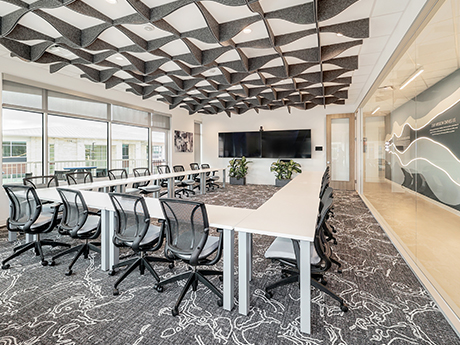
Acoustic performance can also be integrated into the visual design of a space. For example, decorative acoustic ceiling panels in a conference room help absorb sound while contributing to the room’s overall aesthetic. These elements demonstrate how performance and design can work together rather than compete with one another.
When acoustics are overlooked early in the design process, organizations often end up addressing complaints after employees move in. Retrofitting solutions later can be disruptive and costly, making early planning a critical step in creating a high-performing workplace.
Variety for changing workday
A typical workday rarely involves a single type of activity. Employees may spend time reviewing documents at their workstation, joining small team meetings, participating in video calls or collaborating informally with colleagues.
Workplaces that support this range of activities offer multiple types of environments within the same office.
Traditional workstations remain important, particularly for technology-heavy tasks that require monitors and extended periods of focus. Nearby meeting rooms support team discussions or collaborative work sessions. Lounge seating areas provide comfortable settings for informal conversations or quick brainstorming sessions. Enclosed focus rooms allow employees to step away from activity on the main floor when they need quiet concentration.
The placement of these environments also matters. Lounge seating positioned near circulation paths can encourage spontaneous interaction, while focus rooms are most effective when located away from high-traffic areas.
Rather than assuming everyone works the same way, this layered approach allows employees to choose the environment that best supports their work at any given moment.
Hybrid collaboration
Hybrid work has also reshaped expectations for meeting spaces. Conference rooms and collaboration areas must now function equally well for in-person and remote participants. Achieving this balance requires thoughtful coordination of lighting, acoustics and video conferencing technology.
Camera placement, lighting design and acoustic performance all influence how well remote participants can see and hear conversations taking place in the room. When these elements are considered together during the design process, meetings feel more natural and inclusive for everyone involved.
This challenge is often most noticeable in larger meeting rooms, where it can be more difficult to create an equitable experience for both in-person and remote participants.
In a recent technology office build-out, S. Tipton Studio collaborated closely with the AV [audio-visual] team to coordinate built-in acoustic solutions with microphone placement and camera positioning. Microphones were evenly distributed throughout the room, and an oscillating camera allows each participant to appear in their own on-screen tile.
These strategies help remote attendees clearly identify who is speaking and remain fully engaged in the conversation, while acoustic design elements reduce reverberation and improve sound clarity within the space.
Central gathering points
Another notable change is the evolving role of amenity spaces. Break rooms and kitchens were once treated primarily as functional spaces tucked away from the main workplace. Today, they are often designed as central gathering areas that encourage employees to connect with each other.
As hybrid work changes when employees come into the office, in-person time is increasingly valued for the collaboration and relationship-building it supports. Amenity spaces help facilitate those moments.
Designers are incorporating residential-inspired elements such as warm wood finishes, soft seating and layered lighting to create environments that feel comfortable and welcoming. These spaces provide natural opportunities for informal conversations, quick meetings or simply a place to recharge during the day.
In many workplaces, the break room is now designed as a central hub. Soft textures and locally sourced materials create a warm atmosphere where employees can gather, recharge and connect throughout the day, reinforcing a company’s wellness-focused culture.
Designing for performance
As organizations continue to rethink the role of the workplace, one theme is becoming increasingly clear: the next generation of offices is defined by performance.
The conversation is no longer about open versus closed layouts. Instead, the focus is on how effectively the workplace supports the way people actually work.
Offices that provide a thoughtful mix of environments, combined with strong acoustic performance and flexible layouts, allow employees to focus when needed, collaborate effectively and maintain meaningful connections with their teams.
For organizations planning new offices or tenant improvements, investing in these fundamentals early in the design process can help avoid costly adjustments later.
The most successful workplaces are not simply designed to look good. They are designed to perform, supporting focus, collaboration and connection in ways that help employees do their best work.
— By Anna Wiles, RID, senior interior designer at S. Tipton Studio, an interior design firm with offices in Austin, Texas, and Raleigh, N.C. This article was originally published in the April 2026 issue of Southeast Real Estate Business.