

By Brian Vanevenhoven and Joseph Ziolkowski, Newmark
The metro Milwaukee retail market remains strong, supported by historically low vacancy rates. Elevated construction costs — and the resulting pressure on rents — continue to limit new construction, keeping inventory low and occupancy high. The western suburbs have the lowest vacancies in the region and are seeing robust demand for available space. While the urban core continues to face challenges, the Historic Third Ward remains a bright spot, benefiting from favorable demographics and a cultivated consumer base driving strong retail sales.

Recent data underscores this trend. While Milwaukee County saw modest population growth in 2025, surrounding suburban counties are expanding at a faster pace, according to CoStar Group. Waukesha County alone has added more than 10,000 residents since 2020, according to the U.S. Census Bureau. This outward migration — driven by affordability, schools and lifestyle preferences — is creating new pockets of retail demand across the metro area.
Drivers of growth
Several factors are fueling suburban retail expansion. The continued strength of experiential retail, particularly in the fitness and wellness sector, is the most notable driver. Concepts such as Crunch Fitness and Planet Fitness have been among the most active tenants, leasing large-format spaces ranging from 20,000 to 50,000 square feet.

In 2025 alone, Crunch Fitness opened four locations across Southeast Wisconsin — including in Brookfield, Greenfield, Hales Corners and Waukesha — while continuing its regional expansion with an additional lease in Kenosha. Planet Fitness has followed a similar path, opening a new 24-hour club along Mayfair Road in Wauwatosa, expanding in Brookfield on Bluemound Road and relocating to a larger footprint in both Oak Creek and Menomonee Falls.
These concepts are emblematic of a broader shift toward “experience-driven” retail. Fitness, entertainment and service-oriented tenants are increasingly anchoring suburban centers, drawing consistent foot traffic and complementing traditional retail uses.
Mixed-use momentum
At the same time, suburban retail is increasingly integrated into mixed-use developments that emphasize walkability and convenience. Projects that combine retail, residential, office and entertainment components are gaining traction as communities seek to create live-work-play environments.
One of the most prominent examples is The Corridor in Brookfield, a 66-acre mixed-use development led by Irgens. The project’s retail component, The Shoppes at The Corridor, has demonstrated strong leasing momentum despite being developed without full preleasing — a rarity in today’s environment.
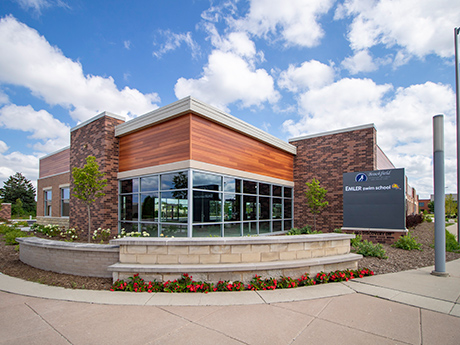
New tenants including Mission Veterinary Partners, Emler Swim School, Forage Kitchen and Mind + Neurology have committed to the project, underscoring demand for well-located, high-quality suburban retail space. They join an existing lineup that includes Life Time, Portillo’s, Dick’s Sporting Goods and Old Navy. Positioned along Bluemound Road, one of the state’s busiest retail corridors, the development highlights how strategic site selection and mixed-use integration can drive leasing success.
Growth along I-94 corridor
Further west, communities along the I-94 corridor are experiencing a new wave of retail and mixed-use investment. Oconomowoc, located roughly 30 miles from Milwaukee, has emerged as a key growth node, driven by its balance of accessibility, natural amenities and strong residential expansion.
Much of this activity is centered around the 1,500-acre Pabst Farms development, which is transforming the area into a regional destination. A range of projects, including retail, residential and commercial uses, are reshaping the corridor and attracting both national and local tenants.
A major catalyst is Costco, which has acquired more than 23 acres for a new store expected to open in 2026. The planned 161,000-square-foot location, complete with a fuel station and ancillary services, is already spurring additional development interest nearby. Other approved and established projects include a Fleet Farm, UW Credit Union, multi-tenant retail buildings and quick-service restaurants, reinforcing the area’s emergence as a retail hub.
Complementing this growth is the Olympia Fields redevelopment led by Wangard Partners. The project is transforming a former resort site into a modern, walkable mixed-use destination featuring residential, retail and entertainment uses.
Recent activity has established a “restaurant row” with national brands such as Chipotle, First Watch, Caribou Coffee and Panera Bread. Plans are also underway for a 60,000-square-foot entertainment complex featuring pickleball, bowling and year-round recreation, further reinforcing the experiential focus of suburban retail.
Economic fundamentals
Underlying this suburban retail growth is a stable and expanding regional economy. The Milwaukee metro area benefits from a diverse employment base, with strong representation across healthcare, manufacturing, financial services and education.
Population gains in suburban communities are translating directly into increased consumer spending and demand for retail amenities. At the same time, relatively affordable land and favorable municipal incentives are enabling new development that would be more difficult to achieve in denser urban environments.
Importantly, new retail construction remains measured. Ground-up development is still relatively limited and often tied to strong preleasing or anchor commitments. As a result, well-located projects in growing suburbs are outperforming, with high occupancy levels and steady tenant demand.
Looking ahead
As 2026 unfolds, Milwaukee’s suburban retail markets are poised for continued growth. Population migration patterns, combined with evolving tenant strategies, are reinforcing the importance of suburban locations across the metro area.
Experiential tenants, mixed-use environments and large-scale anchor developments will remain key drivers of activity. Communities along major corridors such as I-94 are particularly well positioned to capture this growth, offering the space, accessibility and demographics that today’s retailers increasingly prioritize.
While challenges remain — including construction costs and shifting consumer habits — the broader trajectory is clear. Suburban Milwaukee is no longer a secondary retail story; it is at the center of the region’s next phase of growth.
Brian Vanevenhoven is a managing director and Joseph Ziolkowski is an associate with Newmark. This article originally appeared in the May 2026 issue of Heartland Real Estate Business magazine.