

CHARLOTTE, N.C. — The U.S. industrial real estate sector has been on a long rebound from the supply wave following the COVID-19 pandemic. Approximately 2.5 billion square feet of industrial space was delivered between 2020 and 2025, according to data from Cushman & Wakefield.
In the Southeast, deliveries were especially pronounced, most notably in the high-growth I-85 industrial corridor that spans from Montgomery, Ala., to south Richmond, Va. The 666-mile interstates traverses through Atlanta, Greenville-Spartanburg, Charlotte, the Piedmont Triad (Greensboro, High Point and Winston-Salem) and Raleigh-Durham.
Editor’s note: InterFace Conference Group, a division of France Media Inc., produces networking and educational conferences for commercial real estate executives. To sign up for email announcements about specific events, visit www.interfaceconferencegroup.com/subscribe.
Gregg Healy, executive vice president and head of industrial services at Savills, says that since the beginning of 2022, nearly 250 million square feet of industrial space has been delivered along the I-85 corridor, which has taken longer to be absorbed than anticipated.
“We were oversupplied, not just in the I-85 corridor, but nationally, because of the post-COVID boom when everyone was developing,” says Healy. “But vacancy rates did drop in the first quarter of 2026 for the first time in three years. It’s finally flipped where absorption is outpacing deliveries.”
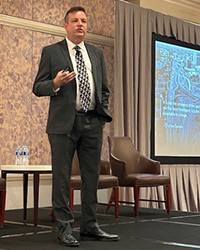
Healy’s comments came during his keynote address on Wednesday, May 20, during InterFace I-85 Industrial Corridor, a two-day conference held at the Hilton Uptown Charlotte. The event drew 287 attendees and included expert-led roundtable sessions, a cocktail reception, exhibitor booths and presentations and seven panel discussions, as well as Healy’s address.
Healy explained that the supply wave for the industrial sector has appeared to crest. The construction pipeline has declined by 61 percent since its peak in third-quarter 2022 for the collective I-85 markets, which has allowed the region to stabilize. However, Healy said that industrial developers have 43.2 million square feet of new space in the development pipeline in the I-85 corridor, which is an increase from fourth-quarter 2025 (36.3 million square feet).
Panelists throughout the InterFace I-85 Industrial Corridor conference said that the upcoming cycle of industrial development hinges on several factors, most of which fall under the umbrellas of utilities and infrastructure.
More power needed
Several panelists expressed angst over the war in Iran and the rippling effects on the U.S. economy, most notably in utility pricing and consumer spending due to the supply disruption of oil and natural gas. Healy pointed out that there has been an estimated $41.2 billion rise in energy costs since the United States entered the conflict in late February, which equates to $312 per American household.
The added energy costs directly impact demand stateside as industrial users, especially advanced manufacturers and data center tenants, are heavily reliant on power. Developers and tenants alike are heavily weighing utility considerations during the site selection process.
Benton Blaine, managing director of Cushman & Wakefield’s Charlotte office, said that 95 percent of his current role comprises site selection for user clients and that utilities are front and center during due diligence.
“If you’ve got dirt and you can’t show how water and sewer are going to get there, you don’t have a site, you have an idea,” said Blaine, who moderated the conference’s economic development panel. “I would take a greenfield site if water, sewer and power are already at or to the property line, because I’ve already mitigated a lot of my costs. That’s a win. If the right of way for power is not clear and if the water and sewer lines have to cross rivers or streams to get to the site, that’s a risk factor.”
For some users, it’s necessary to have an electric substation onsite. Vulcan Elements, a rare earth magnet manufacturer, conducted a multi-state search in 2025 for its new $1 billion plant before ultimately selecting CrossPoint Logistics Center, a speculative industrial facility in the south Raleigh suburb of Benson, N.C., that Edgewater Ventures delivered in 2022. In addition to its ideal location in the state’s Research Triangle Park, the site includes an electric substation that can provide 30 megawatts (MW) of critical power, which is well-suited for advanced manufacturers such as Vulcan Elements.
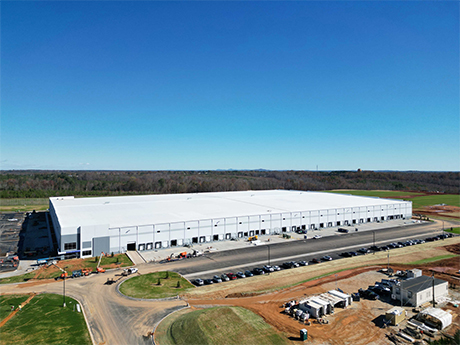
In Gaffney, a South Carolina city equidistant between Greenville and Charlotte, Glenstar is leading the development of Cherokee Commerce Center 85 (CCC-85), a 290-acre industrial project that will span approximately 3.6 million square feet upon completion. Glenstar and the development’s leasing agency, Colliers, are emphasizing the site’s power capacity — up to 100MW in the first three years of operation — during the marketing stages. Late last year, First Solar selected CCC-85 for its new $330 million plant, which is expected to create more than 600 jobs and produce up to 3.7 gigawatts (GW) of solar production capacity annually.
During the economic development panel, Scott Malone, president of the LaGrange Development Authority, explained that a demand driver for the southwest Georgia city is its public-private enterprise model. The City of LaGrange, which is located about 60 miles southwest of Atlanta via I-85 in Troup County, owns its own utilities. The economic development authority has leveraged this advantage to establish the market as an advanced manufacturing hub, attracting several global and regional companies, including Google and Remington Arms.
“When you’re going up against a Georgia Power or a rural co-op and you can give a lower rate for some period of time, that becomes a huge differentiator in attracting the right user,” said Malone. “The developer also realizes that we’re able to fill this building up, it’s not going to sit on the market.”
Power capacity is also a critical metric for industrial investment firms when considering acquisitions. Tyler Swann, managing director of W. P. Carey, said that utilities directly impact owners’ ability to lease properties to advanced manufacturers and other tenants that operate highly automated facilities.
“We are looking at assets where maybe a user is manufacturing plastic products or something that has nothing to do with automation or AI, but they use a whole lot of power,” said Swann, who spoke on the investment panel. “Part of our thesis there is that if we ever lose that tenant sometime down the road, because of that power capacity, we’re more likely to find a company to backfill it. That has been proven out in our asset management decisions, and it’s having an impact on our investment decisions.”
Conor Mullen, managing partner at Port Commercial Real Estate, added that power capacity is another critical element in his firm’s investment decisions at the property level, joining other factors like clear heights and building configuration.
Water and sewer were brought up less frequently than energy during the conference, but Blaine closed the economic development panel by saying that industrial stakeholders should consider themselves lucky as they don’t have to contend with water rights negotiations like many developers in other regions.
“We are blessed with the natural resource of water in the Southeast,” said Blaine. “If we go out to develop in Phoenix, we’re negotiating land rights to build the building, planning and zoning, permitting — and we’re negotiating water rights. We just don’t do that here because we don’t need to.”
Infrastructure creates opportunities
Panelists across multiple sessions discussed the importance of infrastructure, which is fitting, given that the conference is centered around the I-85 interstate. States in the corridor are helping advance their logistical advantages by investing in both road expansions and new inland ports, which are critical infrastructural touchpoints for industrial users.
For example, the North Carolina Department of Transportation is currently underway on a $337 million project to expand I-85 from six to eight lanes for a 10-mile stretch between Gastonia and Belmont/Mt. Holly.
Earlier this month, the Georgia Ports Authority (GPA) opened the Gainesville Inland Port, a $134 million port in the northeast Georgia city of Gainesville. The 104-acre project gives manufacturers and suppliers in the region an alternative to a 600-mile roundtrip truck route by providing direct Norfolk Southern rail service between the inland port and the Port of Savannah. The GPA estimates that the new inland port will replace approximately 26,000 roundtrip truck routes in the first year of operation.

Additionally, the GPA is working on the West Georgia Inland Port in LaGrange, which will connect distributors in the region to the Port of Savannah via CSX rail.
Justin Patwin, principal of Farpoint Development, was one of the speakers on the closing panel entitled “A Close-Up Look at Five Markets.” Farpoint, along with development partner Grandview Partners, is underway on Lafayette Logistics Park, a 134-acre industrial park situated off I-85 in LaGrange near the new inland port and the Kia plant. Plans for the site include the development of up to 2 million square feet of industrial facilities across two phases. Committed tenants include The Home Depot, Atlas Roofing and an unnamed Korean automotive supplier.
Patwin likened the LaGrange/Troup County region to Greenville-Spartanburg 10 to 15 years ago, as both markets have a heavy presence of a global automakers — Kia and BMW, respectively — and an inland port. The South Carolina Ports Authority opened Inland Port Greer in late 2013, which many local experts have said catapulted the Upstate South Carolina region into a heavy bulk market that has basically doubled in size since the inland port’s opening.
“The LaGrange/Troup County region has all the combination of elements that are like Greenville 10 to 15 years ago,” said Patwin. “And if you can command Atlanta rents without having to pay Atlanta prices for dirt, that seems like a pretty decent trade.”
— John Nelson