

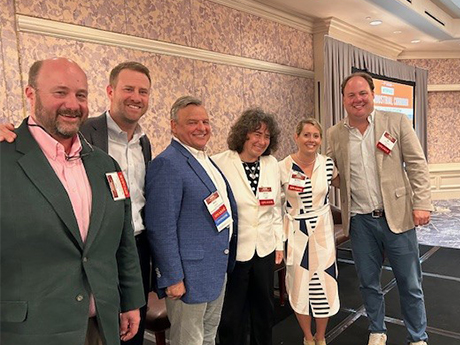
During his keynote address at InterFace I-85 Industrial Corridor, a two-day conference held May 19-20 at the Hilton Uptown Charlotte, Gregg Healy, executive vice president and head of industrial services at Savills, shared a quote from Charles Darwin to end his presentation.
“It is not the strongest of the species that survives, nor the most intelligent, but the one most adaptable to change.”
Editor’s note: InterFace Conference Group, a division of France Media Inc., produces networking and educational conferences for commercial real estate executives. To sign up for email announcements about specific events, visit www.interfaceconferencegroup.com/subscribe.
Industrial owners and developers have had to be adaptable given the haymakers issued by macroeconomic forces the past several years. During the COVID-19 pandemic, they rode the reinvigorated demand wave for e-commerce fulfillment with large-scale developments in key transportation corridors. In the following years, they scaled down their pipelines to focus on smaller, more targeted requirements as construction and capital costs rose significantly.
And since Liberation Day, when the Trump administration declared a sweeping package of tariffs for foreign trade partners and specific commodities in April 2025, industrial developers have been building and leasing facilities for domestic and global manufacturers that were nearshoring their investments.
Today, owners and developers are in somewhat unfamiliar territory where demand is coming from all sides, and is taking multiple forms. During the leasing panel at InterFace I-85 Industrial Corridor, Britten Mathews, senior vice president and market officer at Link Logistics, said that the key question that her firm asks prospective tenants is, “Why?”
“We’re asking [tenants] ‘why’ upfront,” said Mathews during the panel, which was moderated by Tim Robertson, partner at Beacon Partners.
Mathews said that understanding a tenant’s “why” is a cheat code for executing leases, which is not a given today as companies typically have several availabilities to consider.
“To be a step ahead in understanding what your client needs, and what your building can accommodate, is a huge differentiating characteristic,” said Mathews.
Anne Johnson, senior vice president of CBRE’s Charlotte office, said that understanding a tenant’s needs can take many twists and turns. She said that tenants have been taking down spaces recently that defy conventional wisdom.
“In the past year, we’ve quickly leased buildings that I thought we would struggle to get leased,” said Johnson. “Sometimes it was something that I thought was going to be a problem — too much office space, or it was rail-served, or it had a giant grade-level door. Sometimes one feature that doesn’t seem important is what drives the deal.”
Mathews echoed that sentiment, sharing an anecdote about deciding not to demolish office space within a facility in Greensboro with seemingly excess office space and then successfully finding a tenant that needed a higher-than-average office finish.
“Trends will change — don’t be scared away from a space that has something nuanced,” said Mathews.
“Differentiating yourself is really important right now,” added Johnson.
The panelists said that part of the calculus for executing leases is being creative. Many cited incentives, free rent and waiving customary broker fees in order to get deals done. Al Williams, executive managing director of industrial at JLL, said that landlords and brokers have had to be creative by necessity because tenant’s needs have been so dynamic.
“We are seeing a lot of atypical requirements; whether they need five acres of laydown yard or they need 100,000 feet with a 3/1,000 parking ratio,” said Wiliams. “Those deals are not necessarily going to go in spec development.”
Mathews mentioned that she’s seen tenants that will opt to go into a functionally obsolete, infill industrial facility simply because it has adequate power supply compared to other availabilities that may be more turnkey, at least on the surface.
Tenants deal with higher costs
Landlords are working harder than ever to fill their availabilities while keeping their base rental rates intact. Johnson said that industrial owners have mostly held rental rates steady in her home market of Charlotte.
“Most landlords have a fairly high investment in their asset, and so even if they wanted to, luckily they can’t give space away,” said Johnson.
Jordan Quinn, partner of Trinity Capital’s industrial division, added that tenants are also dealing with higher costs for build-outs and other operational expenditures, which is changing the physical space requirements they need.
“It’s not just racking and 2,000 square feet of office anymore,” said Quinn. “A lot has changed, it’s so fluid.”
Because of the timing of the leases that are coming up for renewal, many tenants are having sticker shock at what market rates are today. Johnson said that rents today may be double what the tenant initially paid when they signed the lease.
“A lot of companies are experiencing this for the first time in this five- to seven-year cycle,” added Mathews.
The panelists stated that tenants are opting to downsize or even shutter some of their ancillary locations to keep their operational expenditures manageable.
Who’s leasing?
One of the trends the leasing panelists discussed was the halo effect of data center developments in the Southeast. The panelists said that requirements from tenants that are supplying those data center campuses have largely bolstered the industrial sector.
“We’re seeing at least 2 million square feet of active deals [in metro Charlotte] that are just data center support,” said Johnson, whose firm recently executed a 700,000-square-foot lease with an unnamed tenant that just needed the space “to store equipment for their data center.”
Alan Lewis, managing partner of The Keith Corp.’s industrial division, said that some tenant categories that were long dormant will be coming back en vogue, maybe sooner than later.
“National retail distribution is coming, brace yourselves on that,” said Lewis. “They’re incredibly active up in Pennsylvania and New York and in areas that are very densely populated. For our project up in Pennsylvania, we’ve gotten five RFPs for 1 million square feet from national retailers, none of which are Amazon or Walmart.”
— John Nelson