

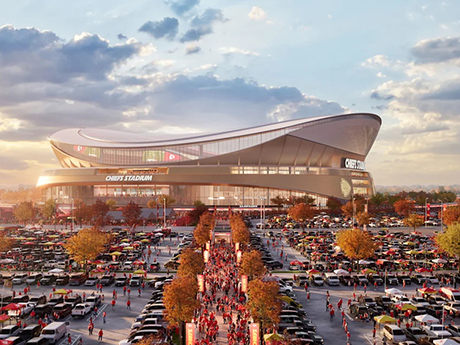
KANSAS CITY, KAN. — The Kansas City Chiefs have released initial concept renderings for the team’s new enclosed stadium set to open in Kansas City, Kan., in 2031. The Chiefs are still finalizing details, but the $3 billion stadium will hold 70,000 fans, feature a fully enclosed roof with translucent panels and include more than 20,000 parking spots. The Chiefs also announced the project team, which includes Kansas City-based MANICA as the lead design architect and Kansas City-based sports architecture firm HNTB as the architect of record. CAA ICON is serving as owner’s representative on the project.
The stadium’s size, shape and roof geometry have been studied by audio engineers to maximize crowd noise. The stadium’s seating bowl is reminiscent of Arrowhead Stadium, the team’s current stadium. The new development will include a “Drum Deck” for pregame and in-game ceremonies as well as the “Chiefs Ring of Honor” above the bowl. The translucent panels on the roof will maximize visibility for military flyovers.
Outside the stadium, fans will be able to visit the Lamar Hunt statue in a modern plaza, access a specially curated Chiefs Hall of Honor more than twice the size of its current space and peruse an expanded Chiefs Team Store approximately four times larger than the current store. The stadium will also anchor a mixed-use development.
Based on the most recent economic impact figures released by the team, the fixed-roof stadium project in Kansas, along with the practice facility/team headquarters in Olathe and two private ancillary mixed-use development districts, are slated to deliver 36,500 full-time equivalent (FTE) jobs and $8.2 billion in economic impact for the Kansas City region during the construction period. Once operational, the projects are slated to support 8,500 FTE jobs and generate $1.5 billion in economic impact annually.
The project is being financed through a public-private partnership, with the public portion funded through Sales Tax and Revenue bonds and the Attracting Professional Sports to Kansas Fund. Both funding mechanisms were established to ensure that there will be no new state taxes and no negative impact on the state budget. The remaining portion will be privately funded. The project also includes $1 billion in additional development in Kansas.