

By John Schenk and Parker Gilmore, CBRE
For two decades, Cincinnati did not see many new apartment projects built compared with its peer cities, with annual deliveries trickling along at roughly 965 units between 2000 and 2020, while merchant builders showed a preference to Columbus or Indianapolis for their predictability.

But 2021 marked the beginning of a breakout period as a favorable macroeconomic backdrop, along with surging national and regional appetite, conditioned a thunderstorm of new development at the record-breaking tune of over 3,000 units per year.
A combination of economic growth, demographic shifts, refreshed renter expectations and institutional capital interest has positioned Cincinnati as one of the Midwest’s most compelling multifamily investment stories as of late.
The numbers tell a story of Midwestern confidence. Cincinnati recorded nearly $943 million in multifamily sales volume for 2025, representing 7,381 units traded — a dramatic increase from 2024’s $517 million and 2023’s $314 million. Blended pricing reached approximately $122,834 per unit with transaction counts on the rise as investors sought exposure to the fundamentals Cincinnati offered so well.

Behind the surge in transaction activity is a fundamental shift in how developers, investors and residents are viewing the Queen City’s investment potential.
A new generation of renters
The new-age Cincinnati renter looks very different than the renter from a decade ago. Young professionals working in finance, healthcare, technology, life sciences and advanced manufacturing are increasingly seeking options that emphasize a lifestyle. Major employers like Medpace, General Electric, Procter & Gamble, Kroger, Fifth Third Bank and a growing healthcare ecosystem continue to attract highly educated and well-paid talent to the region.
At the same time, Cincinnati households are confronting a housing market where elevated mortgage rates and stagnant wages have made homeownership less attainable. Pandemic-forced challenges further contributed to a lagging housing pipeline. Renters are choosing to remain in apartments longer, often seeking higher-quality communities that offer conveniences and luxuries traditionally associated with homeownership. Nationally, research points to higher mortgage rates limiting home sale activity, supporting apartment demand.
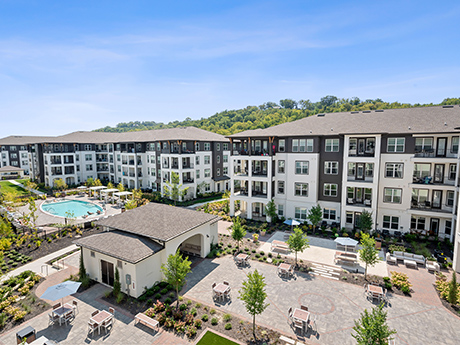
Developers have responded accordingly, building for experience rather than simply housing. Resort-style pools and sun decks, fitness centers, coworking lounges, pet amenities, rooftop lounges, covered parking and curated resident experiences are now standard features rather than premium add-ons.
Building the experience
The shift shows up directly in the regional development pipeline. The market has delivered over 15,000 units since 2021 and currently has roughly 3,963 units under construction, with another 6,500+ planned. With this new wave of supply, demand has remained remarkably resilient and net absorption reached approximately 3,514 units during 2025. These signs point to Cincinnati’s growth being absorbed by real renter demand rather than outrunning it.
The developers driving this pipeline are, almost without exception, building amenity-rich communities designed to compete with luxury for-sale housing rather than simply add units to inventory. Most of them have Cincinnati roots to begin with.
A closer look shows that Northeast Cincinnati and Warren County lead the region, accounting for roughly a quarter of all completed units and the largest share of the current construction pipeline — driven in large part by Hills Properties’ footprint in Liberty Township, West Chester and Miami Township. Central Cincinnati, anchored primarily by Downtown, Over-the-Rhine and Uptown, isn’t far behind, fueled by continued infill and office-to-residential conversion projects.
Northern Kentucky has emerged as a parallel growth story in its own right. Covington, Newport, Florence and Erlanger have collectively pulled in more under-construction activity than almost anywhere else in the metro. Developers are betting big on waterfront proximity and the distance to downtown Cincinnati, the CVG International Airport and Amazon Air Hub.
Meanwhile, long-established Cincinnati neighborhoods are seeing their own wave of reinvestment. Walnut Hills, Hyde Park, Norwood, Pleasant Ridge and Sharonville — mostly overlooked in favor of greenfield suburban sites — are now being considered for master-planned, walkable redevelopments, signaling that Cincinnati’s growth story isn’t confined to its edges.
Investors are taking notice
That development boom hasn’t deterred investors; if anything, it has attracted them on a national scale.
Institutional capital increasingly views Cincinnati as a market capable of offering a combination of stability and growth. The metro offers relatively affordable living costs compared with larger coastal cities while still maintaining cultural amenities, professional sports franchises, nationally recognized universities and a growing urban core.
Neighborhoods such as Over-the-Rhine, Oakley, Hyde Park, Downtown, Walnut Hills, Pleasant Ridge and Northern Kentucky continue to attract residents who prioritize walkability and lifestyle. And while many Sun Belt markets saw aggressive rent growth give way to elevated vacancy from oversupply, Cincinnati’s fundamentals have remained measured and sustainable by comparison.
CBRE Econometric Advisors recorded Cincinnati’s vacancy rate at approximately 4.4 percent in the first quarter of 2026, near national equilibrium and below many high-growth or gateway markets. Average occupancy reached roughly 95.8 percent, with annual rent growth of about 2.8 percent, comfortably outperforming the national multifamily rent growth rate of roughly 0.5 percent. Resilient occupancy and dependable rent growth have captured the attention of investors searching for predictable cash flow.
The nearly $1 billion of multifamily sales during 2025 shows confidence from private equity firms, pension funds, family offices and institutional investors. Compared with historical transaction volume, it represents one of the strongest years on record for the market.
In many respects, Cincinnati has become an attractive middle ground: Investors gain access to higher going-in yields than those typically available in gateway markets, while benefiting from economic and socioeconomic drivers that are stronger and more diverse than those found in many secondary Midwest cities.
In this latest version of Cincinnati, renter demand, development activity and investment capital are now moving in the same direction.
John Schenk is a senior associate and Parker Gilmore is an investment sales analyst with CBRE. This article originally appeared in the July 2026 issue of Heartland Real Estate Business magazine.