

In today’s market, builders are met with longer decision-making timelines and increased scrutiny over budgets before projects are approved, according to John Line, executive vice president with Farmington Hills, Michigan-based Huntington Construction.
Last year, CBRE reported that the construction pipeline continued to contract across all property types, estimating that construction costs increased 35 percent since 2020. A J.P. Morgan report from earlier this year states that rising costs, largely fueled by tariffs and trade policy uncertainty, present challenges for commercial real estate. For instance, imported aluminum, copper and steel parts are subject to a 50 percent tariff.
“While there’s still a healthy pipeline of opportunities, clients are carefully evaluating scope and costs before breaking ground,” says Line. “As a result, preconstruction and collaboration are more important than ever, and contractors are expected to provide strategic guidance long before construction begins.”
Kinjal Patel, president of Chicago-based McHugh Construction, echoes this sentiment. He says success in today’s market depends on disciplined project selection, early planning and closer coordination with clients and trade partners during preconstruction.
McHugh has utilized time during slower development cycles over the past few years to strengthen subcontractor relationships, procure long-lead-time materials earlier and leverage emerging technology to improve efficiencies.
According to the Associated General Contractors of America, weakness is spreading across much of the private construction market despite continued strength in infrastructure, power and data centers. Construction spending totaled $2.2 trillion in June, down 3.2 percent from a year ago. Private nonresidential construction fell 4.7 percent year-over-year, manufacturing construction dropped 22 percent and commercial construction was 5.3 percent lower.
Rich Jacobson, president of Minneapolis-based Kraus-Anderson Construction, says he expects “steady-to-soft” conditions for the remainder of 2026 and into 2027. He anticipates pockets of strength where funding is less interest rate-sensitive, citing certain healthcare projects, public/institutional and mission-critical/industrial developments.
“If interest rates ease or lenders reopen for development, we may see a modest pickup in late 2026, but not a broad-based surge,” says Jacobson.
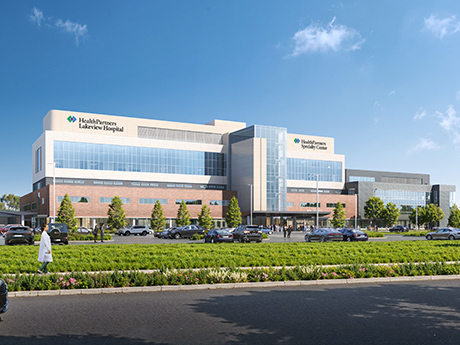
Right now, Kraus-Anderson is serving as construction manager for the new HealthPartners Lakeview Hospital in Stillwater, Minnesota. The six-story, 400,000-square-foot hospital and clinic campus is slated to open in early 2028.
Strategize for costs
The high costs associated with building today are a daily consideration for general contractors. At the latest Federal Open Market Committee meeting at the end of July, the Federal Reserve voted to leave its benchmark federal funds rate unchanged at a rate of 3.5 percent to 3.75 percent, marking the fifth straight time that it held the rate flat. As of June, the U.S. annual inflation rate was 3.5 percent.
“Not only do we have inflation and tariffs to monitor, but we also have financing, interest rates and wars to keep an eye on,” says Jacobson. “Our team is in constant contact with our clients, design partners, subcontractors and vendors to maintain an accurate database. When we do get the notice to proceed on a project, a detailed procurement strategy is implemented immediately so we can lock in pricing and delivery.”
Preconstruction has become one of the most valuable services that Huntington provides, says Joe Butler, senior project manager with the firm. “Clients are looking for partners who can identify cost-saving opportunities without compromising quality or project goals,” he states.
Examples include value engineering, evaluating alternative materials and systems, and in some cases, utilizing cost-plus contracts that provide owners with greater transparency into where every construction dollar is being spent. A cost-plus contract provides reimbursement for all of the costs associated with a construction project, plus a fee to account for the contractor’s overhead and profit, according to construction software company Procore.
One project of note for Huntington is the renovation of a high school in Southwest Detroit that serves at-risk students. The builder is modernizing classrooms and common areas while adding a new accessibility lift that will enable the building’s second floor to be fully utilized for the first time in decades. The renovation will also create additional space for childcare and community services, expanding the building’s impact beyond education.
Justin Spafford, a vice president with Montgomery, Alabama-based Caddell Construction and head of the firm’s newly opened Columbus, Ohio, office, says his firm provides real-time cost modeling, constructability reviews, value engineering and procurement strategies to help its customers make informed decisions earlier in the construction process.
“While certain commercial sectors have slowed, we continue to see significant activity in the markets where we work, specifically in mission-critical facilities, advanced manufacturing, automation, logistics and infrastructure,” says Spafford. “As financing conditions improve and owners gain greater confidence in the market, we expect other sectors that have been delayed to gain traction.”
In fall 2025, Caddell broke ground on a new fiberglass insulation line for Owens Corning at the company’s Kansas City manufacturing facility. The expansion project is expected to open in 2027.
For Patel, activity is picking up in multifamily housing, including affordable, market-rate, adaptive reuse and ground-up developments. He says strong rental demand, suburban growth and investment in sports and entertainment districts are also contributing to new construction opportunities.
For example, McHugh is working on the 1901 Project, a mixed-use campus redevelopment near the United Center, home of the Chicago Bulls and Chicago Blackhawks. Along with joint venture partner GMA Construction Group, the firm is constructing the West Garage, the project’s first phase.
The three-story structure includes a lower-level loading dock and operations area for the United Center, street-level retail space and parking, a second level with 266 parking spaces and a rooftop public park.
As part of the same redevelopment, McHugh is also serving as general contractor with joint venture partner Ujamaa Construction on the new Music Hall, an entertainment venue that will further expand the United Center district as a year-round destination for live events and community engagement.
Supply chain fluctuations
Going hand in hand with costs is the ease with which general contractors can procure materials. While availability of most common building materials has improved since the widespread supply chain disruptions several years ago, certain manufactured materials such as electrical equipment remain an exception, says Patel.
“Demand from data center and industrial development is extending lead times for electrical and mechanical equipment and increasing subcontractors’ overall pricing,” he explains. “In some cases, those costs can determine whether a project meets its pro forma. Fuel price fluctuations also continue to affect certain commodity materials and transportation costs.”
The Consumer Price Index for July showed that energy prices increased 14.7 percent year-over-year, and gasoline prices were up 24.6 percent.
Butler says that unpredictability remains a factor for supply chain conditions, as lead times can fluctuate dramatically from one week to the next. Mechanical, electrical and plumbing equipment continue to require close coordination, and certain specialty products can still impact project schedules. The solution? Identify acceptable alternatives early in the process to keep projects moving while still maintaining quality standards.
Building materials that require early procurement and close coordination today include structural steel, electrical equipment, transformers, switchgear, generators and certain HVAC components, according to Spafford. Preconstruction efforts pay off here.
“Our teams continue to engage trade partners and vendors early, monitor procurement milestones and work collaboratively with our clients to mitigate potential schedule impacts before they become project risks,” notes Spafford.
How to grow the workforce
A widespread challenge in the construction industry is the availability of labor. Patel says a few factors account for the recurring problem.
“Many craft professionals who entered the workforce during the construction booms of the 1970s, ’80s and ’90s are nearing retirement age, while younger workers are not entering the trades at the same pace,” he states. “Labor availability has also been affected by broader immigration policy, particularly in skilled trades.”
One way McHugh is working to address labor challenges is through partnerships with labor advocacy groups and workforce development organizations. The goal is to promote construction careers and support apprenticeship and training programs aimed at developing the next generation of skilled workers.
One area of concern is the impact of large-scale data center development on the electrical and mechanical trades. The surging product demand has intensified competition for skilled labor, equipment and materials.
Jacobson says the labor supply is still very tight in the skilled labor trades and for experienced project management positions.
“Kraus-Anderson continues to be active with all our partners that work in this space to help bridge this gap we have been talking about for years,” he says. “The unions, trade schools and construction management and engineering colleges all have a role in helping with the industry-wide problem.”
Jacobson believes the hard work is paying off. He says the message is more widespread today — not only about the need for new workers in the industry but also that construction can be a great career path.
Caddell continues to invest heavily in recruiting, mentoring, leadership development, internships and career advancement opportunities.
“We believe building future leaders is just as important as building projects,” says Spafford. “Our expansion into Columbus allows us to recruit top talent throughout the Midwest while creating additional opportunities for professional growth within our organization.”
Tech tools boost efficiencies
In addition to investing in their employees, general contractors are implementing new technologies to enhance tasks. Artificial intelligence (AI) is becoming an increasingly valuable tool throughout preconstruction and project management, says Butler. Huntington is utilizing AI platforms such as Claude to review project documents, improve estimating accuracy and streamline proposal development.
In the field, cloud-based project management software and mobile technology enable project teams to access real-time information virtually, improving communication and reducing delays. Technology also speeds up the process for submittals or requests for information.
“Trade partners can now capture field measurements digitally and generate shop drawings in hours rather than weeks, helping projects move forward more efficiently while reducing administrative bottlenecks,” says Butler.
McHugh uses virtual design and construction tools and building information models (BIM) from its design partners to coordinate structural, mechanical, electrical and plumbing systems before field work begins.
One example is OpenSpace, which enables the firm to capture jobsite imagery and create virtual project environments so that project teams and owners can review progress remotely while supporting quality control and communication.
McHugh’s in-house drone program provides aerial documentation and project monitoring during construction. For the preconstruction phase, McHugh is evaluating estimating technologies that could shorten budget timelines and improve accuracy as well as exploring AI tools for further efficiencies.
Spafford names several technology platforms that Caddell leverages, including Procore for project management; Oracle Primavera P6 for scheduling; LEAN planning tools to improve workflow reliability; Power BI dashboards for executive reporting and analytics; and BIM to improve coordination before work reaches the field.
These tools, in conjunction with 360-degree video and drone technology to document project progress, create a digital record of construction. Doing so allows teams to monitor progress, validate quality and make informed decisions more efficiently, says Spafford.
“Our goal is to leverage technology not only to improve efficiency but also to provide greater transparency, collaboration and value to our clients throughout the lifecycle of every project.”
— Kristin Harlow
This article originally appeared in the August 2026 issue of Heartland Real Estate Business magazine.