

By Tony Kennedy, Colliers | St. Louis
St. Louis is more than the Gateway Arch and the St. Louis Cardinals (although those are two pretty awesome things to have). With a robust and diversified economy, St. Louis continues to be a steady performer across all sectors predominantly in manufacturing, financial services, healthcare, biotech, energy and education.
St. Louis ranks as the 23rd-largest metro area in the U.S. with an unemployment rate of 4.1 percent versus the national average of 4.4 percent. St. Louis doesn’t have high highs or low lows; rather it is the tortoise and not the hare when it comes to economic growth. And when it comes to real estate, the St. Louis office market follows a similar path and continues to show steady trends across key indicators.

Overall, office vacancy continues to hover around 25 percent with some submarkets performing better than others.
The Clayton submarket remains the “darling” of the St. Louis region with virtually no large blocks of space available and robust demand outweighing supply. With a Class A vacancy rate of 14 percent (about half the region’s average), Clayton landlords continue to push rates upward. Clayton office lease rates are hovering in the low to mid-$30s per square foot with the newer buildings pushing rates into the mid-$40s. These rates are on a full-service basis with building expenses generally in the $13 to $14 per-square-foot range.
While downtown St. Louis remains the region’s largest submarket, it also faces the challenge of having the highest level of vacancy.
With Class A vacancy hovering around 36 percent, significant blocks of available space remain throughout the St. Louis central business district (CBD). Although rental rates are among the lowest in the market, supply continues to outpace demand. Asking rents generally range from the mid- to upper teens, with concession packages continuing to favor tenants.
There are, however, several encouraging developments. One of the region’s largest law firms, Lewis Rice, recently renewed its 107,000-square-foot lease, demonstrating continued commitment to downtown. Meanwhile, The Cordish Cos. appears to be seeing continued success at Ballpark Village. Its Class A office tower is understood to be largely leased, and the company is said to be exploring the possibility of a second tower.
Cordish has also made substantial progress on the demolition of the former Millennium Hotel site, where it plans to develop a 41-story apartment tower and is considering the addition of up to 250,000 square feet of office space. At 10 South Broadway, The Note Wine & Jazz Bistro recently leased 14,000 square feet, while the former Tony’s restaurant space will be converted into a live music venue, adding another attractive amenity to the downtown entertainment scene.
Noteworthy deals
On the investment side, a Columbia, Missouri-based investor recently acquired 800 Market, a 750,000-square-foot Class A office tower previously owned by Positive Investments. The transaction is a notable sign of investment activity in a downtown market that continues to work through elevated office vacancy.
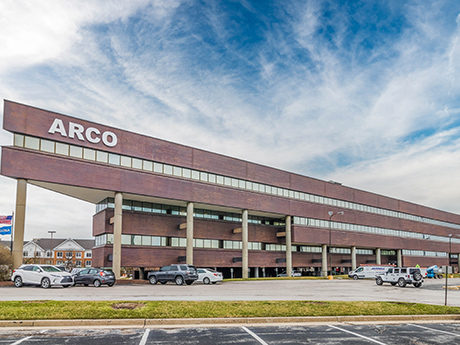
Leasing activity remains concentrated among tenants occupying less than 15,000 square feet, though several larger transactions occurred, including APC Postal Logistics (81,469 square feet), MRHFM Law Firm (58,013 square feet), ARCO National Construction (35,305 square feet) and National Rarities (19,327 square feet).
Diving deeper into the various submarkets, rental performance continues to reflect a clear quality and location premium. Class A properties maintain a noticeable rent advantage over Class B assets, with Clayton, Midtown and Kirkwood/Frontenac commanding some of the highest asking rents in the market, while North County, the CBD and Earth City/Riverport remain among the most affordable options. Overall, relatively stable rental rates alongside elevated vacancy levels suggest that market fundamentals remain highly dependent on asset quality, location and tenant demand for premium office space.
Following more than 1.1 million square feet of negative absorption in 2023, market conditions have generated mixed results during the past three years.
Quarterly performance was largely driven by several occupancy changes, including PennyMac’s 77,441-square-foot move into the former Clayco headquarters in North County, offset by Spectrum’s 43,712-square-foot departure from Barrett Woods III & IV and PennyMac’s 36,122-square-foot move-out from 4300 Duncan. Despite continued absorption volatility, overall vacancy remained stable at 24.7 percent for the third consecutive quarter.
As employers continue to push for three-plus days of in-office attendance, St. Louis is seeing a modest increase in office space demand, particularly from tenants reassessing their workplace needs. There has been a trend for companies selecting buildings that are “commute-worthy” or have amenities that will attract their employees to want to be in the office more often than not. With that has come a shift to quality, and the results show more positive absorption in Class A amenitized buildings than other product types.
While leasing and absorption activity continues to fluctuate, tenant and investor demand remains focused on high-quality assets in established office corridors, reflecting a market that is gradually moving toward stabilization. Slow but steady…a good way to go.
Tony Kennedy is a senior vice president with Colliers | St. Louis. This article originally appeared in the September 2026 issue of Heartland Real Estate Business magazine.