

By Mary Lamie, Bi-State Development and St. Louis Regional Freightway
The St. Louis region’s workforce, multimodal infrastructure and industrial real estate assets have long attracted manufacturers and logistics operators. Today, new analysis highlights another competitive advantage: its role as the anchor of the emerging I-44 Aerospace Supply Chain Corridor.
Stretching approximately 650 miles from the St. Louis region through Tulsa and Oklahoma City and into the Dallas-Fort Worth metro area, the corridor connects one of the nation’s most concentrated networks of aerospace manufacturers, defense contractors, suppliers and maintenance providers.

Bi-State Development
According to the 2026 St. Louis Regional Industrial Real Estate Market Indicators & Workforce Statistics Report, the corridor supports more than 1.6 million aerospace manufacturing and related jobs and generates more than $250 billion in economic activity. Perhaps most significant, one in five of those jobs is located in the St. Louis region, underscoring the area’s importance as a leading aerospace manufacturing and logistics hub.
“The I-44 Aerospace Supply Chain Corridor is the logistics backbone of America’s aerospace industry,” says Doug Rasmussen, founder and CEO of Steadfast City Economic and Community Partners, which prepared the report for the St. Louis Regional Freightway.
The data support that conclusion. Aerospace manufacturing jobs along the corridor are concentrated at nearly 3X the national average, while aerospace manufacturing GDP has grown nearly 40 percent over the past five years. Several St. Louis-area zip codes have location quotients exceeding 4.0, reflecting an exceptionally high concentration of aerospace talent and production capability.
What makes the St. Louis region unique is not simply its participation in the corridor but its position at its origin. It sits at the convergence of aerospace manufacturing, military logistics, multimodal freight transportation and a highly skilled workforce. No other location along the corridor combines prime-level defense manufacturing, six Class I railroads, four major interstate highways, the nation’s most efficient inland port and two expanding airports into a single, integrated ecosystem.
That ecosystem is anchored by Boeing’s expanding defense manufacturing operations on both sides of the Mississippi River and supported by the growing operations of Gulfstream and West Star Aviation in Southwestern Illinois and other maintenance providers, major suppliers and military logistics assets. The St. Louis region is home to Boeing’s Defense, Space & Security Headquarters and production of the F/A-18, F-15EX, F-47 and MQ-25. The company is investing $1.8 billion in expanding its North St. Louis facility.
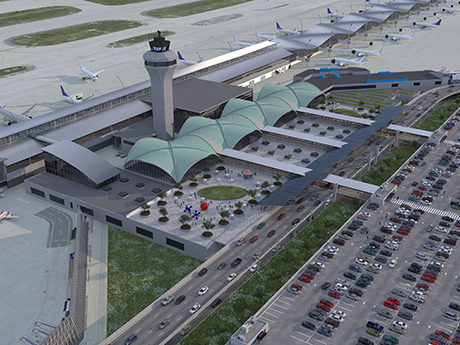
The region’s position is further strengthened by the planned $3 billion-plus modernization of St. Louis Lambert International Airport and MidAmerica St. Louis Airport’s co-location with Scott Air Force Base, a $12.9 billion economic engine.
Companies operating along the corridor recognize its value. Sonaca North America, a supplier to commercial and defense aerospace manufacturers, maintains several facilities along or near I-44. Components routinely move between sites in Missouri and Oklahoma before delivery to customers, including Boeing and Gulfstream.
“For Sonaca, being in Missouri with locations along the I-44 artery contributes to our success because we can be competitive with other suppliers that may have everything on one campus,” says Kevin Goossens, CEO of Sonaca North America. “Easy access and easy connections along I-44 were factors as the company expanded through acquisitions and they continue to support movement of our products between our facilities. It’s the closest we can get to being a one-stop shop.”
Supporting aerospace industry growth is a workforce that outperforms many peer regions. The St. Louis area boasts nearly 1.5 million workers and labor force participation rates that exceed national averages. The region also leads comparable Midwestern metros in production occupations and maintains a strong concentration of transportation and material-moving workers.
At the same time, the region’s industrial real estate market remains one of the most compelling values in the Midwest. The market contains nearly 195 million square feet of industrial inventory, including 727 buildings larger than 100,000 square feet and nearly 18 million square feet of available space. More than 3.4 million square feet is under construction, while asking triple-net lease rates average approximately $6.50 per square foot. The number of industrial occupiers increased more than 26 percent from 2025 to 2026.
Infrastructure investment continues to reinforce the region’s competitive position. The St. Louis Regional Freightway’s latest Priority Projects List includes 29 projects representing more than $9.2 billion in improvements designed to strengthen the freight network. Additionally, more than $1 billion in funded and planned improvements along I-44 in Missouri will enhance reliability and transit times across the aerospace corridor, further strengthening the connectivity manufacturers depend upon.
The aerospace story is unfolding alongside broader industrial growth. Since 2019, companies in advanced manufacturing, food and AgTech, chemicals and metals have announced more than $10.2 billion in investments across the bi-state region.
As industrial development patterns shift nationwide, the St. Louis region’s advantages are increasingly difficult to replicate. Workforce readiness, multimodal access, competitive real estate and infrastructure investment continue to make the region a strong choice for industrial development. Today, as the anchor of the I-44 Aerospace Supply Chain Corridor, St. Louis is helping shape the future of aerospace manufacturing and logistics in America.
Mary Lamie is executive vice president of multimodal enterprises for Bi-State Development and head of the St. Louis Regional Freightway. This article originally appeared in the September 2026 issue of Heartland Real Estate Business magazine.