

— By Patrick Shalz of TOK Commercial —
Amid an office landscape that remains uneven nationally, the Boise MSA continues to distinguish itself with steady fundamentals, improving vacancy and rising rents. The market remained on solid footing through the second quarter of 2026. Overall vacancy held steady at 6.6 percent, down from 7.2 percent one year ago. It has remained remarkably consistent throughout the first half of the year, fluctuating by just one-tenth of a percentage point.

Multi-tenant vacancy also improved, declining to 10.2 percent from 10.5 percent a year earlier, reflecting continued demand for quality multi-tenant space. Overall asking lease rates reached a record high of $23 per square foot (full-service, annual), with nearly every submarket posting year-over-year rent growth. Class A asking rates also strengthened, increasing 2 percent from last year to $25.50 per square foot.
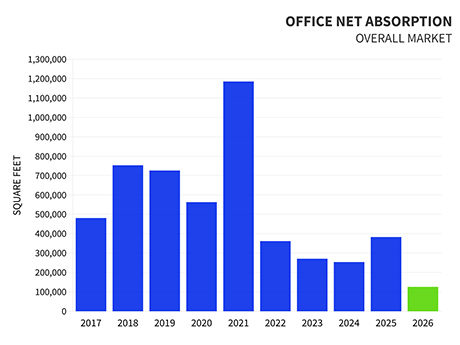
Leasing activity shifted toward larger transactions in the first half of 2026. Although the total number of office transactions declined nearly 10 percent year over year, net absorption increased 36 percent, indicating that tenants leased larger blocks of space than in the prior year. Smaller suites account for the majority of activity, but their share of the market softened with spaces of 2,000 square feet or less representing 47 percent of transactions over the past 12 months, down from 58 percent the year before.
Boise submarkets accounted for the largest share of leasing activity with 56 percent of all transactions, while Meridian and Eagle remained the region’s strongest growth markets, combining for 109,000 square feet of year-to-date net absorption. Downtown Boise also posted encouraging signs of recovery, recording positive net absorption for the first time since fourth-quarter 2023. Transaction volume in the submarket increased 8 percent, while overall vacancy fell to 8.9 percent, its lowest level since January 2024.
Micron Expansion Begins to Reshape Boise Office Demand
Micron’s billion-dollar expansion continues to be one of the most significant long-term economic drivers in the Boise MSA and is beginning to impact office demand across the region. The expansion is expected to create more than 17,000 direct, indirect and construction-related jobs, while attracting a growing network of suppliers, engineering firms, technology companies and professional service providers. As Micron’s supplier ecosystem develops, staffing, leasing and occupancy across the Treasure Valley will ramp up ahead of anticipated production in 2027.
Micron’s expansion, coupled with local organic business growth, continues to drive steady leasing activity across the market. Local start-ups, tenant expansions and additional locations accounted for 61 percent of transactions over the past 12 months.
Companies new to the Boise market accounted for 9 percent of office transactions and are increasingly bypassing traditional core locations, with nearly half choosing Central or North Boise and another 30 percent locating in Meridian or Eagle. These new entrants are also willing to pay higher rents, paying on average 23 percent more per square foot than local startups, and reinforcing demand for well-located, quality office product.
Construction activity is on pace to exceed last year’s total, with 85,000 square feet delivered through the first half of 2026. Meridian accounted for 57 percent of this new development, continuing its role as one of the region’s most desired areas. More notably, 54,000 square feet of speculative office space has already been delivered this year, exceeding all speculative deliveries in 2025. This has signaled renewed developer confidence while remaining measured relative to market demand.
With Micron’s expansion still ramping up and both local and incoming companies supporting leasing activity, Boise appears positioned for continued measured growth rather than a sudden surge. For landlords and developers, that balance — strengthening demand without an outsized construction pipeline — should help keep the market on solid footing as 2027 approaches.
— By Patrick Shalz, Partner and Office Specialist, TOK Commercial. This article was originally published in the August 2026 issue of Western Real Estate Business.