

By Taylor Williams
Tax cuts for the rich. The K-shaped economy. The dawn of the second Gilded Age.
Regardless of your preferred cliché, if you buy into one or more of those views on the current state of the U.S. economy, then you likely have broader concerns about the natural byproducts of unchecked capitalism. But no matter the degree of government oversight and regulation, capitalism at its core is driven by competition, and sometimes that competition can be taken too far.
But those in the business of economic development in North Texas see no real need to take competitive capitalism to extremes, at least at this point in the cycle. The region’s natural magnetism for attracting new commerce, as well as its established patterns of job and population growth, are somewhat self-sustaining at this point, and there’s plenty of business to go around.
“There’s always competition, but we also all talk to each other and share ideas about what’s working from a regional standpoint, and because of what we have in DFW in terms of sheer population and diversity of workforce, there are plenty of opportunities,” says Michael Talley, the City of Plano’s director of economic development. “Competition is part of any business that involves sales, and we’re in the business of selling our communities. But we also utilize each other’s assets, play off each other and even complement each other at times.”
“Super” Dave Quinn, economic development manager for the Town of Fairview, located along the U.S. Highway 75 corridor between Allen and McKinney in Collin County, also points to North Texas’ diverse labor pool as a shared competitive advantage for communities throughout the region.
“A lot of companies are coming here because they see the labor coming into the state, with several hundred people moving to Texas every day and North Texas in particular,” Quinn says. “That signals to companies looking to relocate here that they’ll be able to source the talent they need, from the CEO to the janitorial staff, to take their businesses to the next level.”
“That’s a big part of what makes Texas so great and protects our economy,” Quinn continues. “While other states are experiencing challenges across the country, Texas has multiple major markets that are growing, as well as numerous secondary markets. So it feels like everybody has a place in the system.”
A Vast Playing Field
Economic development professionals aren’t doing their jobs if they don’t showcase the full scope and power of their resources and incentives that can grow their local economies whenever they have the chance.
But whereas the Darwinian view of competition that is often associated with unbridled capitalism ascribes a sense of cutthroat operations — after all, “survival” is the key word of the philosophy — there is no place or need for sabotage, subterfuge or dirty dealing within economic development in North Texas. In fact, sources say the competition is amicable and grounded in the understanding that the positive impacts of a major deal or project are rarely confined to a single municipality.
“We all talk to our neighbors and keep it friendly, and we want them to succeed as well,” says Talley. “A company that’s new in town doesn’t just pull from that town’s workforce. If the deal doesn’t land here, we’d rather it land next door, and if it doesn’t land next door, we’d rather it land in DFW than outside of the region or state altogether.”
As Plano’s personal growth story blazes forward, Talley’s comments are echoed by his colleagues throughout the region. The sentiment is shared among economic development professionals in municipalities that are equally mature and still growing, as well as in smaller cities that are in earlier stages of the North Texas boom.
“That combination of collaboration and competition — we call it ‘a culture of unrivaled performance’ — makes the region so much stronger as a whole,” says Gloria Salinas, senior vice president and chief growth officer at Frisco Economic Development Corp. “When you bring collaboration and competition together, you build strong public-private partnerships and create a market in which the people and jobs reinforce each other. So the metroplex’s success in economic development as a whole is due to the economic development strength of its individual communities.”
“When we compete on a deal, we put our best foot forward and don’t talk badly about any other community,” adds William Myers, executive director of economic development for the City of Bonham, about 70 miles north of Dallas. “If a deal doesn’t land in Bonham, we hope it lands in Sherman, Denison, Paris, McKinney or even southern Oklahoma.”
“We want to win, but at the same time, we support better lives and more opportunities in the region as a whole,” Myers continues. “We share leads about who needs certain buildings in other communities and information like that all the time. Companies absolutely draw from different cities, and when we know that a percentage of the workforce may land nearby or commute, that factors into what we’re willing to do to win the deal.”
Dan Bowman, president and CEO of the Allen Economic Development Corp., says that as Collin County has emerged as one of the nation’s
fastest-growing areas in recent years, economic development professionals within the county have begun working together to highlight certain trade areas. He cites the State Highway 121 corridor as a prime example of this practice, which is beneficial to multiple municipalities.
“We’ve forged a strategic partnership with McKinney because we want to jointly promote 121 North as a centralized area for mixed-use projects on both the north and south sides of the corridor,” Bowman says. “It’s a ‘rising tide raises all ships’ mentality that helps us illustrate the critical mass of amenities and business opportunities that Allen and McKinney offer collectively along the 121 corridor.”
Part of that mindset hinges on mutual acknowledgement of the fact that certain projects are simply better fits for certain communities than others. But working to keep the deal within the region is still a worthwhile endeavor for all relevant parties.
“While it’s always disappointing when a company doesn’t choose Allen, seeing a strong business land right next door is still a win for our entire region,” Bowman continues. “This partnership brings more deals, more projects and more opportunities to all of us. Employees and companies don’t see city lines. They decide where to live, work, shop and dine based on quality of life, not boundaries, so the more we collaborate, the more growth we all get to share.”
Other economic development professionals agree that the cross-pollination across three key verticals of commercial real estate — living, working and shopping/dining — among neighboring communities in North Texas is a net positive for all.
“People live in one community, work in another, shop in another and participate in the broader regional economy,” says Farel Otieno, business growth project manager and head of recruitment, retention and expansion for the City of Grand Prairie, located roughly midway between Dallas and Fort Worth. “If a major employer locates in a neighboring city, our residents still benefit from those employment opportunities without having to move.”
“That will also increase demand for retail and restaurants in the surrounding area,” Otieno adds. “So we want to compete for the right projects, but we also recognize that when businesses and developers invest in the region, the strong regional economy that results benefits all of us.”
What’s Next?
Plano is approaching the 10-year anniversary of the debut of Legacy West, a project that brought several major corporate headquarters to the city and sparked a wave of new retail and residential development. At the same time, Plano is also working to bring two other massive, game-changing projects to fruition: a $1.3 billion headquarters campus for AT&T within the Legacy submarket and a new hockey arena and entertainment district for the Dallas Stars at The Shops at Willow Bend.
Regarding the latter project, which was announced just a few months ago, Talley says that Plano is still very much in the “due diligence phase.” He emphasizes, however, how much the Stars deal speaks to the importance of crunching numbers and conducting research and analysis in economic development.
“We’re still working with consultants, doing studies and collecting data on traffic and other pieces that come into play with that project to present to city leaders and residents,” Talley elaborates. “But with any economic development opportunity in which you have a chance to meet with a major sports franchise and work with city staff, you have to run the data and conduct due diligence to see if the deal makes sense. We’re not doing our jobs if we don’t do those things.”
As the Stars deal advances, bringing the promise of greater foot traffic and consumer spending with it, Talley says Plano is also working to revitalize its older stock of shopping centers via an incentivization program for owners of those properties.
Sports have been integral to Frisco’s growth story as well. Less than a decade after the opening of The Star, the Dallas Cowboys’ 90-acre headquarters and mixed-use campus, Frisco partnered with FC Dallas, the city’s Major League Soccer team, on the $180 million renovation of Toyota Stadium, the club’s home pitch. And on the heels of that project is the very recent announcement by Hunt Sports Development (the Hunt Family owns FC Dallas) to build a mixed-use entertainment district on the east side of Toyota Stadium. Specific plans for that project are still being finalized, and construction is expected to begin next year.
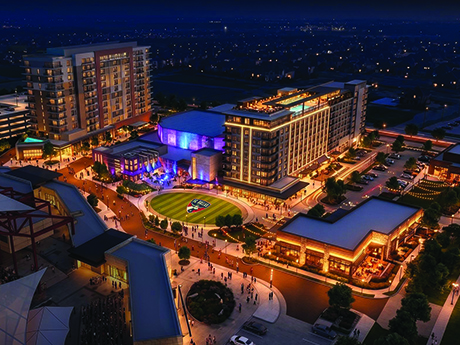
Hunt Sports Development, a group controlled by the Hunt Family, which owns the Dallas FC soccer club, just announced plans to build a mixed-use entertainment district at Toyota Stadium in Frisco, yet another massive, game-changing project for the thriving municipality.
Frisco is also the home of Fortune500 company Keurig Dr Pepper. Several other Fortune 500 groups have major corporate presences in the city as well, and Salinas says that the work being done within these office campuses is fueling a new wave of job growth and innovation within Frisco.
“Our corporate innovation and research-and-development centers have really become this diverse industry sector among Fortune 500 companies, including in financial services, food-and-beverage (F&B), tourism and sports,” Salinas explains. “In the past five years, we’ve seen rapid growth — about 80 percent — in digital and AI jobs, so that technology and innovation is driving a lot of the diversification. And that skill set can be applied to so many industries: supply chain logistics, F&B, finance.”
Tech As A Common Thread
In addition to Keurig Dr Pepper, Salinas identifies Toshiba, T-Mobile and Fifth Third Bank as examples of corporate users that are directly and indirectly contributing to fresh forms of job growth and industry diversification within Frisco.
“They’re all doing something a little different in corporate innovation, but they’re all incubating startups, looking at mergers and acquisitions and growing their corporate footprints through the technology and advancements that are taking place there,” Salinas concludes. “That’s opening up a lot of job opportunities in general and more specifically, the jobs of the future.”
Allen is similarly leaning into tech-oriented job growth as part of its efforts to diversify its industry, and Bowman believes this activity will be instrumental for Allen’s broader economic development.
“Fiberoptics and everything that goes into creating cabling, or even laying high-speed fiber — FiberLight just put their headquarters here, and the fiberoptic interconnects in those systems are being manufactured here,” he says. “We also had BMK Pharma put nearly $50 million into a building here, and now we’re seeing interest from pharmaceuticals because we have such good technical talent here.”
“Experian, the credit reporting agency, is one of our oldest employers, as is Jack Henry & Associates, which provides banks and credit unions with the software, payments and digital banking tools to operate more efficiently,” Bowman continues. “Moss Construction, which does solar panel installations and other huge commercial projects, just moved their Texas headquarters to Allen. The nice thing for our city council when we talk about projects coming in — or moving out — is that there’s no single industry that we’re vulnerable to because we have such diversity.”
Allen’s recent growth on the retail, restaurant and entertainment front has also been significant in attracting new residents and visitors via projects like The Farm, Chicken N Pickle and High 5 Entertainment.
“You can’t start with the end goal of bringing in the big office campus or employer without giving those people a reason to be here in the first place,” Bowman says. “So we’ve been very intentional in building out places like Watters Creek, which has 50-plus retailers and restaurants. The same goes for the offices, hotels and convention center with Billingsley and Sloan Corners and its parks, sports courts and dog parks — that has to be where you start.”
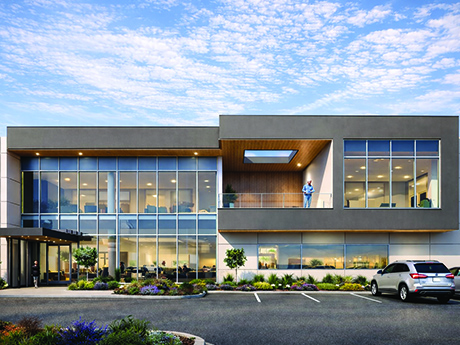
The Allen Economic Development Corp. sold the future site of Allen Place (pictured), a roughly 100,000-square-foot office and flex building that will be located along the U.S. Highway 75 corridor. Gillett Commercial is developing the project, which is envisioned as an ideal landing spot for technology users, on a speculative basis.
Mixing It Up
In Bonham, the city has been playing catch-up with regard to housing for the past several years. Myers says that Bonham “missed the housing boom that started in 2014 and 2015 but is now seeing the fruits” of recent efforts to grow and diversify its residential inventory.
Myers cites Powder Creek Ranch, a 400-acre master-planned development by Sanchez & Associates, as a leading example of the diversity of housing that Bonham is building. Slated to be developed in seven phases over 10 years, Powder Creek Ranch will ultimately feature some 3,000 new homes in a mix of single-family homes, townhomes, build-to-rent residences and traditional apartments.
Myers says that housing growth will largely support existing residents of Fannin County who work at Texas Industries’ semiconductor manufacturing plant in nearby Sherman, as well as employees of more local companies that manufacture products and systems that support data centers and similar ventures.
“We have two cable manufacturers that support electrical communications and high-tech industries, and we have Vector Systems and Northlake Controls, which provide data center parts,” Myers says. “And when you look at the tree of suppliers for global wafers, you see that direct connection. We have people here who work in that industry and are some of the most engaged community members who show up at network events and fundraisers and add to the local culture.”
In Grand Prairie, Otieno points to continued residential development in the Goodland area, including single-family and multifamily housing, as part of the broader growth taking place in the community. He says that this growth, alongside commercial and industrial investment, contributes to the city’s evolving economic landscape.
Otieno also mentions Mission Foods, in addition to the city’s established automotive and industrial manufacturing industries, as vital elements of Grand Prairie’s economic diversity.
“Firms such as Mission Foods, Poly-America, Flex-N-Gate and Lear enhance the robustness of our industrial and manufacturing sector,” he states. “Our goal is to continue to support the businesses that are already present while also attracting new investments that generate jobs and opportunities for future diversification.”
Otieno further points out the increasing activity within the logistics and distribution industry. He notes that Grand Prairie’s central connectivity and its role as a transportation hub are significant contributors to this expansion.
“You also can’t mention Grand Prairie without mentioning EpicCentral; just in that area, we have Topgolf and IKEA, and we continue to see businesses in healthcare, education and professional services contribute to employment,” Otieno adds. “We’re not trying to become one thing, but to build on the industries that are already strong and creating opportunities for future diversification.”
In Fairview, the larger expansion of the regional economy is translating into new commercial investment, housing and opportunities for residents.
At Fairview Town Center, Academy Sports + Outdoors has leased a significant portion of the former Macy’s space and is preparing to open, bringing renewed activity to the regional shopping destination. The recent opening of Children’s Health Specialty Center Fairview has also expanded access to specialized pediatric care for families across the region. A new office development along State Highway 5 is adding commercial space, while the Murray Manor residential addition is bringing 104 townhomes to the community.
Fairview is also part of the larger, aforementioned Sloan Corners development at U.S. 75 and State Highway 121. The mixed-use project envisions additional office, retail and residential development, positioning the town to participate directly in one of the region’s major emerging commercial districts.
Quinn says that these projects reflect a broader approach to growth that balances economic opportunity with community character, but also notes that the objective is not simply to grow alongside Allen and McKinney, but to make Fairview’s own contribution to the evolving North Texas economy.
Fairview’s Neighborly by Nature identity reflects that philosophy, connecting residents and businesses to the opportunities of a growing metropolitan region while preserving the natural surroundings, open spaces and neighborhood atmosphere that distinguish the town.
— This article originally appeared in the September 2026 issue of Texas Real Estate Business magazine.