

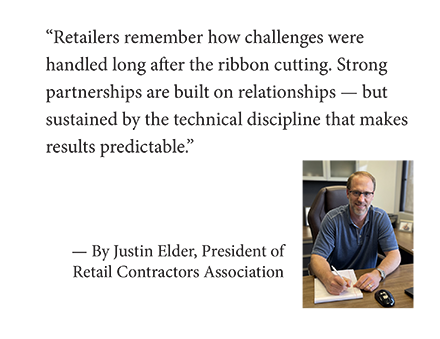
By Justin Elder, President, Elder-Jones, Inc., and President, Retail Contractors Association
Whether a retailer is opening a new location, refreshing an operating store, converting an acquired property or rolling out a new prototype, construction comes with variables. Permits move at different speeds. Existing conditions do not always match record drawings. Electrical gear, HVAC equipment, storefront systems and owner-furnished fixtures may carry long lead times. Late design or merchandising changes can ripple through procurement, sequencing and store-opening plans.
Those conditions may be unavoidable. Cost and schedule surprises often are not. The difference is disciplined preconstruction, clear decision rights, reliable project controls and a contractor who understands that the job site is also a retail environment.
During a roundtable discussion at a recent RCA Annual Conference, experienced retail contractors shared lessons from decades of work. Their central message was straightforward: strong relationships matter, but the best partnerships turn trust into a repeatable operating process.
Start with a technically complete preconstruction process
The most effective time to solve a construction problem is before crews mobilize. Retailers should bring the contractor into the process early enough to test the drawings against field conditions, procurement realities, operating requirements and the proposed schedule.
For remodels and conversions, that begins with due diligence. Depending on the scope, the team may need field verification of dimensions; selective demolition or exploratory openings; above-ceiling surveys; utility locating; review of electrical, plumbing, HVAC, fire protection, structural, and data capacity; and assessment of hazardous-material or environmental requirements. The goal is to identify where the documents rely on assumptions and retire as many of those assumptions as possible before the price and schedule are locked.
A formal constructability review should also reconcile architectural and engineering drawings with equipment plans, fixture packages, vendor requirements and landlord criteria. Prototype details that worked at a ground-up location may not fit an existing building. A contractor with retail experience can flag access limitations, clearance conflicts, shutdown dependencies, code-review questions and sequencing issues before they become Requests for Information (RFIs) or change orders in the field.
Retailers should expect preconstruction deliverables that are specific enough to manage, including:
- a scope-responsibility matrix identifying contractor, landlord, retailer and vendor obligations
- a baseline schedule tied to permits, submittals, procurement, owner-furnished equipment, inspections and turnover
- a long-lead log with required-on-site dates and release deadlines
- an allowances and exclusions log that makes pricing assumptions visible
- a risk register assigning an owner, mitigation plan and decision date to major open items
Build the schedule around retail operations
A construction schedule is not merely a list of trade activities. For a retailer, it must also account for revenue, customer access, associate safety, inventory, deliveries, loss prevention and brand experience.
On an open-store remodel, the retailer and contractor should jointly develop a phasing and logistics plan before work begins. It should show construction zones, temporary partitions, customer and employee circulation, emergency egress, loading and staging areas, delivery routes, debris removal and the sequence for returning completed areas to operations. Requirements for dust, noise, odor, vibration, housekeeping and after-hours work should be explicit — not left to field interpretation.
Utility and system shutdowns deserve their own plan. Electrical, domestic water, fire alarm, sprinkler, HVAC, refrigeration, data, security and point-of-sale interruptions may affect more than the immediate work area. Each shutdown should identify the affected systems, required notice, responsible parties, lockout or impairment procedures, temporary-service needs, testing, and the person authorized to restore the system. Retail operations, facilities, IT, loss prevention and merchandising may all need a seat at that table.
The baseline schedule should be supported by short-interval planning, typically a two- or three-week look-ahead so the team can see approaching constraints. A useful look-ahead does more than list upcoming work; it identifies what must be approved, delivered, relocated, shut down or inspected for that work to proceed. Retailers can then focus decisions on activities that affect the critical path or store readiness.
Make communication measurable
Retailers do not need a perfect project, but they do need early visibility. A weekly report should provide a consistent view of safety, completed work, upcoming activities, schedule variance, procurement status, inspections, RFIs, submittals, change events and decisions required from the owner. Progress photographs and an updated milestone forecast make the report more useful to stakeholders who are not regularly on site.
Decision authority should be documented at kickoff. The retailer should identify who may approve design clarifications, substitutions, schedule changes and added cost — and at what dollar or schedule threshold an issue must be escalated. Response-time expectations should also be clear. An RFI that sits unanswered for a week can delay work even when the field issue itself is minor.
The same discipline applies to change management. Before additional work proceeds, the team should document the condition, the contractual basis for the change, affected trades, cost breakdown, schedule impact, and any alternatives considered. When immediate action is required for safety or to protect the schedule, the parties could still record a not-to-exceed authorization and reconcile the final cost promptly. This keeps the change-order log from becoming a surprise at closeout.
Use contingency deliberately
Contingency is not a substitute for complete documents or careful investigation. It is a management tool for the uncertainty that remains. Retailers should distinguish between design contingency, construction contingency, owner-requested scope and contractor allowances so the team knows which risks each fund is intended to cover.
The appropriate amount depends on project type, design maturity, building age, subsurface or concealed conditions, schedule compression and procurement exposure. More important than choosing a universal percentage is maintaining a live contingency log that shows commitments, pending exposure, and the remaining balance. That visibility allows the retailer to make informed tradeoffs while there is still time to act.
Treat the contractor as a strategic partner — but verify the controls
Experienced retail contractors understand how construction decisions affect the business beyond the barricade. They can help evaluate alternate materials, prefabrication opportunities, off-hours sequencing, temporary conditions, multi-site rollout capacity and lessons that should be fed back into the prototype.
That strategic value is strongest when paired with objective performance measures. Across a program, retailers can track milestone reliability, safety performance, RFI turnaround, change-order cycle time, punch-list closure, closeout timeliness and recurring causes of cost or schedule variance. Post-project reviews should convert those findings into revised details, specifications, scopes and playbooks for the next location.
Finish strong — with a defined turnover standard
Perhaps the most memorable advice from the conference was also the simplest: “We’re always the favorite until we’re not, so finish strong.”
Substantial completion is not the same as operational readiness. Before opening or returning an area to the store, the team should confirm that life-safety systems have been tested, required inspections are complete, temporary protections are removed, systems are functioning as designed, the space is clean and secure and operations can safely stock, train and serve customers.
Closeout requirements should be agreed upon at the start of the project and tracked before the final weeks. Depending on the scope, the turnover package may include punch-list status, certificate of occupancy or final approvals, testing and balancing reports, commissioning documentation, equipment start-up records, training, warranties, attic stock, keys and access credentials, as-built drawings, operations and maintenance manuals, lien waivers and emergency and warranty contacts.
Retailers remember how challenges were handled long after the ribbon cutting. A project can encounter real obstacles and still be considered successful when the team communicates early, documents decisions, protects store operations, and closes every remaining obligation with urgency. Strong partnerships are built on relationships — but sustained by the technical discipline that makes results predictable.