

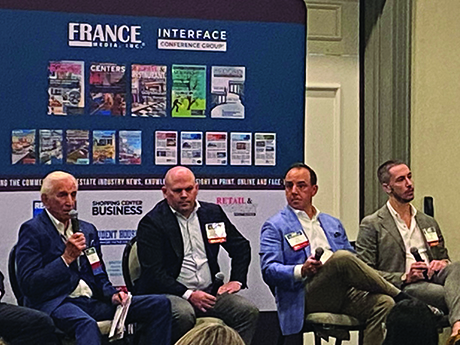
DALLAS — With all due respect to junior anchors, small-shop merchandisers and other inline tenants, it’s the users with the single biggest and smallest physical footprints that are fueling much of the growth within Dallas-Fort Worth’s (DFW) retail development landscape.
Anchors — specifically grocers — and pad users —particularly national companies — are the elements of new shopping center development that perhaps deserve outsized shares of credit in making new projects pencil. And at the annual InterFace DFW & North Texas Retail & Mixed-Use conference that took place on Sept. 15 at the Hilton Park Cities hotel, separate panels — one of actual owners and the other of brokers — spoke to this trend within the local development market.
It’s a narrative that’s fairly easily understood. Grocers represent inelastic consumer demand; pad users represent credit tenancy. Developing new centers without both of those elements is risky. Retail investors have and always will love grocery-anchored retail deals, which are bolstered by the metroplex’s steady population growth. And in these times of high construction costs and rising interest rates, developers have gained extra appreciation for pad sites as pieces of lucrative projects that can be split off and sold or developed as ground leases with high-credit tenants. Solving for those two variables goes a long way in balancing the larger development equation, and with a grocer and some high-volume, daily-needs pad tenants in place, rounding out the rest of the roster becomes much less daunting.
Editor’s note: InterFace Conference Group, a division of France Media Inc., produces networking and educational conferences for commercial real estate executives. To sign up for email announcements about specific events, visit www.interfaceconferencegroup.com/subscribe.
Speaking from the conference’s brokerage and leasing panel, Bob Young Jr., executive managing director at Weitzman, set the table for this piece of the retail development conversation by providing some numbers. Young said that Weitzman’s research projected that DFW would likely total between 4 and 4.5 million square feet of new retail space in 2026, but that these supply gains were “all the anchors.” His analysis was based on Weitzman’s tracking of activity at some 1,500 shopping centers of 25,000 square feet or more across the metroplex.
“There’s limited [small-] shop space, but it’s not a fear factor, but an opportunity to see a marketplace that will continue to thrive based on the commerce that exists here,” says Young.
Panelist Scott Rodgers, managing partner at Dallas-based brokerage firm DUWEST, immediately seconded that notion and took it a step further.
“Anchors are back and really driving growth in new construction, and it’s all great,” Rodgers said. “But even more than that, new construction — mostly [projects that are] sub-25,000 square feet —is being prompted across the street, down the road and catty corner to the anchor. So that parcel with two pads and two retail centers — there’s a significant amount of tenant demand there, because not everybody can afford to go to the anchored shopping centers.”
“Anchors are taking the bulk of the acreage, and there’s not much GLA [gross leasable area] adjacent to them,” Rodgers continued. “So that’s really prompted developers to look across or down the street and build new retail [space] there, and it’s leasing really well.”
The pad-site piece of the puzzle was represented on the panel by Will Harper, national real estate manager and head of new restaurant development at McDonald’s. The Chicago-based fast food giant, which owns most of the underlying real estate within its U.S. restaurant portfolio, could be considered the ultimate pad-site partner by virtue of its branding and credit.
Harper eventually shared with the crowd of several hundred industry professionals what he looks for when looking to open a new restaurant within a larger center, presumably as a pad-site owner/operator. But in segueing the conversation to him, moderator Craig Varney, CEO and partner at Houston-based Sundance Construction, first noted that Harper had previously told the panel that his site-selection strategy had recently evolved, and that anchor tenants were part of that evolution.
“You told us on our call that today you’re increasingly focused on power centers and strong daily-needs anchors,” Varney said. “Why?”
“We really need a lot of housing,” Harper replied. “And where does that housing go every day? To power centers and daily-needs stores. So we’re no longer going to those empty intersections with no co-tenancy. We are chasing rooftops, but we have to be more selective and strategic because we really need to be close to heavy retail.”
Herb Weitzman, the firm’s executive chairman, was also featured on the conference’s development panel. He took the opportunity to emphasize the level of diversity that exists within anchors in Weitzman’s Texas portfolio and to underscore the demand for big boxes and junior anchors, as well as the ground-lease potential that exists within those deals. But Weitzman also touched on the importance of the smaller product too, noting that his company typically does “about 80 pad [deals] per year,” across its development, asset management and leasing/property management verticals.
Others on the development panel discussed retail product as the beneficiary of capital flows, noting that the trend was even more pronounced within the grocery-anchored space.
“Anecdotally, capital really wants grocery-anchored [product],” said Blake Bickmore, vice president of development at Fort Worth-based owner-operator Trademark. “Across all our projects, we’ve raised between $300 million and $400 million in third-party LP [limited partnership] equity and debt. There was a lot of interest in these projects before we had grocers signed up, but not a lot of follow-through. But once grocers were signed, we had interest from capital partners to the point that we had to turn away people that we would have loved to have done deals with.”
Guy Grivas, vice president of the retail division at Hillwood, confirmed that his company is “predominantly focused on grocery-anchored centers across our portfolio,” adding that demand for the product type within the capital markets was a major impetus for that.
“We’ve watched a lot of capital shift into the grocery-anchored space,” added Tripp Russ, managing principal at Dallas-based investment firm 90Ten. “A lot of groups that we’ve competed with over the years are now less focused on core, high-street product and instead really focused on grocery-anchored assets. But that’s created opportunities for us. It’s hard to buy core product, but the tenant demand is incredibly robust.”