

By Chris Trosper, Opus
Omaha can look deceptively simple from a development perspective. Land appears plentiful, industrial vacancy remains tight and the metro continues to attract companies looking for modern space. But the amount of land that is actually ready for development is considerably smaller than a map might suggest.
The role of infrastructure
Omaha’s approach to infrastructure helps explain why. Sanitary and improvement districts, or SIDs, have helped extend roads, water, sewer and other infrastructure into developing areas for decades. They also help explain why land that is available is not necessarily ready for development.

Turning available land into a development-ready site can require significant time and capital, particularly when a SID and new infrastructure are involved. The process can take nine months to a year, and the commitment becomes even more substantial when a developer is contemplating a large tract that will be built out in phases over many years. Even experienced, well-capitalized developers have to be selective about when that investment makes sense.
For those that move forward, that upfront investment is reflected in the value of the development-ready land. A development-ready parcel may carry a premium over nearby undeveloped property because the time, cost and uncertainty involved in preparing the site have already been addressed.
The SID process therefore helps moderate the pace of development in Omaha. The metro has room to grow, but converting raw land into industrial inventory takes time, which can help keep new supply from getting too far ahead of demand.
Current market conditions bring that dynamic into sharper focus. Industrial vacancy remained below 3 percent during the first half of 2026, leaving fewer options for users with requirements that cannot easily be accommodated in existing buildings. Yet tight vacancy does not mean every available site should become a speculative industrial project. Once a viable site is available, the more consequential question is what kind of development best responds to demand in that location.
Different demand, solutions
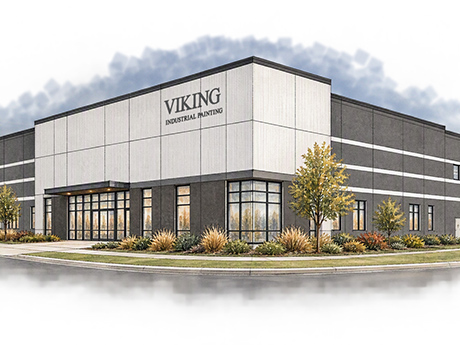
Two Opus projects underway in the same northwest Omaha industrial park illustrate how different the answer can be. Rainwood Industrial is a 272,000-square-foot speculative industrial building designed to accommodate a broad range of warehouse and distribution users. The other project is a 65,000-square-foot build-to-suit headquarters and operations facility for Viking Industrial Painting.
They are advancing in the same submarket and responding to the same broader market conditions, but the design and development strategies are fundamentally different.
For the speculative building, flexibility is central to managing the uncertainty inherent in developing without a committed tenant. The building can accommodate as many as six users, while its loading configuration can expand as tenant needs become known. Those decisions preserve optionality without attempting to anticipate every possible requirement.
An integrated design-build approach allows that flexibility to be considered from the outset. Development, design, engineering and construction teams can weigh marketability alongside constructability, cost and schedule as the building takes shape. Instead of designing the building first and pricing it later, the team can continually test decisions against both the market and the economics of the project. The objective is not to create a building for every possible user. It is to make deliberate choices that preserve flexibility where it matters.
A build-to-suit calls for a different application of the same integrated thinking. With a known user, the focus shifts from preserving optionality to determining how the real estate can best support the company’s operations and long-term objectives.
The 65,000-square-foot headquarters project in the same industrial park provides a great example. The company needed a new home base to accommodate its national growth, but the facility also presented an opportunity to address recruitment and retention. In addition to operational and warehouse functions, nearly 20,000 square feet is dedicated to office and employee areas, including a fitness center, locker rooms and a lounge-style break space.
In a build-to-suit setting, the value of design-build goes beyond customization. A user may know what they want from a facility without knowing how those priorities translate into square footage, cost or design. When development, design and construction expertise are engaged together, operational needs, workplace goals, budget and schedule can inform one another while decisions are still fluid. The process helps distinguish features that create meaningful value from those that may add cost without advancing the business objective.
Start with the business need
Integrated thinking can begin even earlier, before a company has determined what form its real estate solution should take. In a market with limited existing inventory, a user may assume that building new is the only alternative. Another may dismiss a build-to-suit because of the perceived time, capital or complexity involved. Neither conclusion should be reached before the options have been tested.
Starting with the business requirement rather than a predetermined real estate solution allows an integrated team to evaluate existing buildings, speculative space and build-to-suit opportunities against the same operational, financial and schedule considerations. Early design and construction input can establish what is feasible without requiring a company to advance a full design or commit to a site before it understands the implications.
Omaha’s infrastructure environment makes this kind of early evaluation especially useful. Site readiness cannot be taken for granted, and limited existing inventory can further constrain a user’s alternatives. Understanding those conditions alongside building requirements, cost and schedule provides a clearer path to the right solution.
Omaha’s development environment has always required patience. SIDs add time and complexity, but they also contribute to a market where development-ready land is more limited than it appears and new supply tends to arrive deliberately.
The advantage in this environment is not simply the ability to build speculative space or deliver a build-to-suit. It is the ability to recognize what a particular opportunity calls for and bring the right expertise to it from the beginning.
Chris Trosper is senior director of real estate development with Opus. This article originally appeared in the October 2026 issue of Heartland Real Estate Business magazine.