

Major multifamily markets in Texas, beleaguered by an onslaught of supply as developers chased new renters moving to the state during the COVID pandemic, are beginning to see signs of recovery. But it’s one that looks dramatically different not only between cities, but also from one submarket to the next.
Rents are roughly flat in Dallas and remain below year-ago levels in Austin, Houston and San Antonio after two to three years of decline, says Patrick Strake, managing director with Franklin Street. And depending on the submarket, apartment renters are jockeying for, and receiving, significant concession packages relative to the rest of the United States, he adds. According to the Federal Reserve Bank of Dallas, those include six to eight weeks of free rent (and as much as 10 to 12 weeks in some submarkets).
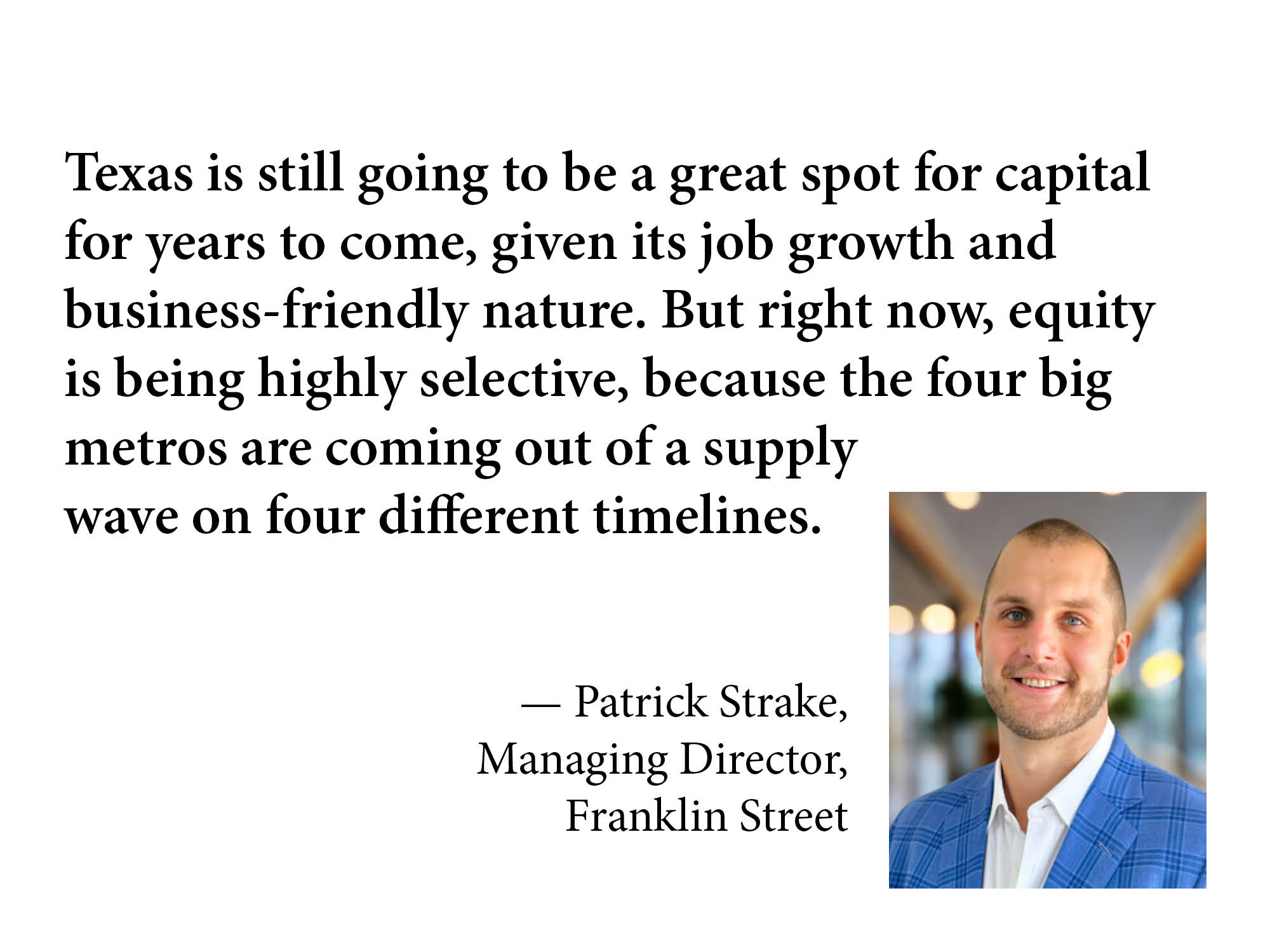
“Texas is still going to be a great spot for capital for years to come, given its job growth and business-friendly nature,” adds Strake, who is based in Austin and leads Team Texas, the firm’s statewide multifamily investment sales platform. “But right now, equity is being highly selective, because the four big metros are coming out of a supply wave on four different timelines.”
Hardest Hit
The good news is that apartment construction has declined across markets in Texas, Strake says. Statewide, deliveries are forecast to fall from roughly 93,000 units in 2025 to fewer than 35,000 this year, according to the Texas Real Estate Research Center at Texas A&M University. Unfortunately, a sizable glut persists in Austin and San Antonio, two cities that experienced the most rampant construction activity. In Austin, for example, developers delivered roughly 29,000 units in 2024 and 30,000 units in 2025, according to Yardi Matrix. As of May 2026, year-over-year construction starts had dropped by 71 percent.
What’s more, the higher interest rate environment has made it difficult, if not impossible, for developers to refinance the low-cost loans prevalent before 2022, whether they used the debt to acquire an existing project or to develop a new community. Owners who may have been hoping for lower interest rates to provide a bump in property values to foster a refinance or provide more pricing power in a sale will need to become more pragmatic, Strake points out.
Stress is building among landlords in San Antonio, as well, especially as lenders tire of extend-and-pretend loans that can’t be refinanced and operations continue to decline due to new supply coming online. Meanwhile, although Houston didn’t see quite the same ramp-up in supply as Austin and San Antonio, investors are still looking for discounts in the market, where the dynamics can change block by block due to the lack of zoning, Strake says.
“It takes real motivation, either debt or operational exhaustion, to sell in these markets right now,” reports Strake. “You either bought at the right price and moment and can still return equity to your limited partners; you’re fatigued with management expenses, taxes and insurance; or your loan is making the decision for you. The owner who calls a year before maturity has options.”
Meanwhile, owners holding fixed-rate agency loans originated between 2019 and mid-2022 may be sitting on a second asset, Strake adds. Those loans often carry interest rates below 4.5 percent and can be assumed by a buyer, which helps offset today’s higher borrowing costs. “If you own an assumable loan at 4 percent or below, that loan should lead the offering,” he says.
Investor Calculations
While a decline in new apartment construction may pique buyer interest in Austin and San Antonio, Strake adds, in order to execute a deal, they need to feel comfortable with an asset’s basis, its age, quality and capital needs, the current loan and the submarket’s fundamentals.
Many deals being facilitated by Franklin Street involve properties built over the last five to six years that are suffering from economic vacancy, Strake adds, which is rent loss due to concessions, delinquent rent payments and similar factors other than occupancy. When considering whether to buy newer assets in urban environments, investors are comparing price to replacement cost and are weighing the rate at which concessions and bad debt in the submarket are burning off. In suburban markets, investors are typically underwriting deals based on true trailing 12-month performance, he says.
“You are seeing economic vacancy start to improve in certain pockets of Austin, and if it’s the right deal, buyers will make the leap,” he observes. “But they’re still cautious. They’re underwriting whether the trailing 12 months is the floor.”
Of all the major markets, investors are displaying the most conviction in Dallas due to its robust job and population growth as well as its diversity of apartment product, he says. Additionally, Dallas experienced a more modest construction boom over the past couple of years compared to Austin relative to total inventory, Strake says. While absorption varies by submarket, the metro continues to see strong renter demand amid a reduction in new construction starts compared to the previous two years.
“Dallas leads the pack in terms of what investors are looking for these days,” Strake says. “It has performed steadily through the supply wave, and there is a lot more capital in the market positioned to go after deals.”
The Risk Next Door
Still, regardless of market, potential buyers of Texas apartments with a property and price in mind are wary of the chance that nearby assets may recapitalize or sell at a lower basis. As a result, Franklin Street has begun to track the capital stacks of multifamily properties to assess the risk in such situations.
“For me, that’s the biggest exposure for groups currently operating or coming into Texas markets,” Strake states. “If the basis has dropped for a new operator next door, they have the ability to adjust their operations, rents or concessions to better compete for renters. You can buy the right asset at the right price and still get undercut by your neighbor’s capital stack position.”
For owners weighing when to sell, Strake advises preparing now rather than waiting for the recovery to show up in the numbers.
“The next few years should bring improvement for the market, and the owners who are ready first will face the least competition,” he says. “By the time the rent growth is in the trailing 12, every owner who waited is listing at the same time.”
— By Joe Gose. Franklin Street is a content partner of REBusinessOnline. To learn more about Franklin Street, click here.