

By Taylor Williams
It’s common knowledge that data centers, specifically those that are developed to support AI (artificial intelligence), require tons of power, and that a deregulated, independent electrical grid has made Texas an attractive market for these projects. What may not be as well-known is just how far developers and end users of these facilities will go to maximize that electrical capacity at their sites.
Indeed, the power factor has more or less inverted the standard site-selection process for the asset class since the AI boom got underway.
“Several years ago, deals would start with colocation companies or end users specifying where they needed to be and resolving to figure out the power situation later,” says Phoebe Bernet, associate within the data center solutions group in CBRE’s Dallas office. “Today, it’s the opposite — groups go where the power is and figure out the rest later. There are quite a few obstacles that groups will work around if there’s power at a site.”
Alternative, outside-the-box methodologies that deliver power to data center sites outside of the existing infrastructure are typically referred to within the industry as “behind the meter” solutions. The degree to which sites have features in place that can support the generation of supplemental power may ultimately determine whether or not the site is deemed viable. And whether that power arrives from burning fossil fuels or through renewable energy sources is largely irrelevant, so long as it arrives.
Tom Kruger, principal in the Los Angeles office of Dallas-based architecture firm Corgan, is one of the company’s studio leaders for data centers and has been involved in several such projects in Texas. Kruger says that the fact that Texas is a major supplier of fossil fuels — as well as a state with a strong presence in the wind and solar energy spaces — has been instrumental in allowing developers and end users to capture “stranded” power.
“There’s a lot of stranded power in Texas. For example, as part of the oil extraction process, natural gas has to be burned off, and instead of burning it off into the atmosphere, some groups are attaching turbines to it and turning that into power for the data centers,” Kruger explains. “It wasn’t feasible to build the infrastructure to tap into that power before because many of the sites are so remote.”
“There are also several campuses that have solar fields dedicated to them,” Kruger continues. “Those are easier to build; there’s more available land to support them, and a lot of them are already generating their own off-grid power, reducing their reliance on the main grid. Practices like that are more common in Texas than most other places.”
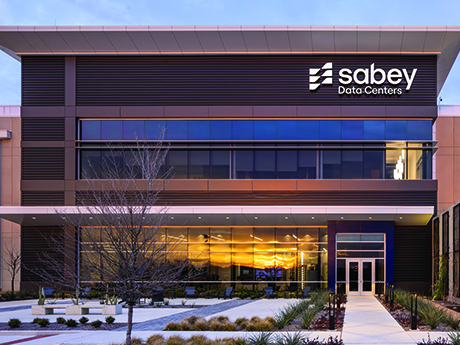
Pictured is one of the facilities of Sabey Data Centers, a Seattle-based owner-operator, at the company’s 84-megawatt, 603,000-square-foot campus in the northern Austin suburb of Round Rock. Sabey is a joint venture between Sabey Corp. and National Real Estate Advisors.
Natural gas in particular represents a shift in site-selection requirements for the asset class that is a direct result of rapid growth in the AI business.
“Having natural gas onsite used to be a no-no,” says Chris Herrmann, executive vice president within the aforementioned data center solutions group at CBRE. “In the past, if a gas line was found on the site, it was considered a risk factor, and the site would be nixed. Pockets of large power loads are few and far between, so at a certain point, site selection becomes a question of generating more power. And if there’s a generation story to be told [with a site], that’s an important consideration.”
Herrmann’s partner in the data center solutions group, Brant Bernet, who also holds the title of executive vice president, says that while establishing supplemental power sources upfront is crucial to getting projects off the ground, most groups ultimately want to be able to plug into the grid.
“Everybody is trying to find alternative ways to generate and provide power because these facilities need power 24/7,” Bernet says. “But if it’s not windy, you don’t get power from that source; the same applies to solar at night or when it’s cloudy. Battery systems won’t hold the charge long enough to be the ultimate answer, so most of our existing and prospective clients that are looking for power want to be connected to the grid. Even with a ‘behind-the-meter’ solution, most of the big hyperscalers want to know that there’s some pathway to getting grid power.”
The CBRE team identifies some other site-selection factors that have changed dramatically as part of the quest for power.
“We used to say we’d never put a data center next to an active airport runway; today they’re near every airport,” says Brant Bernet. “Same with being close to the Gulf [of Mexico] — there’s available power there, so at some point, the risk of a hurricane may be trumped by the ability to get that power.”
“Groups are looking at every step of the process to increase power efficiency however possible because speed to market is so important,” confirms Kruger. “Some projects are also already producing power through their own means to supplement the grid. These developers are very forward-thinking. They see the writing on the wall and know that they have to get ahead of any impacts to the grid and look for ways to minimize them whenever possible.”
Bernet and Herrmann acknowledge that meeting demand for power through alternative means adds more complexities and challenges to closing data center deals. That endeavor is even further complicated by the fact that speed to market is a top priority for data center developers and end users.
“It’s a race, not only the United States against China and others, but also among the hyperscalers,” says Bernet. “Speed to get sites, get power, be energized, build and put electrons in and out — it’s a feeding frenzy, and the faster you can get there, the better.”
“We certainly classify speed to market as [a] core priority,” adds Ali Greenwood, executive director of the global data center advisory group within Cushman & Wakefield’s Dallas office. “In most ways, that is a challenge across the country on every project and requirement. From a standpoint of opportunity, it means that the more advanced, highly vetted and qualified projects rise to the top and have a high propensity of moving forward. Expertise and patience are key.”
Other Considerations
Sites for AI-specific data centers tend to be larger than those of their “traditional” counterparts and to be located in more remote areas. Among those that have been announced in Texas in the past couple years and that fit that particular bill are:
• Soluna Holdings’ 397-acre project in West Texas’ Briscoe County that is located adjacent to Soluna’s 150-megawatt Briscoe Wind Farm
• Meta’s $14 billion, 1 gigawatt campus in El Paso, which the tech giant is developing via a joint venture with BlackRock
• Rowan Digital Infrastructure’s 700-acre, 300-megawatt hyperscale campus in the Central Texas city of Temple
• Microsoft’s $400 million project in Castroville, about 25 miles west of San Antonio
• Vantage Data Centers’ campus in the West Texas city of Abilene, which is estimated to span 1,200 acres and have a total electrical capacity of 1.4 gigawatts
Whereas traditional data centers tend to be clustered within a couple hundred miles of major metropolitan areas to better draw from labor pools or leverage existing infrastructure, with AI-oriented centers, those concerns — like most everything else — are secondary in importance to power. For this reason, sources say, modular construction is often employed with the new breed of centers as a means of offsetting high construction costs in areas with minimal labor.
The process of cooling servers is another utilities-based aspect of this asset class that has been subject to scrutiny. Traditional data halls have historically relied heavily on air-based cooling systems, like fans, to keep racks and other equipment from overheating. Because of high rack densities associated with AI workloads, the sector is now seeing greater adoption of liquid-cooling systems, including closed-loop systems that recirculate water through the cooling infrastructure, which adds to the overall power requirement.
Kruger says that another key feature that differentiates traditional versus AI data centers is the weight and sophistication of the racks.
“Traditional racks aren’t as heavy, which makes it more feasible to build higher, multi-story buildings. AI rack configurations are evolving all the time and becoming increasingly dense and heavy,” he explains. “So typically AI centers are single-story and keep everything on the lower level, keeping critical equipment at grade to provide for greater flexibility as rack densities continue to increase.”
Sources say that sites that include wetlands or are partially situated within floodplains are considered problematic; the same applies to sites in coastal markets that could potentially be damaged by hurricanes or tropical storms. Proximity to rail lines that transport high volumes of hazardous materials is another consideration.
Every case is different. But so strong is the power factor in making these projects realities that groups are showing a willingness to push forward in the face of some of those hurdles if the electrical capacity is there.
Looking Backward & Forward
Texas made big news in the data center world in late September when Gov. Greg Abbott issued a moratorium on approving new data center projects until the entity that manages the grid, the Electric Reliability Council of Texas (ERCOT), could conduct an audit of these facilities’ impacts.
The official press release behind the order directed ERCOT and the Texas Public Utilities Commission (PUC) to “audit all data centers undergoing ERCOT’s interconnection process so their development does not compromise the reliability of the Texas electric grid and does not put Texans’ natural resources at risk.”
Bernet and Herrmann both say that given the sheer volume of requests for electrical capacity across all Texas data centers in various stages of development, the state’s decision to hit the pause button was understandable. The duo provides some basic numbers that better illustrate just how much the data center boom of recent years has changed the game with regard to demand for power.
“When 2022 hit, everything started changing very quickly,” Bernet says. “In Dallas, up until that year, we had an average annual absorption — or leasing — rate of about 35 megawatts per year. In 2022, it was closer to 300 megawatts, and that figure hasn’t slowed since then.”
“We have about 100 to 110 gigawatts in the grid with ERCOT,” adds Herrmann. “Groups would go through the process of applying for large loads for these projects, and when that was halted by the PUC, there were almost 500 gigawatts of requests in the queue — five times the amount of power in the entire grid. That’s impossible to accommodate.”
The CBRE team believes that the moratorium could also provide better transparency in terms of allowing the public to become better informed about how AI-driven data centers get approved. Because even with a pause in place, in the Dallas-Fort Worth (DFW) metroplex alone, the new projects that were approved pre-moratorium represent enormous growth and are backed by extremely healthy demand.
“Just in the DFW colocation market, we’re currently building twice as much [product] as what’s existing on the ground,” says Herrmann. “Over the next two years, it’s going to essentially triple in size relative to what’s been built up over the past 20 years, and those facilities are 98 percent leased. The demand is there, and it’s hard to see it slowing down.”
— This article originally appeared in the October 2026 issue of Texas Real Estate Business magazine.