

By Abby Cox
The Great Greek’s national footprint can be traced back to a much smaller setting: two neighbors in Las Vegas, a shared idea and a small Greek restaurant that was about to become something bigger.
One brought three generations of restaurant experience to the table; the other, a background in real estate and business. Thus, in 2015, Nick Della Penna and Trent Jones began discussing the possibility of opening a restaurant together.
Their idea took shape when they discovered a small Greek restaurant in Henderson, Nevada, whose owners were looking to sell. They saw an opportunity in the concept and took over the 1,400-square-foot restaurant in January 2016, building on its Greek-inspired menu while bringing their own restaurant and business knowledge to the operation.
What started as a neighborhood restaurant quickly became a growth opportunity. The partners opened additional Las Vegas locations before turning to franchising, eventually partnering with United Franchise Group to take The Great Greek beyond its Nevada roots.
Today, the search for the right space has become part of The Great Greek’s growth story, creating a full-circle connection between the restaurant concept and the real estate expertise that helped launch it.
“The Great Greek has evolved since our first restaurant, but in many ways, it has stayed the same,” says Bob Andersen, president of The Great Greek. “We’re still focused on providing fresh, delicious food and an upscale, standout guest experience, and those values have held true as we’ve expanded into an international brand.”
The Road to Expansion
For fast-casual concepts, choosing a location is about far more than finding an available space with the right square footage. The restaurant has to fit into the rhythm of the surrounding community — its traffic patterns, demographics, daily routines and, increasingly, its future.
For The Great Greek Mediterranean Grill, site selection is an exercise in looking beyond what is immediately visible. A promising shopping center might have strong traffic counts, but the bigger question is what traffic actually looks like and whether it aligns with the restaurant’s consumer.
“When we look at a traditional [shopping] center, we really want to see a dynamic trade area where people are living, dining and working,” says Andersen. “Ideally, we’re looking for a center that is prominent and high performing, because that’s what our customer wants.”
A restaurant can have a great menu and a recognizable brand, but customers still have to find it — and, just as importantly, want to come back.
That experience, however, doesn’t begin and end at the restaurant’s front door; the surrounding environment plays a role in shaping how shopping center patrons perceive the brand, too.
“We consider our food as a highly elevated, fast-casual experience, and we want the shopping centers to meet that same profile for our guests,” continues Andersen.
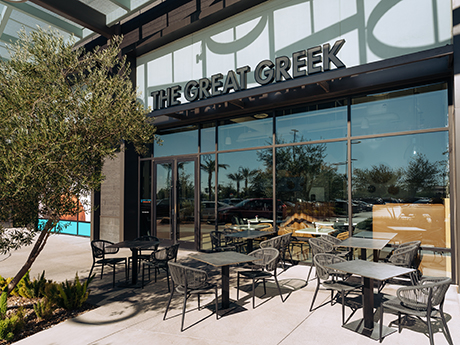
Beyond the restaurant’s aesthetics, Andersen explains that The Great Greek emphasizes functional attributes like strong visibility, convenient access, ample parking and a well-maintained environment.
For the fast-casual restaurant sector, those seemingly small details can have a monumental impact.
In addition to its operational characteristics, The Great Greek has established a flexible footprint, says Andersen. While a traditional store ranges in size from 1,700 to 2,000 square feet, the Mediterranean restaurant is also located at special venues like T-Mobile Arena on the Las Vegas Strip and inside Pierpont Commons food hall on the University of Michigan’s North Campus in Ann Arbor, as well as select endcap or notable inline locations.
Looking Beyond the Storefront
Part of Greek cuisine’s appeal is its ability to meet people where they are. Its flavors are familiar without being confined to a single audience, and Greek food has a broad cultural reach that extends well beyond Greece itself. In fact, Mediterranean cuisine is the primary cuisine in 23 countries — such as Italy, Morocco, Spain, Portugal, Cyprus and Croatia — underscoring the category’s ability to transcend cultural boundaries and appeal to a wide range of consumers.
“We have a natural identification with our type of food, and it’s really easy and simple to understand,” says Andersen. “So, we’re able to attach our brand to many different types of demographics and groups of people.”
But for restaurant tenants, the question is therefore not simply how much traffic a center receives, but where that traffic comes from and how it moves through the property.
“My parents used to say, ‘You are who you hang around,’ and it’s the same with a business, so we often want to partner ourselves next to brands who also have high levels of expectations for their company and customers.”
Andersen notes that specific co-tenants such as Starbucks Coffee, Chipotle Mexican Grill, Panera Bread, Whole Foods Market, Sprouts Farmers Market and Costco are highly effective at supporting traffic and customer alignment for The Great Greek.
The value of those relationships, however, extends beyond foot traffic. The right co-tenants can help attract consumers whose expectations already identify with the brand.
For these consumers, value is not necessarily about finding the lowest price, but about understanding what they are getting in return — high-quality ingredients, generous portions and a presentation that is as appealing to the eye as it is to the palate, notes Andersen.
The appeal also goes beyond flavor and presentation. The Mediterranean diet is widely recognized by health and nutrition experts as a beneficial dietary regimen, giving restaurants built around its ingredients another point of connection with increasingly health-conscious consumers.
Where Real Estate Meets Relationships
Locating the right site is only half the equation. For The Great Greek — which has built its growth strategy around franchising — the search is increasingly about finding the right real estate partners to help turn that pipeline into restaurants.
Andersen says the brand’s growth is currently being constrained less by franchisee demand, and more by the availability of sites that meet its requirements.
“What we need from developers and landlords is more inventory. We’re only limited in our growth by the number of sites we can acquire now.”
That need comes as The Great Greek continues to expand its franchise network. The brand opened 20 new restaurants in 2025 and reported a 41 percent year-over-year increase in franchise sales. In the first half of 2026 alone, it signed 20 domestic franchise agreements, including four multi-unit development agreements, representing 30 future restaurants across various markets, while also securing its first franchise agreement in Massachusetts.
The brand’s development activity features six locations in Nassau County, New York; five locations in Dallas, Texas; three locations in Naples, Florida; five locations spanning Omaha, Nebraska, and Sioux Falls, South Dakota; two locations in Bakersfield, California; and single locations in Dothan, Alabama; Reading, Massachusetts; Charlotte, North Carolina; Boynton Beach, Florida; Rocklin, California; Suffolk County, New York; and additional locations in New Jersey, California and Indiana.
Building on its international growth strategy, the brand also signed a master franchise agreement covering Guyana and several Caribbean countries, further strengthening its global development pipeline.
Internationally, The Great Greek opened its first restaurants in Australia and Egypt while continuing to expand its presence in Canada with an additional location. With these openings and a robust pipeline of new development, The Great Greek Mediterranean Grill is on track to surpass 100 open and operating locations by the end of 2026 — another milestone for its 15th anniversary year.
But ultimately, that growth depends on more than franchise demand. Every new franchise agreement eventually has to become a physical restaurant, and every prospective franchisee needs a site that can support the brand’s operating model.
For Andersen, the property itself is only part of the equation; the people behind it matter, too. The way a site is maintained and presented, how a landlord communicates and how willing they are to adapt can all influence whether a space feels like the right fit.
The restaurant needs a site that can support its business, while the landlord needs a tenant capable of generating consistent traffic and contributing to the center’s overall mix.
Putting the Pieces Together
What began as a small neighborhood restaurant has evolved into a brand with scale and credibility to pursue opportunities that once may have been out of range.
“We have the reach now for significant sites that put us in a much better position to respond to developers and landlords who want to have The Great Greek in their centers,” says Andersen.
There’s no single formula for a successful restaurant site. A strong location might have excellent visibility, a growing residential population and complimentary tenants, while another might succeed because of its proximity to offices, a grocery anchor or a major intersection.
What matters is how those pieces come together — and whether they create a place customers can easily find, conveniently reach and ultimately want to return to. For The Great Greek, that equation will continue to change as the brand enters new markets and evaluates new opportunities.
“Today, as a $100 million brand approaching 100 locations, we’ve grown our team, expanded our marketing and operational capabilities, launched a mobile app and optimized processes that make our business run smoothly for franchise owners while yielding strong unit-level economics,” says Andersen.
In restaurant real estate, the storefront may be where the story begins, but the real measure of success is found in everything that happens beyond its doors.
This article originally appeared in the November 2026 issue of Shopping Center Business magazine.