

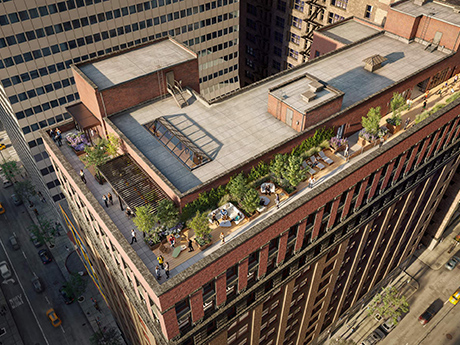
The number of underutilized office buildings being converted into apartment units continues to steadily rise, largely due to the acceptance that the post-COVID hybrid work format is here to stay. At the start of 2026, the national office-to-apartment conversion pipeline reached 90,300 units, up 28 percent year over year and nearly four times larger than in 2022, according to RentCafe, a sister company of Yardi Matrix.
Office conversions now account for almost half (47 percent) of all planned adaptive reuse projects nationwide (roughly 90,300 apartments out of 193,900 planned projects).
Behind New York City and Washington, D.C., Chicago ranks third on the list for the largest office-to-apartment conversions pipeline, according to RentCafe. Cleveland and Cincinnati round out the top 10. Five other Midwest markets — Detroit, Minneapolis, Kansas City, Milwaukee and St. Louis — are included in the top 20.
These cities are deploying combinations of tax-increment financing (TIF), local tax abatements, Housing Trust Fund dollars and historic tax credits to support office conversions in their downtown districts, says Al Fiesel, commercial business unit leader at Chicago-based LJC Design & Engineering.
“The specific tools differ by market, but the underlying premise recognizes that public participation is the mechanism that makes these projects viable.”
For Fiesel, Chicago is perhaps the most aggressive and well-resourced example of what a coordinated public strategy can look like. The city’s LaSalle Corridor Revitalization is a building-specific plan to transform a stretch of the Loop by combining TIF dollars, direct city subsidies and streamlined approvals designed to reduce the time and cost of entitlement.
As of January 2026, more than $315 million in TIF has been approved by the Chicago City Council for six projects, representing more than $900 million in total investment and encompassing 1,765 units. Thirty percent of the apartments will be designated as affordable for residents earning an average of 60 percent of the area median income.
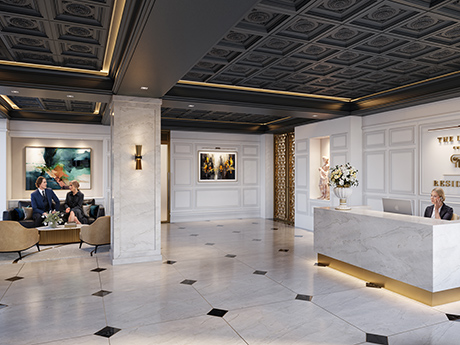
LJC is the architect for The LaSalle Residences in Chicago. The building’s office floors are being converted into 167 apartment units that will be integrated within an existing hospitality footprint. (Rendering courtesy of The Prime Group Inc. and Walk the Room)
LJC is the architect for one such project at 208 S. LaSalle St. The building, designed by architect and urban planner Daniel Burnham and completed in 1914, is being transformed into The LaSalle Residences by Chicago-based developer The Prime Group Inc.
Rather than a straightforward office-to-residential conversion, the project is being integrated into an existing hospitality footprint. The JW Marriott Chicago hotel occupies the lower floors, while The LaSalle Chicago, Autograph Collection hotel anchors the upper levels.
LJC helped reimagine the office floors in between as 167 apartment units and 74 additional hotel rooms for The LaSalle Chicago. Residents will have access to the amenities and services of the hotels.
“The building’s architectural legacy boasts extraordinary craftmanship, soaring ceilings and generous window lines that will produce a residential environment that no new construction can easily replicate,” says Fiesel. “But the building’s heritage is more than a design asset. Its historic designation unlocked tax credits that formed a meaningful layer of the project’s financing.”
The LaSalle Residences is a perfect example of the collaboration needed among a city, developer and design team, emphasizes Fiesel. “The building’s bones made it worthy of investment; the financing structure made it feasible; the mixed-use programming made it distinctive; and the public commitment to the corridor made it possible.”
How to manage costs
Using existing buildings for adaptive reuse or renovation typically costs 15 to 30 percent less per square foot than new construction, according to Mark Schwamel, regional director in the Chicago office of architectural firm Ware Malcomb. That’s a bonus in today’s building environment, which is limited by a high cost of capital and rising construction costs.
Reusing a building in a favorable location is a huge advantage because the site already has value, says Schwamel. “Even if a new project could look more modern, it won’t instantly have the same neighborhood connections, easy access to transit or the recognition that comes with a truly timeless architectural landmark,” he says. “Visibility, foot traffic and a sense of place take years to build from scratch.”
Ware Malcomb is designing the first project under the LaSalle Street initiative, 79 W. Monroe St. Constructed in 1905, the historic Rector Building is the oldest surviving commercial structure designed by Chicago architect Jarvis Hunt.
The renovation project involves transforming seven of the building’s 14 floors into 117 units, 41 of which will be designated as affordable, as well as an upscale lobby and indoor-outdoor amenity floor. Ware Malcomb is working with developer R2 Cos., building owner Lagfin, Leopardo Construction and GMA Construction Group to deliver the project this year.
In qualifying for the city’s LaSalle Street program, the project captures meaningful public funding while also reducing long-term property tax burdens — two factors that significantly strengthen the overall feasibility of the conversion, says Schwamel.
Despite reusing property, adaptive reuse projects can be very costly because of the level of detail required to complete a successful redevelopment. Most are financed in large part with historic state and federal tax credits.
“Without these additional incentives, the burden and financial gap to cover is often too large,” says Mike Krych, senior design leader and development managing partner with BKV Group in Minneapolis.
Minneapolis is a city that has incentivized office-to-residential conversions by instituting a policy that allows projects to bypass certain inclusionary zoning policies, according to Krych. This expedited administrative approval enables a project to get to market faster than a public hearings process and can shave anywhere from three to six months off an entitlement process.
At the state level, Krych notes lobbying efforts to pass a CUB (Conversion of Underutilized Buildings) tax credit bill to help with the redevelopment of vacant office and commercial buildings.
Schwamel says he always recommends layering in historic tax credits for office conversion projects. The federal platform provides a 20 percent credit for qualified rehabilitation costs on certified historic buildings. On the local side, 37 states offer their own credit (often 20 to 25 percent), which can be sold to investors to raise upfront equity.
According to Fiesel, the most common approach is what is often referred to as “lasagna financing.” This deliberately layered capital stack combines multiple funding sources to achieve viability, he says.
“A typical capital structure might stack tax-increment financing or tax abatements from the municipality with federal or state historic tax credits, low-income housing tax credits where affordability is part of the program and special revitalization grants tied to broader economic development goals. Each ‘layer’ addresses a different piece of the gap,” explains Fiesel.
A developer’s checklist
In addition to supportive local policies, the feasibility of an office adaptive reuse project depends on the right purchase price and a building that is well suited for conversion, says Ersal Ozdemir, founder and owner of Keystone Group in Indianapolis.
“The best candidates are buildings in strong locations with solid structural integrity, generous ceiling heights and efficient, shallower floor plates that allow natural light to elevate interior spaces,” he says.
While multifamily is often the most natural solution for an office conversion project because many urban cores need more housing, it is not the only answer.
“The key is understanding what the market is telling you and identifying the most impactful use for each building rather than applying a one-size-fits-all solution,” says Ozdemir.
For example, the InterContinental Indianapolis is Keystone’s most recent redevelopment project. It involved the restoration of a century-old office tower into a 170-room luxury hotel on Monument Circle within the heart of Indianapolis.
The $120 million project required extensive historic restoration efforts while integrating modern hospitality infrastructure, including multiple dining concepts and a new floor with a rooftop.
Nearby, Keystone is completing 220 Meridian Tower Residences, the conversion of an office tower into 273 luxury residences. Construction commenced on the former AT&T office once the tenant’s lease expired in May 2025.
Adaptive reuse projects can be more complex than ground-up developments because there’s always the possibility of discovering unknown conditions once work begins. At the same time, since the primary structure is already in place, that eliminates the time and cost associated with foundations and building the structure, says Michael Sinickas, project manager with Chicago-based McHugh Construction.
“With thorough preconstruction planning, timelines can be comparable to ground-up development, but the process requires more upfront investigation and coordination,” he adds.
McHugh is currently converting the historic art deco office tower at 65 E. Wacker Place in Chicago into 252 apartment units on behalf of Mavrek Development. The project required extensive preconstruction work to map structural beams, locate risers and integrate new mechanical, electrical and plumbing systems within the existing building, according to Sinickas. The property was originally built in 1928 as the Millinery Mart Building.
Ware Malcomb recommends a thorough due diligence report that examines an office building inside and out for every client or developer it partners with on these types of projects. The first step is checking the depth of the building’s floor plates.
“Office buildings typically have very deep floor plates to maximize expansive, open-plan workspaces, making it difficult for efficient residential layouts,” says Schwamel. “Office buildings around 60 to 65 feet wide are considered ‘Goldilocks’ because they allow for units with good depth and access to windows.”
Additionally, turn-of-the-century buildings are beneficial because they have generous floor-to-floor heights, adds Schwamel.
“A floor-to-floor height of 14 to 16 feet is preferred. This extra 1 to 3 feet of headroom (versus new construction) is necessary to accommodate new residential-grade HVAC ductwork, unit plumbing for kitchens and bathrooms and fire sprinkler systems without sacrificing living spaces.”
The final item on the checklist is to review unit layouts to ensure adequate space for vertical plumbing lines and individual electrical subpanels.
What about the future?
While the concern of empty office buildings and their impact on a city’s larger ecosystem with retail and restaurants is legitimate, sources say the solution is not to simply fill downtown buildings with offices again. The key lies in diversification.
“Hybrid work is here to stay; companies are streamlining their real estate portfolios to improve efficiency and lower leasing expenses,” says Schwamel. “Downtowns that thrive will be those that diversify their economic base. Adding residents creates steady, 24-hour live-work-play environments beyond downtowns that empty at 5 p.m.”
In Chicago, for example, a shortage of housing is pushing rents higher, limiting who can afford to live downtown and weakening the customer base that downtown restaurants, shops, schools and services rely on, says Schwamel.
Sinickas echoes this sentiment, emphasizing that residential density can strengthen local businesses by creating a 24-hour population that goes beyond the traditional workday.
“Whether people are working from home or working in an office, they still need places to eat and shop,” he says. “In many cases, the most resilient downtowns will be those with a balanced mix of office, residential, retail and hospitality uses.”
Naturally, not every office building will be an optimal candidate for conversion. For the properties that fall into this category, some may be worth renovating to extend their life as office space, while others may be better suited for less intense uses such as storage or data operations, says Fiesel. These types of uses are less demanding in terms of light, layout and code compliance.
In instances where the property isn’t protected by landmark status, the most rational outcome may be demolition and development of a purpose-built project.
In other cases, owners may pursue partial conversions where they reprogram certain floors for retail, hospitality or amenities while keeping some office space intact. Public and institutional uses such as charter schools, medical centers or shelters can also be a strong fit, according to Schwamel.
For Ozdemir, the fate of underutilized office buildings really comes down to two important considerations — “recognizing when a building’s use no longer reflects the needs of the market and being willing to take the steps to reimagine its future.”
— Kristin Harlow
This article originally appeared in the April 2026 issue of Heartland Real Estate Business magazine.