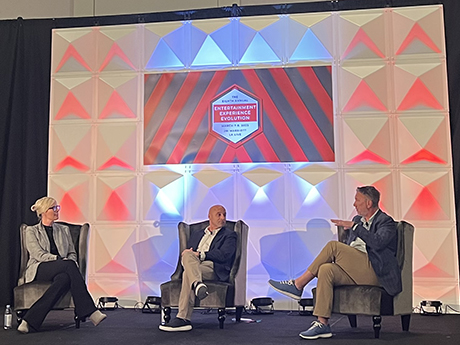
By Nellie Day LOS ANGELES — The advice offered by a panel of developers at InterFace Seniors Housing West, held Feb. 2 at the Omni Los Angeles, mirrors the advice many would give to their senior residents. Namely, “stay active and stay creative.” But these verbs take on a slightly different meaning when you’re talking about the smartest plays for seniors housing developers during a time in which key economic conditions are changing. “The smarter operators and developers have been developing pipelines,” said panelist Paul Mullin, principal at Flatiron Development Group. “The key is momentum. Keep momentum going. Keep the pipeline going. Don’t stop because bankers aren’t lending. We’ll all get out of this; it’s just a short-term issue we have to overcome.” The issue of the current market conditions may be short term, but it’s also multifaceted, as David Waite, partner at Cox, Castle & Nicholson, pointed out. “The challenges are real,” he said. “You’ve got the spread between bid and ask and a rising-cap-rate environment. To go in and buy an asset today in this market is super challenging because you know it’s going in the wrong direction in terms of the valuation.” The solution, according to Waite, …
Features
‘Conference Season’ Is Underway and Early Feedback Shows Concern Over Low Deal Volume, Office Sector
by John Nelson
By Brennen Degner of DB Capital Management The early part of the real estate industry’s “conference season” brings many quality catch-up conversations, and those talks have included concerns. The biggest takeaways from the expert exchanges regarding the broader market are stagnation in transaction volume, office becoming a four-letter word and, most worrying, the limited number of active deals getting re-traded as though it were the new industry standard. Regarding transaction volume, the majority of individuals I had the pleasure of connecting and reconnecting with maintain that the first quarter will be slow as all eyes are on the February and March moves to be made by the Federal Reserve. The consensus seems to be a couple additional 25 basis point rate increases — modest compared to what was seen through the second half of 2022 — and then some pricing stability while the Fed monitors the impact now making its way into the capital markets from its 2022 moves. Once that leveling off occurs, transaction volume should increase rather quickly as there is significant idle capital that needs to be put to work, along with sellers sitting on the sideline waiting for capital market stability. Regarding office real estate woes, …
‘Conference Season’ is Underway and Early Feedback Shows Concern Over Low Deal Volume, Office Sector
by John Nelson
By Brennen Degner of DB Capital Management The early part of the real estate industry’s “conference season” brings many quality catch-up conversations, and those talks have included concerns. The biggest takeaways from the expert exchanges regarding the broader market are stagnation in transaction volume, office becoming a four-letter word and, most worrying, the limited number of active deals getting re-traded as though it were the new industry standard. Regarding transaction volume, the majority of individuals I had the pleasure of connecting and reconnecting with maintain that the first quarter will be slow as all eyes are on the February and March moves to be made by the Federal Reserve. The consensus seems to be a couple additional 25 basis point rate increases — modest compared to what was seen through the second half of 2022 — and then some pricing stability while the Fed monitors the impact now making its way into the capital markets from its 2022 moves. Once that leveling off occurs, transaction volume should increase rather quickly as there is significant idle capital that needs to be put to work, along with sellers sitting on the sideline waiting for capital market stability. Regarding office real estate woes, …
By Taylor Williams After eight interest rate hikes totaling 450 basis points over the last 10 months, courtesy of the Federal Reserve’s war on inflation, commercial borrowers can only hope that the fundamental law of gravity — “what goes up must come down” — will start to become reality in 2023. But the economic clarity that the commercial lending community seeks is muddied by conflicting agendas. On the one hand, the nation’s central bank has made some headway in taming inflation through the rate hikes. The Consumer Price Index fell from an annual rate of 9.1 percent in June 2022 to 6.5 percent in December, but is still well above the Fed’s 2 percent target rate. On the other hand, expansionary fiscal policy such as the $1.2 trillion infrastructure bill signed into law in late 2021 and the $1.7 trillion omnibus appropriations bill passed in December 2022 could undermine the Fed’s efforts to curb inflation, say some economists. The U.S. national debt stood at a record $31.5 trillion as of press time due to the cumulative effect of recessions, wars, tax cuts, the COVID-19 pandemic, and excessive government spending. The ratio of U.S. federal debt to GDP as of press …
WASHINGTON, D.C. — With many office buildings, hotels and shopping malls sitting vacant or underutilized, repurposing commercial properties into multifamily housing is growing more commonplace. A recently released report suggests that these conversions could be financially feasible across a broad range of markets and circumstances. “Conversions have existed for decades, but the pandemic has accelerated their growth potential by rendering more commercial properties obsolete,” says Anita Kramer, senior vice president of the ULI Center for Real Estate Economics and Capital Markets. “Our research demonstrates that there’s no ‘cookie-cutter’ formula for executing a successful project, but we do hope the insights that experienced developers shared with us can provide valuable guidance.” Behind the Facade: The Feasibility of Converting Commercial Real Estate to Multifamily was conducted by the National Multifamily Housing Council (NMHC) Research Foundation and the Urban Land Institute (ULI) Terwilliger Center for Housing. The report examines the viability of converting old or under-utilized commercial properties, with data gathered through interviewing the developers of 29 commercial-to-multifamily conversion projects. According to the report, costs can vary based on several factors, particularly the initial acquisition and the demographic the project targets once completed. Most developers reported successful returns on investment regardless of cost, however, …
By Kul Wadhwa, founder & CEO, BeyondView It has been widely broadcasted that commercial leasing and office occupancy have struggled since the onset of the COVID-19 pandemic, with headlines including words and phrasing like “zombie,” “apocalypse,” “urban doom loop” and even “epic crash” routinely making the rounds. As employers, landlords and commercial real estate professionals all grapple with fully remote and hybrid work routines, proptech and its application of artificial intelligence (AI) can prove to be essential tools in accelerating commercial leasing activity and supporting property management. Simply put, digital twin technology looks amazing, is cost-effective and saves time. For real estate professionals looking to streamline processes, digital twin technology eliminates the need for multiple service providers, facilitates a streamlined decision-making process and is more visually appealing than other proptech on the market. In dealing with an uncertain economy, deploying new technologies will offer a smart and versatile troubleshooting platform all while allowing for significant savings. And this relatively new digital offering is only going to get better with time. Real estate’s use of digital twins is the property technology of the future. Digital twins provide an exact digital representation of a physical object and can be developed from various …
It is hard to imagine that anyone could be insulated from the strife currently pervading the economic landscape. Likewise, the rise of e-commerce has for years been permeating everyday life and discussions of commercial real estate. One might think that these two factors in combination would spell depressed retailer expectations. But the opposite turns out to be true: Nearly 70 percent of retail store managers say they are bullish on the current state of retail and its future going into 2023. That’s according to the most recent Outlook Retail Sentiment Survey by Levin Management Corp. (LMC), an owner of 120 shopping centers. Survey respondents are store managers from LMC’s over 1,100 individual tenants. Undeniable obstacles With inflation reaching a 40-year high in June, and the Consumer Price Index (CPI) registering a 9.1 percent increase, a full 80 percent of survey respondents say that they have had to raise prices, with 34.7 percent anticipating further increases. Inflation has now cooled somewhat, with the CPI clocking in at 6.4 percent in January of this year. Nevertheless, it is a factor that continues to put strain on consumers and retailers alike. Considering this, in conjunction with supply chain issues, low supply of labor …
By Rod Olivero, senior director at Getzler Henrich It appears that the hybrid workforce is here to stay, leaving the future of traditional office space largely unknown. As return-to-office policies continue to evolve, an increasing number of companies are either embracing, or adjusting to, the reality that accommodating some level of remote workforce is now an inevitability. When workers packed up their laptops and work documents and walked out of their offices in March 2020 in compliance with U.S. stay at home mandates, few employer/tenants, landlords or lenders could have imagined what would ensue. The state of the workforce today isn’t merely a function of employees not wanting to return to an office environment on either a full- or part-time basis. In more cases than one might imagine, companies are coming to realize that they can, in fact, operate effectively and with great efficiency under some level of remote worker scenario. Collectively, these businesses occupy tens of millions of square feet of office space in some of the nation’s most historically valuable urban real estate markets. Regardless of their motivation, as more companies embrace or acquiesce to the reality of remote work, companies have started to shrink their physical footprint …
Arbor Realty TrustBuild-to-RentContent PartnerDevelopmentFeaturesLeasing ActivityMidwestMultifamilyNortheastSingle-Family RentalSoutheastTexasWestern
Arbor Report Finds Rental Housing Insulated from Economic Contraction, Risk Factors Endure
— By Ivan Kaufman, founder, chairman and CEO of Arbor Realty Trust, Inc.; and Sam Chandan, a professor of finance and director of the Chen Institute for Global Real Estate Finance at the NYU Stern School of Business Rental housing is uniquely positioned to withstand tremendous economic headwinds. Although some observers point to the slowdown in apartment rent growth as a sign of growing weakness, this trend is a cyclical feature that is not reflective of any structural change in the profile of demand or supply. It is normal to expect a period of slowing rent growth while there is uncertainty in the economic outlook. In-depth findings on these trends, plus a thorough economic outlook for 2023 and a complete breakdown of risk factors, are detailed in Arbor Realty Trust Special Report Spring 2023: Navigating a Corrective Environment, from which this article is excerpted. While no asset class is immune from the challenges of higher interest rates, the presence of amortization, which spreads out a loan into a series of fixed payments over time, makes the multifamily sector less likely to see mounting distress. All Department of Housing and Urban Development (HUD)-conforming multifamily loans are fully amortizing. Moreover, Fannie …
The self-storage sector has historically been considered resilient and recession-resistant. This year, key trends are already emerging that will contribute to the health and performance of this $80 billion industry. Despite risks of oversaturation in some urban markets, 2023 promises to be a strong year for self-storage investments. Shined-up facilities What started in early 2000s continues to today. Where decrepit, one-story metal buildings with chain-link fences were the standard, now high-caliber, well-designed and polished facilities dot the landscape. Today, new development is almost exclusively Class A product. Intown and suburban communities demand it. And customers now expect professional lobbies with music and complimentary snacks and beverages, staffed by knowledgeable and skilled managers selling space that is clean, bright and secure. The once red-headed stepchild of commercial real estate is now the belle of the ball. The proof can be seen in the fervent attention from public REITs and private equity firms. Blackstone Real Estate Income Trust grabbed headlines in 2020 with its acquisition of Simply Self Storage for $1.2 billion. Smaller, yet just as notable, transactions also support increased valuation. In 2022, Space Shop Self Storage, one of the top 20 self-storage operators in the United State, sold two portfolios …