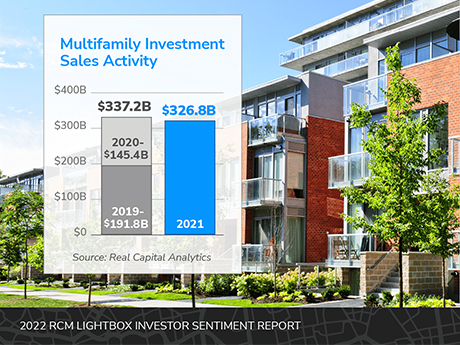
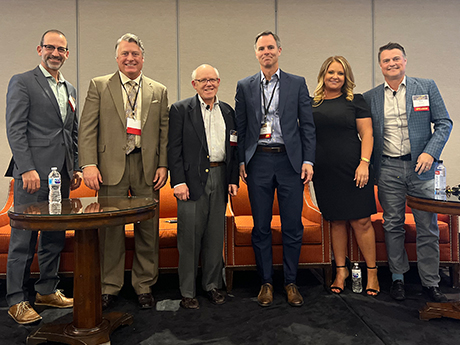
ATLANTA — The third quarter of 2021 was the most prolific quarter on record for U.S. multifamily investment sales, according to Real Capital Analytics (RCA). Apartment sales volume totaled $78.7 billion for the quarter, a 192 percent increase from third-quarter 2020 and a 59 percent jump from third-quarter 2019. RCA data shows that the dollar amount of assets traded this past quarter exceeded the average annual sales from the period 2008 through 2011. James Mehalso, managing director of transactions for PGIM Real Estate, expects his firm to keep its foot on the gas for next year on both the acquisitions and sales side for multifamily assets. “The rental market is hot,” said Mehalso. “We don’t see it really changing much in 2022, at least in the first six months.” Mehalso’s comments came Thursday, Dec. 2, during a panel discussion as part of the 12th annual InterFace Multifamily Southeast conference hosted by France Media and the InterFace Conference Group at the Westin Buckhead in Atlanta. Moderated by Paul Berry, vice chairman of CBRE, the panel was titled, “After a Wild 2021, What’s the Investment Market Outlook for 2022?” The event, which attracted more than 300 industry professionals, marked the return of …
Features
Mall and shopping center owners nationwide are faced with the vacancy of major big box anchors that have closed their doors due to the continued uptick in online retail and changing shopping habits and desires of today’s consumers. Often massive, these two-story, or even three-story spaces seem impossible to fill with the decline of most brick and mortar retail stores. Developers are being challenged to think outside the [big] box to find new tenants and creative uses for the space. Malls were originally thought of as community centers for neighborhoods during the mall boom. That attitude fell by the wayside as malls removed their socially engaging aspects and lost their sense of place — instead of being a place for the community to gather, the mall became simply a place to shop. Now, largely expedited by the pandemic, there have been seismic shifts in retail and shopper habits/what the consumer wants out of their shopping experience. The key word here is experience. Malls have had to readapt to fill in vacant spaces from large department stores that consumers no longer favor. This has opened up a lot of atypical uses, from distribution centers to residential to entertainment components to medical facilities. …
DALLAS — Since the COVID-19 pandemic began there have been many changes in travel, employment and supply chain issues, all of which have an effect on the hospitality sector, according to the U.S. Hotels State of the Union: CBRE Hotels Research Report. Dallas-based CBRE released the report earlier this month. Travel rebounds Regarding travel, the sector seems to have picked up momentum. CBRE says air travel is above 80 percent of pre-COVID-19 levels after high levels of travel during Halloween this year. Also, hotel cancellations have remained fairly steady since the beginning of the pandemic. In March 2020, there was a huge spike in hotel cancellations, but since then, cancellations have remained fairly low for most of 2021 with a slight increase in July 2021. Additionally, international travel restrictions are hurting the U.S. hospitality sector. This year, there has been considerably less international travel spending in the country than pre-pandemic with August 2019 seeing around $12 billion in spending versus around $2 billion in August 2021. Another change since the pandemic is that most of the inbound travelers are now coming from Latin America, with the top border entrants from Mexico, Colombia, Peru and Ecuador in August 2021. Two years …
By Paul Getty, president & CEO, First Guardian Group The calendar year is rapidly drawing to a close, and society is moving closer to pre-pandemic normalcy. As 2022 approaches, we expect a combination of more-of-the-same trendlines punctuated with a few new developments that will reshape the residential and commercial real estate landscapes in 2022. Asset-Specific Predictions Due to a combination of scarcity, demand and historically low interest rates, betting on the strength of residential real estate, both single- and multifamily alike, seems like a low-risk proposition in 2022. According to the National Association of Realtors, the country is currently experiencing a housing shortage of some 6.8 million units. The Brookings Institute reports that millennials now make up more than half of the U.S. population, and a growing percentage are hoping to start families and buy homes. Thanks to the Federal Reserve’s accommodative policies, the golden era of low-cost financing will continue into 2022. Many landlords and commercial real estate owners hit pause on rent increases amid the pandemic. But 18 months into the public health crisis, we’re seeing rent hikes across the country for investors to catch up and return to normalized rates of return. The constrained supply of single-family …
Company NewsFeaturesHeartland Feature ArchiveHospitalityIndustrialMixed-UseMultifamilyNortheast Feature ArchiveOfficeRetailSoutheast Feature ArchiveTexas & Oklahoma Feature ArchiveWestern Feature Archive
Forecast Survey: What’s Your Take on Commercial Real Estate in 2022?
by John Nelson
The editors of REBusinessOnline.com are conducting a brief online survey to gauge market conditions in 2022, and we welcome your participation. The survey should only take a few minutes to complete. Questions range from property sectors that you are most bullish on heading into 2022 to trends in deal volume to your outlook for interest rates. The results of our 11th annual survey will be collated and published in the January issues of our regional magazines. Conducting these surveys is part of our mission at France Media to provide readers with indispensable information, and we couldn’t do it without your help. To participate in our broker/agent survey, click here. To participate in our developer/owner/manager survey, click here. To participate in our lender/financial intermediary survey, click here. (Note: Please remember to click on “done” to properly submit the survey.)
By Molly Luhrs, Popp Hutcheson Diminishing tax liability may offer a silver lining amid a horror show of declining property values playing out for owners of silver screen properties across the nation. Many theater owners will pay more than their fair share in property taxes, however, unless and until they educate local tax assessors of the sinister influences that oppress their businesses. Movie theaters have been one of the hardest-hit industries during the COVID-19 pandemic. Spaces where the big screen once lit the faces of attentive viewers fell dark and silent, to sit lifeless for months. Studios released only 23 films in 2020, the fewest since 2003, and box offices sold less than 225 million tickets. As regulations eased, cinemas emerged far behind the pack of other businesses in a race to resume normal operations. Now, most states are allowing 100 percent occupancy in movie theaters; however, this does not mean movie-goers are rushing back to theaters. What is there to attract them? Some of the most anticipated new movies had their 2020 premiere dates pushed to middle or late 2021, with some even transitioning directly to streaming platforms like HBO. On top of the lack of content, theaters are …
By Isabel Mandujano, director of lab planning, LPA Inc. The COVID-19 pandemic brought to the forefront the importance of research and innovation in life sciences, which is driving incredible demand for new construction of these and laboratory facilities. At the same time, an increasing focus on the health and wellness of life sciences workers is pushing innovation in the way these facilities are designed and constructed — as well as with regard to the roles these spaces play for employees and surrounding communities. Adaptive Reuse The biggest challenge within this space is getting life sciences facilities built fast enough to meet the high tenant demand. One common solution is to adaptively reuse existing office space, which has become increasingly available with continued work-from-home and hybrid work schedules for traditional office workers. In addition to being a more environmentally friendly solution, this approach shortens project timelines significantly and allows end users to move in and start using the space much more quickly. The conversion of space that was not originally designed for laboratory use comes with the complex technical challenges of upgrading the required infrastructure and adapting less-than-ideal physical space. An integrated team of architects, designers and engineers is best suited …
By Jeff Shaw HOUSTON — Although the seniors housing industry as a whole suffered big setbacks throughout the COVID-19 pandemic, hitting record-low occupancy rates across the board, one sub-segment was an exception to the rule. “During COVID there were clear winners and losers in commercial real estate,” said Aron Will, vice chairman of debt and structured finance at CBRE and co-head of CBRE Senior Housing. “Industrial, life sciences, medical office and multifamily were very clear winners. But one asset class that’s been overlooked is active adult, as it was also a very clear winner.” Although there is much discussion around how to define the active adult segment, generally it’s an age-restricted apartment community for physically healthy seniors who don’t yet need the services in independent living such as meal preparation, cleaning or assistance with the activities of daily living. Without temporary government regulations stopping move-ins to active adult communities — plus a younger, healthier resident than in independent living or assisted living — active adult communities thrived during the pandemic. Lease renewal rates were 80 percent; collections were close to 100 percent and the segment experienced “phenomenal rent growth,” according to Will. Will’s comments came during a panel he moderated …
Build-to-RentContent PartnerDevelopmentFeaturesMidwestMultifamilyNortheastSoutheastTexasWalker & DunlopWestern
Demographic, Economic Trends Likely to Sustain Build-For-Rent Sector’s Growth
Institutional investors have been increasingly interested in the build-for-rent (BFR) space over the last five years. But the pandemic poured gasoline on an asset class that offers tenants space, privacy and the flexibility of renting. Now that COVID appears to be receding in some areas, can the BFR sector maintain its growth? Paul Garner, director at Walker & Dunlop, believes that demographic and economic trends will maintain the demand for BFR, especially in the Sun Belt states, for the near future. Opportunities for Growth and a Focus on the Sun Belt Garner sees the most potential for BFR growth in suburban areas — particularly those located 15 to 20 minutes outside of a metropolitan statistical area. The economic growth and increasing populations of nearby cities determine whether suburban BFR setups will attract tenants. According to Garner, the dedicated BFR/single-family rental (SFR) team at Walker & Dunlop has started to see a lot of action similar to what they saw on the West Coast (especially in Arizona) four or five years ago. He notes, “BFR properties are becoming increasingly popular all throughout the Sun Belt states, especially Florida and the Carolinas. There’s a potential in this area to get land very, …
WASHINGTON, D.C. — While the impact of the COVID-19 pandemic is still being felt across all sectors of commercial real estate, economists are forecasting strong recovery in the years ahead. This prediction comes from the Fall 2021 Urban Land Institute (ULI) Economic Forecast for 2021 to 2023. The semiannual survey polled 49 economists and analysts at 36 leading real estate organizations on 27 key economic and real estate indicators, ranging from GDP and employment figures to commercial real estate transactions and property sector performance. US GDP shrank 3.4 percent in 2020 — the first economic contraction since 2009. Recovery from the pandemic is expected to occur dramatically faster than what transpired following the Great Recession of 2007-2009, according to Washington, D.C.-based ULI. A bounceback in growth of 5.7 percent is expected in 2021 with continued growth of 4 percent in 2022. The U.S. economy recorded a net loss of 9.42 million jobs in 2020. Economists predict a two-year recovery process is imminent, with a growth of 6 million jobs in 2021 and 3.7 million jobs in 2022 for total growth marginally exceeding the jobs lost. Further growth of 2.2 million jobs is forecast in 2023. The inflation forecast for 2021 …