Features

Olshonsky NAI Industrial

Shifting behaviors and expectations for consumers, manufacturers and distributors have made industrial space central to the commercial real estate landscape. “This is an asset class that for 25 years of my 39 years in the commercial real estate business was a boring, middle-of-the-road class. But this steady investment has just exploded,” says Jay Olshonsky, president and CEO of NAI Global. Much of the most recent change has been driven by the particulars of the COVID-19 pandemic. Delivery became a way of life for those socially distancing, creating an instant need for more distribution and warehousing centers. Olshonsky explains that the behavioral changes starting in March of 2020 accelerated trends (online shopping, delivery/pickup services and working from home) that might otherwise have taken five or more years to come to fruition. Olshonsky explains that there are still hurdles for this ascendant product type to overcome, but the changes we’ve seen over the last year will remain. Industrial Not a Bubble  “Industrial is here to stay,” says Olshonsky. “COVID accelerated trends that already existed, but those trends were already in motion. We’re seeing some changes that are fundamental.” The need for delivery and warehouses is fed by new expectations: “Ecommerce is the …

FacebookTwitterLinkedinEmail
Solaris-Lofts-Jersey-City

By Kathleen Tarbox Munoz, partner, Hunton Andrews Kurth LP The outbreak of the coronavirus pandemic cultivated an economic downturn that differed significantly from financial crises like the Great Recession or even the Great Depression. Worldwide stay-at-home orders and mass business closures meant that industries across the board were hit simultaneously, as opposed to experiencing the domino effect reminiscent of past crises. At the onset of the pandemic, the lending industry ground to a halt; few lenders were advancing funds for several months as the world waited to see how long this period would last. The commercial real estate industry as a whole has suffered as much as any industry, with retail and hospitality being hit fast and hard at the beginning of the pandemic. A future second wave of commercial foreclosures and defaults within these asset classes looms as a near certainty. But the response to these defaults from lenders has followed a unique trajectory — one that is as much a response to the pandemic as a product of it. Increased Flexibility Perhaps the result of empathy born of a shared experience, or perhaps due to the introduction of highly effective vaccines that support the notion of a swift …

FacebookTwitterLinkedinEmail
Jeffrey-Dunn

By Jeffrey Dunn, principal, Fineman West Real estate investments often show taxable losses, even though they have positive cash flows. There are also many elections and actions that investors can take to drastically increase real estate losses and reduce taxes. By default, real estate losses are suspended and cannot be used until a property generates positive rental income or is sold. In addition, there is a 3.8 percent net investment income tax on real estate losses and gains if real estate is considered passive. For example, a taxpayer could have a rental property with a positive cash flow of $100,000 and a taxable loss of $1 million due to depreciation or other non-cash deductions. If nothing is done, the $1 million loss is suspended and there is no immediate tax benefit. If the rental is converted to non-passive income, then the taxpayer could use the $1 million loss immediately and possibly have $500,000 of tax savings, assuming the investor is subject to a 50 percent tax bracket. Also, if the building is converted to a non-passive rental and later sold at a $5 million profit, the investor will save the 3.8 percent net investment income tax, or $190,000. Passive Loss Hurdle …

FacebookTwitterLinkedinEmail
hyatt-regency

By Angela Adolph, partner, Kean Miller LLP Judith Viorst, author of the children’s book Alexander and the Terrible, Horrible, No Good, Very Bad Day, had nothing on 2020. By virtually every metric, 2020 was a terrible, horrible, no good, very bad year. Taxpayers quickly learned that while most states have some sort of catastrophe exemption for property tax tying an abatement or reduction to a defined disaster event occurring that year, the provisions and requirements in these statutes are state-specific. Few states had any authority to address whether physical damage to the property was required for the taxpayer to receive any relief. Most states eventually concluded that some form of physical damage was necessary for property values to be reduced following a disaster. Other states went the other direction, concluding that their disaster statutes did not require physical damage, only that the property be inoperable due to a declaration of emergency by the governor. Accordingly, property values for the 2020 tax year could be reduced in those states due to COVID-19-related economic losses. Fortunately, 2021 gives all taxpayers a fresh start. Most states use Jan. 1 as the “lien date” or valuation date for determining fair market value of property …

FacebookTwitterLinkedinEmail
Bohler Due Diligence Development Redevelopment

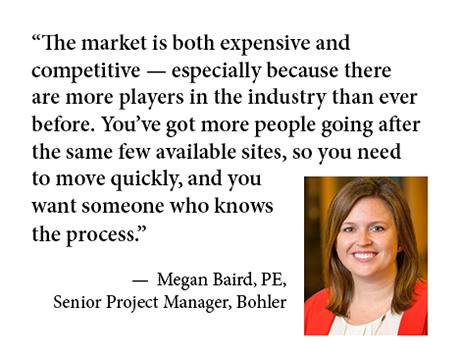
Whether you are buying undeveloped land or assessing a property for potential redevelopment, thorough due diligence is critical to good decision-making. With the speed at which today’s commercial real estate market operates, you may face time constraints and you definitely want to limit expenditures related to due diligence — but you don’t want to cut corners. An incomplete understanding of the challenges at the site will limit your ability to scope out the project and could impact your ability to keep it on schedule and within budget. Even if you need to complete due diligence on an expedited timeline, make sure you check all the boxes. Here are six key items that should be on your checklist to ensure you limit unexpected costs and delays. 1.    Geotechnical and Environmental Investigations Depending on your project scope, some form of a geotechnical investigation makes sense. Prior to design, it’s important to find out if soil constraints pose risks or design challenges. Geotechnical due diligence will disclose information about the physical properties of the underlying soil including rock, historic fill, unsuitable organic layers, seasonal groundwater and/or buried debris. Environmental due diligence will provide information about existing site challenges including wetlands, floodplains, brownfields, archeological factors …

FacebookTwitterLinkedinEmail
YOUnion @ Ann Arbor

When the world shut down over a year ago, architects, designers and developers took a collective pause to assess what needed to change in the built environment. A particularly scrutinous eye was paid to off-campus student housing, a sector whose successful model was based on bringing students together, not keeping them a safe distance apart. Some sweeping changes were recommended at the onset — many operational in nature, based on the latest guidance from health officials. As courses moved online and on-campus residence halls closed, off-campus communities emerged as a safe haven for students who did not want to — or were unable to — return home. The resilience of the sector, as evidenced last fall by pre-leasing rates and rents that were only slightly below 2019 levels, suggested the temporary tweaks made out of necessity in 2020 worked. The real question was whether those modifications would carry through to newly developed and renovated communities post-pandemic, and if so, what form they might take. Our firm took the time to reflect on how design must evolve to meet the changing needs and expectations of students, parents, operators and developers — all of which have different priorities. At the top of …

FacebookTwitterLinkedinEmail
Theobald 2021 transaction volume

Back to Normal? The U.S. economy has improved significantly since April 2020, the peak of the pandemic-induced recession. The national unemployment rate stood at 6.0 percent in March of this year, well below the peak of 14.8 percent in April 2020. Companies were effective in implementing work-from-home technology, keeping unemployment rates for office-based service sectors relatively low. For those with a bachelor’s degree or higher, unemployment rates were only 3.7 percent as of March 2021. In 2020, third-quarter GDP growth made up much of the second-quarter losses, followed by 4 percent annualized economic growth in the fourth quarter. Retail sales also rebounded quickly, returning to pre-pandemic levels by June and continuing to increase through the beginning of 2021. However, the U.S. economy is still far from “normal.” Of the 22 million people who lost jobs in March and April 2020, only 57.8 percent had regained employment by March 2021. Stronger growth should return jobs to industries hit hardest during the pandemic. In March of this year, restaurants and bars added 176,000 jobs; arts, entertainment and recreation venues added 64,000 jobs and accommodations added 40,000 jobs. Still, employment in the overall leisure and hospitality sector is down by 3.1 million, or 18.5 …

FacebookTwitterLinkedinEmail

The seniors housing industry has had a rough ride through the COVID-19 pandemic. First-quarter occupancy clocked in at a record-low 78.8 percent, a drop of 870 basis points from the year prior, according to the National Investment Center for Seniors Housing & Care (NIC). But seniors housing is a needs-based product, and most industry professionals expect a strong rebound. As a result, new construction projects are starting to make a comeback in preparation for pent-up demand. That was the topic of discussion during “The Power Panel: CEOs Discuss the State of Development” at France Media’s InterFace Seniors Housing Development, Design & Finance conference, held virtually on April 20 and 21. Panelists included Marco Vakili of Alliance Residential; Keven Bennema of Charter Senior Living; moderator Kevin Kinigstein of Cox, Castle & Nicholson; Scott Stewart of Capitol Seniors Housing; and Torsten Hirche of Transforming Age. “The pandemic was a double whammy. Revenue is going down and expenses are going up,” said Stewart. “The good news is it wasn’t as bad as we thought. Fast forward to where we are today, we’re essentially at the same occupancy level as we were in March of 2020. That gave us the green light for developing.” …

FacebookTwitterLinkedinEmail

The U.S. multifamily sector remains an attractive option for real estate investors looking for a safe haven. Beyond the pool of traditional buyers who are actively acquiring apartment properties, the sector has become a landing spot for companies that aren’t legacy multifamily owners. Steven DeFrancis, CEO of Cortland, cited REITs like Blackstone Real Estate Investment Trust as newly establishing a presence in the multifamily sector. BREIT recently made a $240 million preferred equity investment in Tricon Residential connected with Tricon’s purchase of single-family rental (SFR) homes in Nashville. Nuveen Real Estate is also a recent institutional investor entrant in the emerging SFR sector. “We’re seeing a lot of new capital, whether it’s coming from overseas or from here,” said DeFrancis. “Institutional capital is continuing to move into real estate, and then within real estate there’s a lot of movement from other sectors into multifamily.” Jessica Levin, senior director of acquisitions at Intercontinental Real Estate Corp., said that the influx of capital into the U.S. apartment market the past six months has been “astronomical.” She also said that there’s no slowdown ahead. “Competition is stiffer now than in the past 10 to 15 years, and it’s only going to increase from …

FacebookTwitterLinkedinEmail
Keaton Merrell BFR

The past few years have seen a surge in interest in single-family rental (SFR) and build-for-rent (BFR) spaces in commercial real estate. Traditionally the domain of small- and medium-sized investors, the SFR/BFR space has begun to attract institutional investors. BFR, in particular, can often offer higher occupancy levels and rents while promising lower capital and operating costs than traditional multifamily housing. Keaton Merrell, managing director, Capital Markets, Walker & Dunlop, spoke to REBusinessOnline about debt and equity in BFR, as well what to know when it comes to agency involvement. First, Merrell briefly clarifies the terminology: “Oftentimes, people use SFR and BFR interchangeably. They are two totally separate asset classes and are looked at differently by capital. SFR is defined as a cluster of homes in various geographies that are pooled together for investment purposes. BFR is purpose-built housing within contiguous rental communities, much like traditional multifamily properties.” For a more in-depth look at the SFR and BFR in general, read more on the asset class here. REBusinessOnline: What is the current state of debt and equity capital in the market when it comes to BFR? Merrell: I will start with equity and then move on to debt. The equity that is coming into the …

FacebookTwitterLinkedinEmail