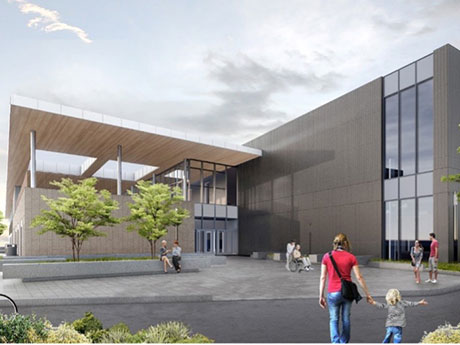
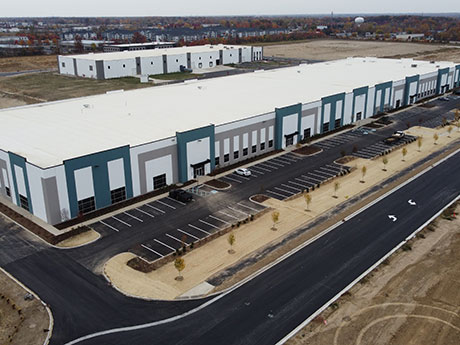
By Abigail Sievers, JLL The Indianapolis industrial market is entering 2026 not merely recovering but evolving. What began as a “quiet” shift has matured into a definitive new phase of activity characterized by renewed user confidence, disciplined development and a manufacturing ecosystem that’s gaining national attention. While headlines often focus on coastal or larger Midwest markets, Indianapolis is steadily emerging as a strategic center for large-scale industrial investment, offering the rare trifecta of scalable Class A space, a resilient workforce and the high-capacity infrastructure that modern manufacturers require. Mega deals return After more than two years of cautious expansion, the market is now seeing a resurgence of large industrial commitments. Leases and acquisitions exceeding 500,000 square feet — which had significantly slowed during the previous 24 months — are re-entering the landscape as users move forward with previously paused growth plans amid market uncertainty. The broader leasing environment reflects this momentum. In fourth-quarter 2025 alone, Indianapolis recorded 7.2 million square feet of absorption — the strongest single‑quarter performance since the third quarter of 2021. Year‑to‑date absorption reached 13.1 million square feet, surpassing the previous two years combined. These mega deals confirm what we’re hearing daily from both new and existing …
Market Reports
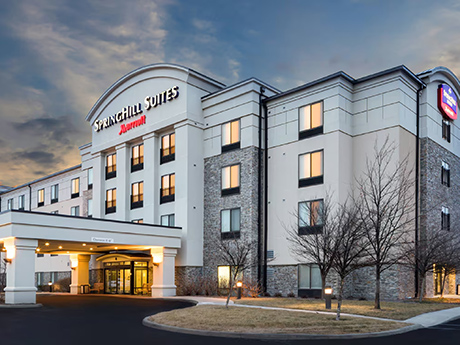
By Aghfar Arun, Bradford Allen Indianapolis has a reputation as a convention town, but its hotel story has moved well beyond lanyards and name badges. A growing mix of sports, healthcare, corporate and leisure demand is now filling rooms year‑round — downtown and across the suburbs — turning the market into one of the Midwest’s most reliable hospitality overachievers. Event boom downtown Indianapolis experienced 8.1 million room nights of demand in the 12-month period ending at mid-year 2025, according to CoStar data. This is over 580,000 more than the market’s pre-COVID peak. To meet this demand, the construction pipeline at mid-year included more than 1,500 hotel rooms, with another 3,402 rooms in the final planning stages and 3,220 rooms proposed. According to Visit Indy, new projects slated for delivery in 2026 include a pair of adaptive reuse projects: The Kimpton will transform the historic Odd Fellows Building into a 167-key luxury hotel and the Motto Hotel will bring 116 rooms to the King Cole Building. The most notable project is Signia by Hilton, a 38-story hotel with 800 guest rooms developed alongside a 143,500-square-foot expansion of the Indiana Convention Center. A snapshot of downtown Indianapolis, prepared last year by …
By Jeremy Woods and Gwen Rodenberger, CBRE Indianapolis industrial leasing activity in January may have started as cold as the winter temperatures, but activity has only gotten hotter, even as fall wanes into winter. Indiana at one point called itself the Crossroads of America, and the moniker holds true today. Indianapolis is strategically located in the center of the state, with four major interstates running through it. The city’s businesses also benefit because of the second-largest FedEx hub at its airport. As a result, businesses can easily ship to most of the continental U.S. within three days, minimizing outbound shipping costs. In January, occupiers requiring 1 million square feet of distribution space in Indianapolis would have six first-generation shells (equivalent of 104 football fields) to choose from. If you could live with a bit less space, roughly 900,000 to 975,000 square feet, another three options could be added to the tour (adding an additional 47 football fields). Fast forward just three quarters to today, and five of the nine “mega-bulk” warehouses, as they are aptly named, are 100 percent occupied. Even the most seasoned experts would not have predicted the speed at which these spaces would be absorbed. In these …
By Lee Kiser, Kiser Group Multifamily real estate investment in the Midwest in 2025 presents a compelling opportunity, driven by strong fundamentals, favorable market dynamics and emerging trends. Here’s an overview of the key trends and outlook. Strong rent growth Midwestern cities are experiencing some of the fastest rent increases in the nation. Cleveland leads with a 5.1 percent year-over-year rent growth, while other metros like Chicago, Kansas City and Detroit rank among the top 10 for rent gains, outperforming the national average. This surge is attributed to steady demand and limited new supply, allowing landlords to continue raising rents. Much of the rent growth is due to declining construction activity. Nationally, multifamily construction is expected to decline by 11 percent in 2025, with completions projected to fall to 317,000 units. The Midwest has a significantly smaller pipeline than the national statistics, with only 3.4 percent of inventory currently under construction versus 6 percent nationally. Workforce housing stock The Midwest is recognized for its affordability, with monthly multifamily rents averaging $1,405, which is lower than the national average of $1,823 and more than 10 percent less than the Sun Belt average. Midwest transaction velocity is shifting toward Class B and …
By Chris Bruzas, Berkadia After a particularly challenging and unpredictable 2024, marked by continued interest rate volatility and a persistent bid-ask spread differential that contributed to low transaction volume, the Indianapolis apartment market is showing promising signs of stabilization as we move into 2025. Yardi Matrix data highlights Indianapolis’ resilience, posting 2.7 percent year-over-year rent growth in November. This performance is especially noteworthy as it surpasses several popular Sun Belt markets, which have experienced declines, dipping into negative territory. The outlook for 2025 appears more balanced, with new supply moderating to approximately 3,500 units from 2024’s record-breaking 6,500+ deliveries. This timing aligns well with the market’s strong population growth, as Indianapolis expects to welcome 22,200 new residents in 2025, significantly exceeding the historical average of 12,800 annual net movers. Key factors of the population’s growth are due to the presence of reputable universities and colleges, such as Indiana University-Purdue University Indianapolis (IUPUI). Compared with other major metropolitan areas, Indianapolis offers a relatively low cost of living, making it an attractive destination for those looking to maximize their quality of life without the high expenses associated with larger cities. The region’s economic fundamentals remain strong, anchored by transformative projects including Eli …
By Lance Evinger III, Hendricks Commercial Properties In an era where consumers seek more than just products, experience-driven spaces are reshaping the commercial real estate landscape. In Indianapolis, developers and urban planners are increasingly focused on transforming some of the city’s most underutilized yet high-potential areas into dynamic destinations that foster engagement, connection and excitement. Indianapolis boasts a diverse and rapidly evolving commercial real estate market that continues to attract significant investment and development. Key sectors — including office, industrial, retail and mixed-use developments — have experienced steady growth, with a strong focus on adaptive reuse projects and innovative design concepts. The city’s strategic central location, robust infrastructure and thriving convention scene make it a prime destination for businesses and developers alike. Named USA Today’s No. 1 Convention City in the U.S. in 2024, downtown Indianapolis attracts over 10 million visitors annually, a number that continues to grow. In the past year, downtown hotels have set all-time monthly revenue records, fueled by major events like the NFL Combine and NBA All-Star Weekend. At the same time, the Indiana Convention Center has seen a 14.5 percent year-over-year increase in visitors, further cementing the city’s reputation as a top-tier event destination. With …
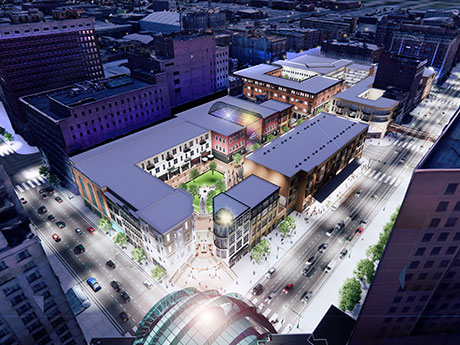
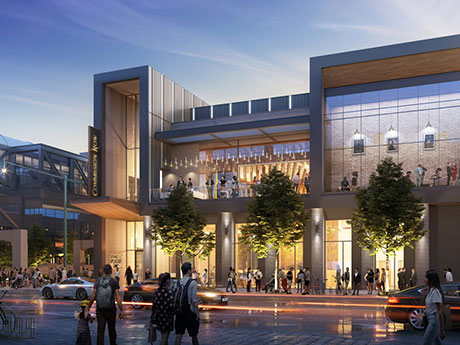
By Stephen Daum, Colliers The eyes of the sporting world once again focus on downtown Indianapolis as it hosts the 2024 NBA All-Star Game at Gainbridge Fieldhouse in mid-February. It is anticipated that the game will have a $320 million economic impact to the city. Indianapolis was set to hold the 2021 NBA All-Star Game, but the COVID-19 shutdown forced a postponement until 2024. Similarly, the pandemic also stunted development efforts in the central business district. But like the return of the All-Star Game, downtown development projects have rebounded, with an estimated $9 billion in projects set to be completed over the next few years. In anticipation of hosting the All-Star Game, Pacers Sports & Entertainment finished an extensive $400 million remodel of Gainbridge Fieldhouse, including new seats, expanded social gathering areas, plus the new outdoor Bicentennial Unity Plaza — offering public basketball courts and an ice skating rink in the winter. Overlooking Bicentennial Plaza is Commission Row, a 30,000-square-foot mixed-use, multi-story development. Basketball isn’t the only sport driving downtown development. Indy Eleven, a United Soccer League (USL) franchise headed by local developer Ersal Ozdemir, has begun construction on its expansive Indy Eleven Park. This will be located just south …
By Jim Pitoukkas, Coldwell Banker Commercial Shook Outside of recognition related to Purdue University, the Greater Lafayette region (consisting of West Lafayette, Lafayette and surrounding towns in Tippecanoe County), has been in the shadows of the Indianapolis MSA to the south and Chicago MSA to the north. This is changing, though. Growth over the last decade has pushed Greater Lafayette into the national spotlight as an emerging hub for innovation in advanced manufacturing in industries including medical, aerospace and defense, agriculture and nanotechnology, and a burgeoning housing market. For three quarters straight, The Wall Street Journal and Realtor.com have ranked Greater Lafayette the No. 1 Emerging Housing Market in America based on comparatively affordable housing, a skilled technology-based workforce, and a strong growing local economy. Additionally, current and to-be residents benefit from consistent public investments in quality-of-life infrastructure that continue to attract new residents across a range of ages and backgrounds. Quality of life Greater Lafayette has invested in excess of $889 million in public investment since 2015. These investments have ranged from new utility infrastructure, a new minor league ball field, parks, county-wide trails, public facilities like the West Lafayette Wellness Center and the Lafayette Public Safety Center, and …
By Ken Martin, JLL The Indianapolis industrial real estate market ended 2022 nearing a record high for a single year with more than 19.6 million square feet of absorption. Much of this was recorded in Hendricks, Johnson and Hancock counties with total year-end net absorption of 7.3, 6.4 and 3.2 million square feet, respectively. These submarkets continue to offer tenants excellent access to both interstate highways to transport goods across the country, as well as strong employment bases. Developers and tenants often cite employment bases as their No. 1 criteria in selecting an optimum site. With vacancy at an all-time low of sub 5 percent for the majority of 2022, developers and owners were able to push rents as demand outstripped supply. As recently as two to three years ago, rents were consistently in the high $3’s per square foot range and now we consistently see rents in the $5 per square foot range or higher. Year-end asking rents averaged $5.54 per square foot overall and $6.48 per square foot for mid-sized warehouse space. In some markets, however, rents for warehouse space were well above the average. In the central business district, for example, asking rates for warehouse …
By Steve LaMotte Jr., CBRE With 2021, a record year for asset appreciation and fundamentals, 2022 marked a turning point in the apartment space across the nation. Multifamily leasing velocity, rent growth and occupancy levels have seemingly reached their current peak levels and begun to cool. Instability in the capital markets throughout much of 2022 encouraged many on both the buy and sell sides to wait it out, looking for signs of stability. However, despite the turbulence and the pause, the multifamily sector has remained resilient and is expected to maintain its claim as the preferred asset classification in 2023. Further, metro Indianapolis has been a standout performer in every meaningful measurement. Now widely regarded as an emerging star of the Midwest, metro Indianapolis has earned its place as the nation’s rent growth leader in the back-to-back months of October and November of 2022, according to Yardi Matrix. The metro has outperformed many major markets while maintaining its characteristic affordability. According to research from CBRE Econometric Advisors, the average metro rent of $1,200 per unit ($1.30 per square foot) shows that metro Indianapolis will deliver outsized rent growth in times of distress while remaining one of the most affordable metro’s …
Newer Posts