
PFLUGERVILLE, TEXAS — Tampa-based brokerage firm Franklin Street has arranged the sale of a 12,705-square-foot office building in the northern Austin suburb of Pflugerville. The building at 508 Old Austin Hutto Road was built in 2013 and will be the future home of the Cameron Road Church of Christ. Marshall Durrett and Laura Fretwell of Franklin Street represented the church in the transaction. The seller was an entity doing business as Government Leases LLC.
Civic
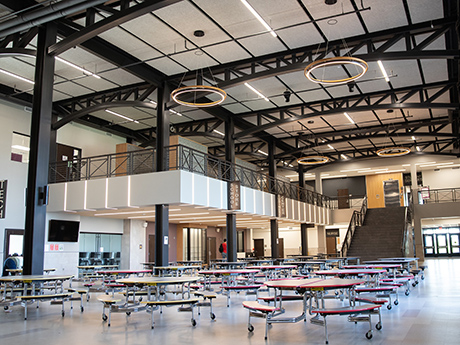
DALLAS — Cadence McShane has completed a 143,000-square-foot academic project in North Dallas. The Henry W. Longfellow Career Exploration Academy is a replacement school for the Dallas Independent School District. In addition to classrooms, the three-story building houses administrative offices, fine arts spaces, a theater, library, cafeteria and kitchen and physical education facilities. Huckabee designed the project.
WESTFIELD, IND. — Structural engineering firm O’Donnell & Naccarato has topped out the new Westfield Police Headquarters, a $35 million public safety facility. The new headquarters, rising two stories and totaling 63,000 square feet, will replace the city’s existing public safety building. The project team includes architect Dewberry, construction manager Skender and the City of Westfield as the project owner. The design incorporates a range of structural systems and materials as well as a 2,700-square-foot storm shelter. The project also includes planning for a future 30,000-square-foot expansion to accommodate the city’s growth. The topping out marks the completion of the building’s structural framework. The project is on track for completion in 2027.
BETHLEHEM, PA. — Colliers has arranged the sale of a 14,000-square-foot historic building located at 46-52 West Broad St. in the Lehigh Valley community of Bethlehem. The new owner, private investor Rocco Ayavoz, plans to reposition the building, which was originally constructed in 1925 for Lehigh Valley National Bank, into a retail, restaurant and entertainment destination. Derek Zerfass and Seth Lacey of Colliers brokered the sale.
NEW YORK CITY — Zeta Charter Schools will open a 35,000-square-foot temporary high school facility in the Washington Heights area of Upper Manhattan. The lease term is two years, and the space is located within St. Rose of Lima Catholic Church. Lindsay Ornstein and Alexander Smith of OPEN Impact Real Estate represented Zeta Charter Schools in the lease negotiations. The landlord, the Archdiocese of New York, was self-represented.
GAINESVILLE, GA. — The Georgia Ports Authority plans to open the Gainesville Inland Port, a $134 million inland port in the northeast Georgia city of Gainesville, on May 4, 2026. The 104-acre project will give manufacturers and suppliers in the region an alternative to a 600-mile roundtrip truck route by providing direct Norfolk Southern rail service between the inland port and the Port of Savannah. The Georgia Ports Authority estimates that the new inland port will replace approximately 26,000 roundtrip truck routes in the inland port’s first year of operation. The Gainesville Inland Port, formerly known as the Blue Ridge Connector, will have an annual capacity of 200,000 containers. The Georgia Ports Authority is currently executing a nearly $5 billion infrastructure investment plan over the next decade to expand berths, yards, gates, inland ports and rail capacity for the state’s port network, headlined by the Port of Savannah.
WYLIE, TEXAS — Skanska USA Building has broken ground on the 66,309-square-foot Career and Technical Education facility at Collin College’s Wylie campus on the northeastern outskirts of Dallas. The facility will support education and training for fields such as welding, HVAC repair/maintenance and veterinary technology, among other disciplines. Completion is slated for summer 2027.
PEABODY AND DANVERS, MASS. — MassDevelopment has provided $27.7 million in tax-exempt bond financing for the metro Boston expansion of the Pioneer Charter School of Science. The school used the bond proceeds to purchase adjoining lots in Peabody and Danvers, both of which are located northeast of the state capital, and is now constructing a 53,217-square-foot facility for students in grades kindergarten through eighth. The new facility will have six special education and English Language Learning classrooms, 14 offices, labs, art and music rooms, a gym and a cafeteria. Construction is slated for an August completion. Salem Five purchased the bond.
DENTON, TEXAS — Texas Woman’s University (TWU) has opened the $107 million health sciences center at its campus in the North Texas city of Denton. The 136,000-square-foot facility serves students in the allied healthcare fields, such as nursing, physical therapy and occupational therapy. The new health sciences center was constructed on seven acres adjacent to Parliament Village, a TWU residential complex. The facility houses laboratory space, classrooms, collaborative workspaces, outdoor clinic sites and a teaching kitchen, as well as community healthcare clinics and training areas for students. Construction began in fall 2023 and topped out in August 2024.
By Michael Poris, McIntosh Poris Architects Long defined by its industrial legacy, Detroit development currently combines ground-up construction with intelligent, innovative adaptive reuse. Brick-and-mortar manufacturing-era remnants include many buildings that originally served the automotive industry. As large-scale manufacturing relocated and Detroit’s population declined, several significant buildings were abandoned. Many are viable for second lives, ones that fulfill current commercial real estate market demands. Adaptive reuse makes sense I co-founded McIntosh Poris in 1994 to protect Detroit’s historic buildings from bulldozers and redesign them for a post-manufacturing economy. At that time, demolition was the most expedient option. To address this, we focused as much on civic networking and preservation education as architectural design. Implementation involved organizing events with public officials and the local business community to meet leaders of other cities’ successful urban-renewal programs. To make Detroit more attractive to commercial real estate investment, we lobbied for zoning changes. Most relevant, commercial and historic districts were re-evaluated to permit mixed-use redevelopment. Historic preservation became viable, often making sense both financially and culturally. Well before sustainability became a commercial real estate consideration, we educated developers on available adaptive reuse incentives such as historic tax credits. Combined with the inherent efficiencies of reuse, …
Newer Posts