By Michael Poris, McIntosh Poris Architects Long defined by its industrial legacy, Detroit development currently combines ground-up construction with intelligent, innovative adaptive reuse. Brick-and-mortar manufacturing-era remnants include many buildings that originally served the automotive industry. As large-scale manufacturing relocated and Detroit’s population declined, several significant buildings were abandoned. Many are viable for second lives, ones that fulfill current commercial real estate market demands. Adaptive reuse makes sense I co-founded McIntosh Poris in 1994 to protect Detroit’s historic buildings from bulldozers and redesign them for a post-manufacturing economy. At that time, demolition was the most expedient option. To address this, we focused as much on civic networking and preservation education as architectural design. Implementation involved organizing events with public officials and the local business community to meet leaders of other cities’ successful urban-renewal programs. To make Detroit more attractive to commercial real estate investment, we lobbied for zoning changes. Most relevant, commercial and historic districts were re-evaluated to permit mixed-use redevelopment. Historic preservation became viable, often making sense both financially and culturally. Well before sustainability became a commercial real estate consideration, we educated developers on available adaptive reuse incentives such as historic tax credits. Combined with the inherent efficiencies of reuse, …
Property Type
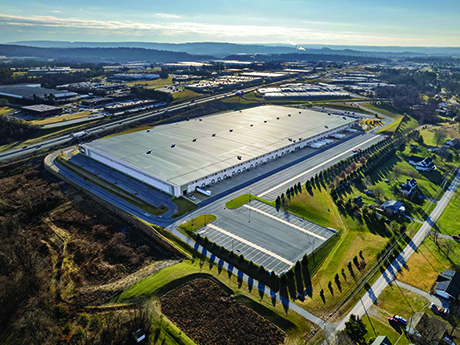
NEW YORK CITY AND RADNOR, PA. — Mapletree, a global real estate development, investment, capital and property management company, has completed the sale of an industrial portfolio located along the East Coast for $575 million. EQT Real Estate, an industrial owner-operator based in Radnor, was the buyer. Totaling 4.4 million square feet, the logistics portfolio comprises 25 warehouse properties located in Connecticut, Florida, Georgia, New Jersey, North Carolina, Pennsylvania, Tennessee, Virginia and Washington, D.C. Of the assets, 24 were held under Mapletree US & EU Logistics Private Trust (MUSEL), a closed-end private fund established in 2019. MUSEL launched with $4.3 billion in assets under management. The additional property included in the portfolio was held under the Mapletree US Logistics Private Trust (MUSLOG), a closed-end private fund launched in 2021 with a portfolio of 155 logistics properties totaling $3.3 billion in value. “This divestment reflects the successful execution of our closed-end fund strategy and illustrates the strength of our U.S. industrial platform,” says Richard Prokup, CEO, U.S., at Mapletree. “Looking ahead, we remain confident in the logistics sector’s long-term fundamentals as we advance new development opportunities nationwide to grow our pipeline.” Last year, Mapletree sold another portfolio to EQT for $242 million. …
In the digital age, nearly everything is accessible online — entertainment, shopping, friendship, you name it. With a few taps on a screen, we can order three pairs of jeans, have a pizza delivered and carry on a meaningful conversation without ever leaving the couch. Considering that Generation Z — those born roughly between 1996 and 2013 — has grown up immersed in this digital reality, it would be easy to assume they have little interest in traditional, in-person experiences. Surprisingly, the opposite is true. From pop-ups, influencers, to retail, Gen Z are securing their Labubus to their bags and heading out the door to shake up our understanding of successful contemporary retail experiences. After coming of age during COVID, living through what has been called an “epidemic of loneliness,” Gen Z is craving in person experiences more than ever, and where better to go with your friends than the mall? A reported 69 percent of Gen Z shoppers say they prefer shopping in brick-and-mortar stores over online alternatives. However, their renewed interest in physical spaces doesn’t mean a return to retail as we once knew it. Instead, Gen Z is fundamentally reshaping what in-person shopping and entertainment look like …
HOUSTON — Locally based developer Fein has begun leasing Echo Lake, a 326-unit apartment community in North Houston. The site spans 21.4 acres within the CityPlace mixed-use development, and the property is named after the 1.2-acre lake and trail system that serves as a focal point of the project. Designed by Steinberg Dickey Collaborative, built by Westchase Construction and financed by Comerica Bank, Echo Lake comprises two- and three-story buildings that house one-, two- and three-bedroom units and Class A amenities. About 40 percent of the units are townhouse-style residences with attached garages. Fein developed Echo Lake in partnership with Open House Group. The first move-ins are now underway, with rents starting at roughly $1,300 per month for a one-bedroom apartment. Construction began last spring.
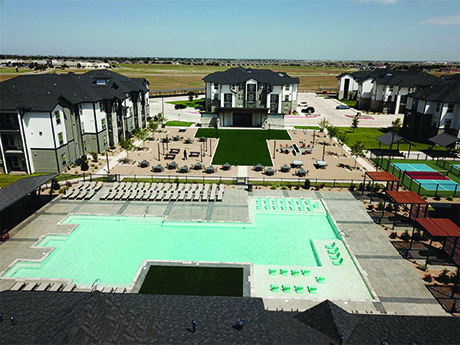
RED OAK, TEXAS — Wan Bridge, a Texas-based developer of build-to-rent residential communities, is nearing completion of The Reserve at Red Oak, a 166-unit project located south of Dallas. The 18-acre development offers three- and four-bedroom homes that range in size from 1,501 to 1,857 square feet with garages, as well as a playground, dog park and fitness facilities. Leasing is underway, and rents start at roughly $2,100 per month. A grand opening ceremony will take place in the coming days.
HOUSTON — San Antonio-based Headwall Investments has purchased a 34,128-square-foot shopping center in northwest Houston. Known as Louetta Retail Center after the neighborhood of the same name, the center was built in 2006 and is home to tenants such as Chrysolite Aesthetics, DR Brassell Eyecare, GN Hearing, Houston Retina, Danny Chirla, Dogtopia and Medella. Matt Maglothin of Altrue Capital brokered the deal. The seller and sales price were not disclosed.
NORTH RICHLAND HILLS, TEXAS — New Hampshire-based Planet Fitness has opened a 15,817-square-foot gym in North Richland Hills, located on the northeastern outskirts of Fort Worth. The space is located within North Park Plaza shopping center and previously housed a Big Lots. The club is the 62nd in the Dallas-Fort Worth metroplex and 83rd overall in Texas for the franchise operator, Excel Fitness.
NEW YORK CITY — JLL has arranged the $129 million sale of Henry Hall, a 33-story multifamily building located at 515 W. 38th St. in Manhattan’s Hudson Yards district. Completed in 2017, Henry Hall houses 225 units in studio, one- and two-bedroom floor plans, in addition to 12,500 square feet of ground-floor retail space. Amenities include a fitness center, landscaped terrace and a “jam room” with professional music recording equipment. Jeffrey Julien, Rob Hinckley, Steven Binswanger, Steven Rutman and Devon Warren of JLL represented the seller, a joint venture between Shorenstein Investment Advisers and Dreamscape Cos., in the transaction. Geoff Goldstein and Christopher Pratt, also with JLL, arranged a $71 million acquisition loan for the deal through U.S. Bank on behalf of the buyer, Amstar Group.
BELLEVILLE, N.J. — Connecticut-based SYM Investments has purchased SilverLake Apartments, a 232-unit multifamily complex in Belleville, about 10 miles west of New York City, for $80 million. Completed in early 2022, SilverLake Apartments consists of two five-story buildings that feature studio, one- and two-bedroom floor plans. Amenities include a fitness center, dog park, game room, entertainment lounge with a kitchen, rooftop terrace, business center and package lockers, as well as 17,024 square feet of commercial space that is fully leased. Mike Oliver, Steve Simonelli, Jose Cruz, Elizabeth DeVesty and Austin Pierce of JLL represented the seller, Baltimore-based developer Klein Enterprises, in the transaction. Michael Klein, Thomas Didio Jr., Gerard Quinn and Joseph Gruber, also with JLL, originated a $56 million Freddie Mac acquisition loan on behalf of SYM Investments.
HOLYOKE, MASS. — WinnCos. has completed a $55.3 million seniors housing redevelopment in the western Massachusetts city of Holyoke. Residences at Appleton is an adaptive reuse of a former alpaca mill complex that has been vacant since the 1970s into an affordable housing complex for residents age 55 and older. Of the property’s 88 units, 12 are reserved for seniors earning 30 percent or less of the area median income (AMI); 63 are earmarked for renters earning 60 percent of AMI; and 13 are set aside for those earning 80 percent or less of AMI. The unit mix comprises four studios, 75 one-bedroom residences and nine two-bedroom units. Amenities include a fitness center, resident lounge and an outdoor recreation area. Keith Construction served as the general contractor for the project, which was designed by The Architectural Team. VHB provided civil engineering and permitting services. Local nonprofit OneHolyoke provided gap financing for the project, and Bank of America served as the construction lender and the investor in the project’s state and federal low-income housing tax credits. MassHousing also provided tax-exempt bond financing for the development.