By Taylor Williams In the eyes of some commercial brokers, especially those who represent tenants, there actually is such a thing as too little vacancy. When markets are running super-hot, meaning demand is far outstripping supply, tenants have minimal options and often end up paying premiums just to be able to secure space. That’s great for landlords — to a point — because markets can only bear so much rent growth in so much time before tenants start looking for workarounds to physical occupancy. Enter the Dallas-Fort Worth (DFW) industrial sector, which has been on fire for the past seven-plus years. Explosive volumes of new deliveries, frenetic paces of absorption, stiff competition for space, record levels of rent growth and a national coming-out party as an undeniable Tier 1 market have all been hallmarks of this activity. But such torrid paces of growth were never really sustainable in perpetuity, and although both the supply and demand sides of the market have cooled, the slowdown in some ways reflects a return to healthier dynamics. Editor’s note: InterFace Conference Group, a division of France Media Inc., produces networking and educational conferences for commercial real estate executives. To sign up for email announcements …

Property Type
By Michael Gelfman, Colliers Like many major cities across the U.S., the Minneapolis-St. Paul office market remains soft while office users continue to adjust to the shifting dynamics of work brought on by the global pandemic. The gap between performing and non-performing buildings, driven by challenging debt markets, evaporation of building owners’ equity and the impact of hybrid work on office space demand, is growing. Building owners are faced with difficult and often expensive decisions: spend what’s needed to create a highly amenitized environment (necessary to compete) that attracts tenants and draws employees back to the office or face a race to the bottom. For tenants in the market, this perfect storm has created unprecedented opportunity. Hybrid work is here to stay For the last several years, many have wondered where the office market in Minneapolis-St. Paul was heading. The pandemic fundamentally changed the way companies use office space — was hybrid work a temporary solution to a once-in-a-lifetime event or was it here to stay? Today we know the answer: hybrid work is here to stay. As a result of this seismic shift, some of which is due in part to artificial intelligence, many tenants over the last few …
Content PartnerData CentersFeaturesHospitalityLife SciencesLoansMidwestMultifamilyNortheastOfficeSelf-StorageSoutheastTexasWestern
C-PACE Maintains Appeal in Lower Interest Rate Environment
The Federal Reserve’s decision to begin aggressively hiking the federal funds rate in 2022 threw the commercial real estate market into turmoil. Property investors found it difficult to refinance much cheaper short-term loans that were often used to renovate or develop properties. However, the interest rate spike greatly enhanced the viability of commercial property assessed clean energy (C-PACE) financing, a type of loan that becomes an assessment that borrowers pay along with their tax bill. The program emerged more than a decade ago and generally pays for energy, water and seismic resiliency upgrades in new construction and rehabs, including retroactively. As a result, developers embraced C-PACE as they sought ways to pay down debt to secure new financing or loan extensions and modifications. Sponsored: A smarter way to finance your next CRE project – PACE Loan Group Now that the Federal Reserve has reversed course with its 50-basis-point federal funds rate reduction in September — and with Wall Street anticipating additional rate cuts before the end of the year — will C-PACE demand start to cool? Don’t count on it, says Rafi Golberstein, founder and CEO of PACE Loan Group, a direct lender of C-PACE financing based in Minneapolis, Minn. …
FORT WORTH, TEXAS — Google has signed a 1.1 million-square-foot industrial lease in Fort Worth, according to reports from multiple news outlets, including Dallas Morning News and the Dallas Business Journal. The latter publication reports that the building is located within Majestic Silver Creek Business Park, a 520-acre development on the city’s west side that is owned by California-based Majestic Realty. The DBJ also reports that the deal is part of a larger initiative in which the California-based tech giant pledged to invest $1 billion in Texas markets to support its cloud infrastructure and data center operations.
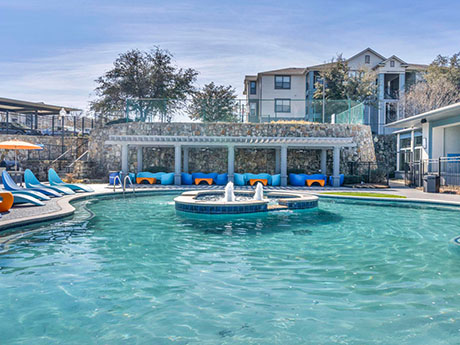
DENTON, TEXAS — Institutional Property Advisors (IPA), a division of Marcus & Millichap, has negotiated the sale of Gateway at Denton, a 696-bed student housing property that serves students at the University of North Texas. Built in 2005, the 228-unit complex is located within a half-mile of campus and features a mix of two-, three- and four-bedroom floor plans with complete bed-bath parity. Units range in size from 816 to 1,360 square feet. Amenities include a newly renovated clubhouse, three pools with cabanas, outdoor grilling and dining stations, basketball court, fitness center and a computer lab. Peter Katz and Drew Kile of IPA represented the seller, Los Angeles-based MJW Investments, in the transaction and procured the buyer, Vesper Holdings.
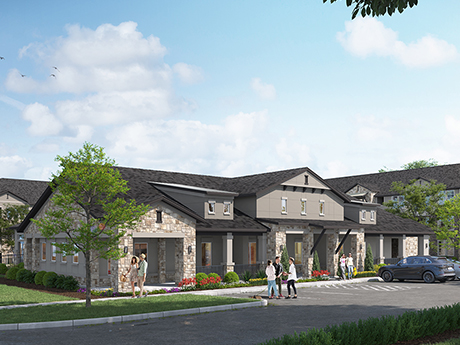
PROSPER, TEXAS — Dallas-based developer SWBC has broken ground on The Royalton at Prosper, a 270-unit multifamily project that will be located on the northern outskirts of Dallas. The site is adjacent to SWBC’s The Royalton at Creeks of Legacy development, which also totals 270 units and is currently in lease-up. Units at the new property will come in one-, two- and three-bedroom floor plans, and select residences on the first floor will have private yards and direct-access garages. Amenities will include a clubhouse with a business center, 24-hour fitness center and a resort-style pool with cabanas and grilling stations. Cross Architects is designing the project, and Carleton Cos. is serving as the general contractor. The first units are expected to be available for occupancy next summer.
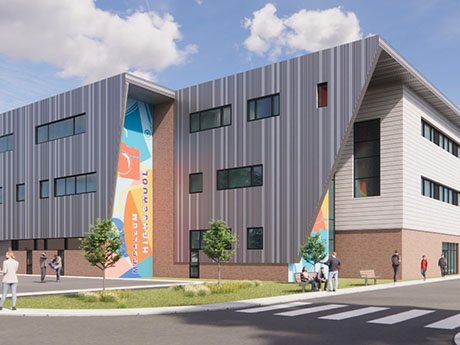
AUSTIN, TEXAS — Adolfson & Peterson (AP) Construction has been awarded the contract to renovate McCallum High School, which is part of the Austin Independent School District and located on the city’s north side. The school originally opened in 1955 and serves roughly 1,500 students. The project team will demolish the existing 30,000-square-foot science wing and deliver a 50,000-square-foot facility with computer labs, robotics, a wood shop and spaces for biology, chemistry and physics classes. In addition, the entry vestibule and front office will be reconfigured/remodeled for enhanced security. PBK Architects is leading design of the renovation, which is expected to begin in May 2025 and to be complete in fall 2026.
CELINA, TEXAS — Lowe’s Home Improvement will open a 94,000-square-foot store in Celina, located at the convergence of Collin and Denton counties in North Texas. The North Carolina-based retailer will join the tenant roster at The Crossing at Moore Farm, a 100-acre mixed-use development located along Preston Road. The store will be situated on a 14-acre site, and Lowe’s expects to receive its certificate of occupancy by March 2027.
WATERTOWN, MASS. — New York-based Clarion Partners has received a $94 million loan for the refinancing of LINX, a 185,015-square-foot life sciences facility in the western Boston suburb of Watertown. Completed in 2018, the two-story facility was fully leased at the time of the loan closing to three tenants: C4 Therapeutics, Addgene and Tectonic Therapeutic. Amenities include a grab-and-go café, indoor bike storage space, a locker room with showers, green space, a bocce ball court and shuttle service to Harvard Square. Riaz Cassum, Amy Lousararian and Robyn King of JLL arranged the five-year loan through European lender Société Générale on behalf of Clarion Partners.
LAWRENCEVILLE, N.J. — New Jersey-based intermediary Cronheim Mortgage has arranged a loan of an undisclosed amount for the refinancing of a 104-room Motel 6 hotel in Lawrenceville, located just outside Trenton. The hotel was originally constructed in 1978 and also houses a PJ’s Pancake House restaurant. Brandon Szwalbenest and Andrew Stewart of Cronheim Mortgage arranged the debt through an undisclosed local bank. The name of the locally based borrower was also not disclosed.