

By Joshua Metzger, studio director, principal, Gensler
The Emerging Trends in Real Estate 2026 publication jointly released by PwC and the Urban Land Institute (ULI) found that North Texas benefitted from more than 100 corporate headquarters relocations between 2018 and 2024, drawn by a business-friendly climate, robust infrastructure and a growing talent pool.
The launch of the Texas Stock Exchange (TXSE), Nasdaq Texas and the reincorporation of the New York Stock Exchange’s regional office from Chicago to Dallas as NYSE Texas are further cementing the area’s status as a financial powerhouse. JPMorgan Chase, Citigroup, Charles Schwab and Fidelity are among the top employers in North Texas, while Wells Fargo recently opened a new $455 million campus in Las Colinas. All this momentum and more has made Y’all Street — the moniker used to contrast Texas’ growing market to Wall Street — the second-largest financial services market in the country, trailing only New York City.

The sublease availability of office space in Dallas has dropped to 3.6 percent of total inventory, signaling strong demand and confidence in the market. The Dallas neighborhoods of Uptown and Turtle Creek are bracing for a surge in development, while suburban mixed-use projects continue to thrive. All these indicators suggest that the financial services industry is not only expanding in the Dallas-Fort Worth (DFW) market, but flourishing.
Confidence in the Market
One of the most telling indicators of market stability involves a shift in lease terms.
Companies moving to North Texas are more frequently signing leases for 10 to 12 years, compared to the previous norm of five to seven years in the immediate post-pandemic era. Bank of America, for example, recently renewed its lease at Hallmark Center in North Dallas for 10 years.
This trend isn’t about securing space or square footage; it’s about investing in experiences, especially those that attract and retain top-tier talent. Longer commitments suggest that firms see the region as a long-term strategic base.
In today’s tight capital environment, the projects that survive share one defining trait: They deliver certainty — certainty of demand, experience and long-term value. The DFW market is bifurcated. Trophy and Class A assets in Uptown, Preston Center and Far North Dallas are thriving. Capital is flowing only to assets that can prove they’re not just square footage, but strategic tools for talent attraction and retention.
The Tech Disruption Factor
While DFW enjoys relative stability, the financial industry nationwide is grappling with volatility driven by artificial intelligence (AI) and emerging technologies. These innovations are reshaping everything from operational workflows to client-facing services.
An August 2025 study conducted by Deloitte underscored the disruptive impact of AI in the financial services industry, particularly agentic AI; an advanced form of artificial intelligence that creates goals, makes decisions on its own and executes complex tasks. Agentic AI, the report said, will likely usher in a new operating model for banks where the AI agents are performing previously human-operated tasks such as analysis, research and simulation under the supervision of humans. Additionally, AI-to-client banking transactions would replace traditional human-to-client commerce. Implementing this paradigm shift is a massive undertaking and requires hiring more tech-driven expertise.
After completing its own assessment of AI in the financial services sector, a 2024 U.S. Treasury Department report recommended that the “financial services sector and government agencies…develop data standards, share risk management best practices and enhance understanding of emerging AI technologies in financial services.” In other words, investment in human intelligence and expertise is needed not only to implement these systems, but to supervise and perfect them.
Thus, financial firms have been hiring tech talent at an unprecedented pace to manage these changes and develop new offerings. According to a 2024 Wall Street Journal story, newly minted tech talent is giving serious consideration to the financial services industry as another option to Silicon Valley. The article cited a 16 percent uptick in computer science graduates at Cornell University and Carnegie Mellon University who entered financial services after college. As AI plays a more central role in operational and client-facing services, we can expect that those numbers will only go up.
This evolving playing field means that office spaces can no longer be static. They must support rapid innovation, collaboration and adaptability. The integration of AI into financial services isn’t just a back-office phenomenon — it influences how companies interact with clients, manage data and deliver personalized experiences.
At this year’s FinTech LIVE conference in London, AI was a major topic of conversation among industry leaders. Many of them said that AI has introduced “speed of delivery” as a major key performance indicator (KPI) for companies refining their operations and client-facing services. Scale matters, and when optimized properly, AI can be an accelerant.
Urban vs. Suburban: The Strategic Choice
Among the most significant decisions corporations are making now is whether to invest in urban versus suburban locations as they look for ways to perfect employee and client experiences. Leaders are examining the question because new research data illustrates a shift in demands and expectations for how the workplace should look and feel.
Gensler’s own 2025 City Pulse Survey illustrated this fact, citing livability benefits as a major driver of an area’s attractiveness. Submarkets like Frisco, Plano and Las Colinas are leading in terms of absorption of office space, driven by shorter commutes, strong demographics and amenity-rich Class A spaces.
In Dallas, the Uptown and Turtle Creek submarkets offer proximity to cultural amenities and walkable neighborhoods, appealing to younger professionals and Generation Z — DFW’s fastest-growing demographic. Meanwhile, suburban developments provide expansive campuses with integrated retail, dining and residential options. Both urban and suburban settings offer their own unique benefits, but the catalyst for success is the presence of mixed-use environments.
Designing for the Future, Employee Experience
After settling the question of where to invest, the conversation shifts to how a company should invest, and that involves a design approach that is strategic, adaptable and sustainable.
Today, the design of financial office spaces is undergoing a transformation. While functionality remains an essential component of interior design, these environments must now also fully integrate flexibility, convenience and security.
Office spaces must adjust to users’ needs and adapt to evolving workflows and technology. This is especially true as companies rapidly hire new tech talent, infusing new expectations and demands within the existing culture. Integration of modular furniture, movable walls and multi-purpose zones allow organizations to respond to those demands and pivot quickly when they change.
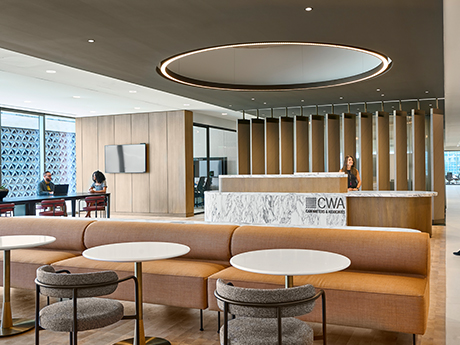
Companies want collaborative zones for brainstorming, quiet pods for focused work and seamless digital infrastructure. These features aren’t perks. They are essential elements for attracting and retaining talent in a competitive market. Design translates into trust and sophistication. A well-designed office communicates stability, innovation and a commitment to excellence. It’s a physical manifestation of a company’s brand and values.
Applying security and convenience to all sides of interior design is another must-have. Amenities such as wellness rooms, collaborative lounges and integrated digital tools are no longer considered add-ons, but critical assets for enhancing employee satisfaction and productivity. With the introduction of AI-driven operations and the presence of sensitive financial data, robust cybersecurity measures and secure physical spaces are non-negotiable.
Looking Ahead
The trends shaping DFW’s financial market and office design are not temporary; they are the strategy for the next decade. We should expect a more diversified ownership landscape, with private capital shaping a market that’s less dominated by institutional core funds and more by entrepreneurial, locally connected investors.
As AI and technology continue to disrupt, adaptability will be the defining characteristic of successful office environments. Incremental change isn’t enough — bold moves toward experience-driven, resilient design will define success. Companies that invest in flexible, tech-forward spaces will not only weather the volatility, but thrive on it.