

By Michael Poris, McIntosh Poris Architects
Long defined by its industrial legacy, Detroit development currently combines ground-up construction with intelligent, innovative adaptive reuse. Brick-and-mortar manufacturing-era remnants include many buildings that originally served the automotive industry. As large-scale manufacturing relocated and Detroit’s population declined, several significant buildings were abandoned. Many are viable for second lives, ones that fulfill current commercial real estate market demands.
Adaptive reuse makes sense
I co-founded McIntosh Poris in 1994 to protect Detroit’s historic buildings from bulldozers and redesign them for a post-manufacturing economy. At that time, demolition was the most expedient option.

To address this, we focused as much on civic networking and preservation education as architectural design. Implementation involved organizing events with public officials and the local business community to meet leaders of other cities’ successful urban-renewal programs. To make Detroit more attractive to commercial real estate investment, we lobbied for zoning changes. Most relevant, commercial and historic districts were re-evaluated to permit mixed-use redevelopment. Historic preservation became viable, often making sense both financially and culturally.
Well before sustainability became a commercial real estate consideration, we educated developers on available adaptive reuse incentives such as historic tax credits. Combined with the inherent efficiencies of reuse, including reduced embodied carbon and construction waste (estimated as about 40 percent of all landfill content), tax incentives helped accelerate adaptive reuse projects across the city. Bedrock Detroit and Olympia Development notably helped lead Detroit’s urban revival and preservation of several legacy buildings.
Today, adaptive reuse has proven viable across a wide range of building types, including housing, hospitality, civic and workplace projects. Several examples below illustrate historic preservation’s viability and adaptability.
Housing opportunities
Detroit’s economic recovery remains slower than some major Midwestern cities. Multifamily housing across a range of affordability levels is Detroit’s primary commercial real estate need. Public financing tools — low-income housing tax credits (LIHTC) plus additional local, state and federal funding — make residential conversions more viable than ever, particularly when paired with the city’s substantial inventory of industrial and institutional buildings.
One prominent example is Fisher 21 Lofts, which is currently under construction. Formerly the Fisher 21 Plant, a 600,000-square-foot factory that produced Cadillac and Buick car bodies from 1919 to 1984, the building sat vacant for nearly 30 years. Working with developers Greg Jackson and Richard Hosey to create a viable reuse strategy, our team repositioned the property for multifamily mixed-use while preserving its industrial character.
The project will deliver 433 apartments — 20 percent reserved for low-income-qualified residents — alongside job-creating ground-floor retail and tenant coworking space. Additional shared amenities include a landscaped rooftop. Public financing sources for the $134 million project combine historic tax credits with Neighborhood Enterprise Zone (NEZ) and Obsolete Property Rehabilitation Act (OPRA) abatements, as well as brownfield tax-increment financing.
Completed projects demonstrate the scalability of repurposed auto manufacturing and industrial buildings. Amsterdam Lofts converted Cadillac’s first assembly plant into 90 apartments within a building listed on the National Register of Historic Places. The Assembly, a warehouse from 1913, was adapted into a mixed-use development for Bedrock, incorporating retail and dining at street level, office space and 32 market-rate apartments. A fifth floor was added to accommodate loft apartments and a rooftop lounge.
Beyond industrial buildings, decommissioned schools are particularly well suited to residential second lives, offering generous floor plates, durable construction and a strong neighborhood presence. Our firm is currently involved in several such projects, including the conversion of Grosse Point’s first public school, originally opened in 1906, into 18 apartments with eight additional townhomes on an adjacent infill site. At Higginbotham Apartments, a 1926 Historic Register-listed school in the Eight Mile/Wyoming neighborhood, we transformed the building into 100 affordable units, complemented by 60 new apartments constructed on the site.
Adaptive reuse also supports civic and cultural reinvestment. At the Woodward Garden Theater, our team participated directly in fundraising efforts to restore and modernize a historic 1,100-seat performance venue in Midtown, along with two adjacent office buildings. The project preserved the architectural shells while reintroducing a significant cultural anchor to a previously underutilized area of the city.
Hospitality and workplace
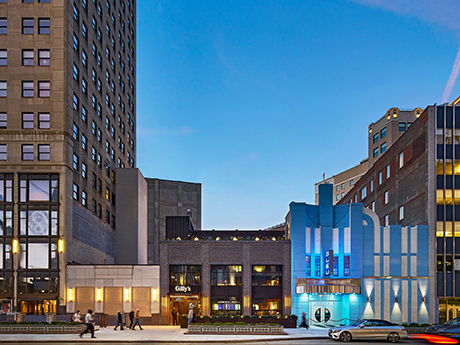
Hospitality projects are especially viable for adaptive reuse, as older buildings often offer attractive character and space for hotels, restaurants and entertainment concepts. Recent examples include Olin Bar & Kitchen, located within an Art Deco building that previously housed a puppet theater. Gilly’s transformed an abandoned department store into a multi-level sportsbar and restaurant with a basement speakeasy.
Among our firm’s most recognized hospitality projects is the Foundation Hotel, an adaptive reuse of the original Detroit Fire Department Headquarters for the Aparium Group. The boutique hotel preserves the building’s civic grandeur and has received numerous national design awards.
While workplace demand in Detroit currently trails housing and hospitality, adaptive reuse continues to play a role in specialized office environments. At The Factory at Corktown, two adjacent 1907 hosiery factories were converted into office and R&D space for Ford. The project demonstrates how legacy industrial buildings can accommodate current demand without sacrificing their architectural identity.
In some cases, reuse projects evolve as occupants’ needs change. We worked with developer Midtown Detroit to add upper-level apartments to an 1896 commercial building. Building tenant Ralph C. Wilson Jr. Foundation grew beyond its existing office footprint and desired an additional floor, so we reconfigured some of our previous residential units into workspace. Further, the Ralph C. Wilson Jr. Foundation sponsors a ground-level coworking space for local nonprofits in the building, which our team was honored to design.
To date, McIntosh Poris Architects has contributed to the preservation and reuse of nearly 100 historic buildings in Detroit. For developers evaluating projects in the city, adaptive reuse merits early consideration during due diligence. With the guidance of experienced preservation architects and a clear understanding of available tax credits, public financing tools and permittable design, adaptive reuse of existing buildings can be cost-competitive with new construction. It also offers resilient, lower-carbon construction and connections to Detroit’s architectural and industrial history.
Michael Poris is a founding principal of McIntosh Poris Architects. This article originally appeared in the February 2026 issue of Heartland Real Estate Business magazine.