

Adaptive reuse has always been an astute trend when it comes to utilizing location, existing bones, and saving a little time and money on delivery. It’s also particularly useful in submarkets like the southeast Las Vegas submarket of Henderson where strong population growth and rising household incomes outpace the availability of new retail.
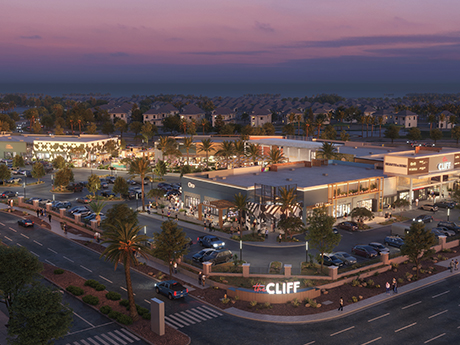
This long-standing unmet demand for Class A retail has inspired one developer to reshape how it views underperforming office assets. Steve Neiger, managing principal at CAST Capital Partners, is co-developing the Cliff, a 100,000-square-foot office-to-retail conversion in Henderson’s Green Valley Ranch submarket.

The project involves the repositioning of a vacant, low-density suburban office property that had struggled to remain competitive as newer product and shifting workplace trends weighed on demand. Rather than pursue a traditional office lease-up or a residential conversion, the development team, which includes Partners Capital, is transforming the site into an open-air retail and dining destination designed to better align with the area’s demographics, accessibility and surrounding residential density.
The repositioning reflects a broader trend in how developers are evaluating aging office assets in high-growth suburban markets, particularly where strong consumer demand is not being met by existing retail supply. Situated along Paseo Verde Parkway, the Cliffs sits in a highly trafficked, amenity-rich corridor where retail, hospitality and residential uses are already proven.
This project strives to add an experience-driven retail environment to the mix. The first round of tenants includes Arhaus, the Taco Stand, Killer Whale Creamery, supplement lounge and social wellness space Lyte House, exotic plant retailer and café Barista Botanist and modern wellness experience Next Health. The Cliffs is expected to break ground this year, with tenant openings targeted for late 2026.
WREB recently sat down with Neiger to discuss the fundamentals behind the deal, what signals supported the repositioning and where similar opportunities may be emerging across the Las Vegas Valley.
WREB: What originally led CAST to see this Henderson office property as a retail opportunity rather than pursuing another office use or a residential conversion?
Neiger: CAST has primarily focused on retail projects, and while the team has been involved in residential and office as principals, that’s not its primary focus. The group is also deeply familiar with the Las Vegas market, with a strong understanding of local demographics and which communities remain underserved when it comes to retail, entertainment and food-and-beverage offerings.
Henderson has been underserved for years, and that gap was evident. When we looked at the vacant office property, its location within the Green Valley Ranch master-planned community and the surrounding density made it much better suited for a retail and dining environment than continuing as office or converting to residential.
WREB: What signals told you there was enough unmet retail demand in the Green Valley Ranch area to support a new lifestyle retail concept?
Neiger: Henderson has lacked new Class A retail development for nearly two decades. The District at Green Valley Ranch, which opened in 2004, has been the primary lifestyle retail destination serving the area. This city has needed more for a long time. The Cliff is a response to long-standing demand from residents who have been looking for something modern, elevated and experience-driven.
Don’t get me wrong — the District has performed exceptionally well over time. But when you compare that to Summerlin, the master-planned community in west Las Vegas known for its much larger concentration of Class A retail and dining, the gap in the Henderson market becomes clear.
Part of the challenge is that Henderson has not historically had a strong “center of gravity” for Class A retail. Many brands look for an established cluster of similar tenants within a submarket. That is what we are working to help create. Green Valley Ranch already has many of the right components, including retail, hospitality, fitness, office and residential. When you look at it as a cohesive mixed-use destination rather than a collection of individual assets, the strength of the location and the brand becomes much more apparent. That broader view is what makes this such a compelling opportunity.
WREB: Across the Las Vegas Valley, what characteristics make an older suburban office property a good candidate for retail repositioning?
Neiger: Two of the “holy grails” in retail are demographics and density. All operators — from retail to dining to experiential — want strong population density and households with meaningful discretionary income. The more discretionary income, the more spending power customers bring to stores and restaurants. In Las Vegas specifically, that demand tends to be concentrated within master-planned communities like Summerlin and Green Valley where you have established residential density and higher household incomes.
Retail also needs to be easily accessible and visible in a very car-driven market, so location and connectivity matter just as much as the underlying demographics. Once those fundamentals are in place, you look at broader market indicators, including occupancy across existing retail, the performance of nearby centers and where residential growth is occurring. Without that combination, repositioning an office property into retail becomes much more difficult to execute successfully.
WREB: How did demographic changes in Henderson influence the tenant mix you’re pursuing at the Cliff?
Neiger: Henderson’s population has grown by roughly 25 to 30 percent since 2014, adding more than 75,000 residents. A lot of that growth has been driven by in-migration, particularly from higher-cost markets like California and other parts of the West. As people relocate to Southern Nevada for a different quality of life, expectations around retail and dining have evolved as well. There’s a growing demand for more elevated, experience-driven concepts that have historically been concentrated in places like Summerlin or on the Strip. Our tenant mix reflects that shift.
We’re focused on bringing in operators and brands that align with how people are living today and what they’re looking for closer to home. At the end of the day, it’s about serving a larger, affluent residential base that has been underserved for a long time.
WREB: Looking beyond this project, do you see more opportunities across the Las Vegas market where underperforming office properties could be repositioned into retail or mixed-use destinations?
Neiger: There will likely be opportunities for adaptive reuse, but it’s not a one-size-fits-all solution. Not every office property translates well to retail or mixed-use. It really comes down to fundamentals like location, surrounding density and household income. Across the Las Vegas Valley, you’re seeing continued population growth, strong in-migration and rising household incomes in certain submarkets. At the same time, some older office product is facing challenges. Where those dynamics overlap, there is potential for repositioning.
That said, ground-up development is often more straightforward, so, in many cases, that remains the preferred path. But in the right submarkets — where there’s a clear mismatch between the strength of the consumer base and the available retail and dining options — adaptive reuse can be a very effective strategy.
— Nellie Day