

By Aran McCarthy, president, FCA
Healthcare providers and designers of those facilities are dedicated to creating spaces that meet the ever-growing demand for their services. Despite this desire, cities and towns nationwide are struggling to meet the needs of their growing populations.
According to the Health Resources and Services Administration, as of January, there are more than 4,800 health professional shortage areas (HPSAs) for primary care facilities in the country. This disconnect between the need for care and the number of facilities equipped to support delivery of said care is on full display, and therein lies opportunity.

Markets across the country are simultaneously dealing with a very different challenge; changes in consumer habits have created vacancies within retail real estate. In response to these trends, healthcare designers and system leaders have recognized that the adaptive reuse of former retail properties into “medical malls” offers a practical solution to increasing access to care. This approach prioritizes speed to market and cost efficiency for operators and also enhances community access without the long and costly timelines associated with new construction.
Physical Synergy: Repositioning Retail for for Healthcare
The physical features associated with many big-box retail locations make them particularly well-suited for healthcare conversions. Large floor plates, high ceiling heights and generous parking allotments — these design features mirror many of the elements that characterize outpatient clinics, diagnostic centers and other specialty practices.
However, reimagining retail facilities for medical use is not as simple as modifying layouts and adding exam rooms to an empty shell. Early feasibility studies should be utilized to examine existing structural realities: column spacing, roof loading capacity, mechanical systems and floor-to-floor heights. These features all represent critical considerations when determining opportunities and existing constraints of a potential conversion.
Fostering this understanding in early phasing allows project teams to better streamline layouts, avoid costly surprises and optimize investment well before construction begins. When approached strategically, these buildings are able to support a wide range of clinical programs while offering greater flexibility.
Key Benefits: Speed to Market and Cost Efficiency
A primary draw of this approach remains the speed at which proposed conversions take place.
Traditional healthcare construction timelines vary greatly but often require several years in development through early phasing to final completion. In areas already struggling to meet demand, this might mean extending care timelines for a significant portion of a community. In contrast, adaptive reuse and conversions can shorten that timeline from a few months to a year.
Financially, these conversions provide a base for reuse that eliminates many of the costly upfront considerations. When foundations, structural and mechanical systems and building envelopes remain in place, shorter lead times and pre-approved regulatory hurdles help reduce projected timelines and budget allocation significantly. The sustainability benefits of adaptive reuse initiatives provide another compelling reason to prioritize this approach, reducing waste and emissions while simultaneously lowering costs.
The Power of Localized Specialty Care
Consolidating primary and specialty care facilities into a “medical mall” style environment — whether in an existing shopping center or retail campus — is a trend that has continued to gain traction due to the ability to provide more convenient access to healthcare.
Typically located near main roads and accessible through public transportation, these previously vacant spaces, when transformed intentionally in established business districts, are often already ingrained in the existing routines of the community. Their transition to supporting the surrounding area is thus seamless, entailing the simple repositioning of an area that locals already frequent.
For owners and designers, the size of existing floor plates of former retail centers makes the consolidation of previously disparate care types in one campus much easier. At the same time, the pooling of resources allows providers to share imaging suites, laboratories, waiting areas and support spaces as needed. This not only lowers investment costs but also allows funding to be allocated to enhancing patient care rather than duplicating areas for administrative tasks.
Retail, Multi-Specialty Practice
An example of this in action is FCA’s recent work at Hackensack Meridian Health’s Eatontown Multi-Specialty Practice Center in Northern New Jersey. This project involved the repurposing of a vacant former Designer Shoe Warehouse (DSW) store and the adjacent Toys ‘R’ Us store, consolidating approximately 45,000 square feet into a single destination.
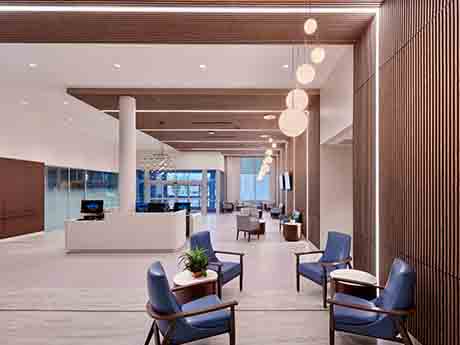
The conversion allowed for the colocation of a central urgent care center with 36 flexible exam rooms supporting cardiac and primary care, as well as spaces for imaging, neurology, rehabilitation, women’s oncology and dedicated lab services. This multi-faceted project was designed for maximum adaptability, allowing individual practices to grow and flex with evolving needs. The center further utilizes a centrally located check-in paired with a light-filled waiting area that supports the entire facility.
One key consideration throughout the design and development of this project was the large need for handwashing stations. While seemingly a simple consideration, traditional retail stores are not typically equipped with plumbing systems to support strict sanitation protocols. To meet this need, the team worked diligently to retain as much of the existing slab as possible in an effort to keep costs down, though substantial modifications were inevitably required to accommodate the increased plumbing and drainage needs of the medical facility. This is a textbook example of a key factor to consider when planning projects of this type.
Beyond internal considerations, condition and appearance are both strong factors when examining exterior architecture. While this location did not require significant architectural modification, it did necessitate some reimagining to identify and brand the facility as part of the Hackensack Meridian Health network. Critically, an existing loading dock for the building provided a substantial advantage. While often overlooked, preexisting loading docks can provide huge cost savings for a retail-to-healthcare conversion, and projects without one can quickly make a space prohibitive for efforts like this.
The Eatontown facility ultimately serves as a prototype for other multi-specialty practices, allowing Hackensack to expand its reach and commitment to providing accessible, high-quality care in a patient-centered environment.
A Solution for Communities Nationwide
As designers and practitioners continue to pilot new avenues to provide more efficient ways to expand healthcare delivery, “medical malls” have emerged as compelling vehicles for addressing the twofold issue of vacant retail spaces and growing healthcare needs.
By offering ways for facilities to colocate to share resources and opportunities to reinvest in existing local infrastructure, retail-to-healthcare adaptive reuse provides a way to increase community access, operational efficiency and long-term flexibility.