

By Beth Mattson-Teig
Healthcare REITs are well-capitalized, and they’re putting that significant financial muscle to work with big moves to expand their seniors housing portfolios.
As the world’s largest healthcare REIT with a market capitalization of nearly $170 billion, Welltower Inc. (NYSE: WELL) continues to dominate the investment market. Year-to-date through mid-August, Toledo, Ohio-based Welltower had a staggering $15.5 billion in new investments that it had closed or under contract, and another $6 billion in deals in the pipeline.

A major focus for the REIT has been expanding its Seniors Housing Operating Portfolio (SHOP) platform. SHOP allows REITs to share in the operational upside of properties compared to the fixed rents with traditional triple-net lease structures (see sidebar).
Across the industry, there is no shortage of mega-deals. American Healthcare REIT Inc. (NYSE: AHR), based in Irvine, California, recently announced plans to acquire eight seniors housing properties managed by Kensington Senior Living for $873 million.
Earlier this year, Chicago-based Ventas Inc. (NYSE: VTR) announced a $540 million deal to acquire a majority stake in an 11-community luxury senior living platform owned by the Wolff Co.
It’s no secret that REITs have been active buyers for the past several years. “This external growth trend and large transaction activity within seniors housing has been going on for a while now, and it’s continued to accelerate,” says Michael Stroyeck, head of U.S. healthcare research at Green Street, headquartered in Newport Beach, California.

Consequently, Green Street has continued to raise its acquisition volume forecast for 2026, which is currently at $30 billion for the seven healthcare REITs the firm tracks.
According to MSCI, the sales volume for seniors housing and skilled nursing properties during the first half of the year jumped 135 percent to $21.8 billion.
“Over the past six months, we’ve seen a broader share of both primary and secondary REITs transacting — not just the largest players, but a deeper bench of buyers competing for assets,” says John L. Sweeny Jr., executive vice president and co-head of CBRE Senior Housing Capital Markets, who is based in the company’s Austin, Texas, office.
The 18 publicly traded healthcare REITs operate with slightly different strategies. They pursue those assets that fit the box, whether it’s preference for a geographic market, a particular property type or price point.
“Some are chasing growth, some yield, some basis — and increasingly a blend of all three,” notes Sweeny. “And given their recent stock performance and improved cost of capital, most REITs are well positioned to keep deploying capital across a range of deal sizes and structures.”
Bigger Pool of REIT Buyers
REITs have a lot of different levers to pull to raise capital with at-the-market offerings (ATMs), lines of credit, equity issuances and unsecured debt in the bond market.
However, most REITs are relying on the equity markets to fund their external growth thanks to stock prices that are trading at premiums to net asset value (NAV). Additionally, ATMs allow REITs to sell small amounts of stock over time instead of a large single block.
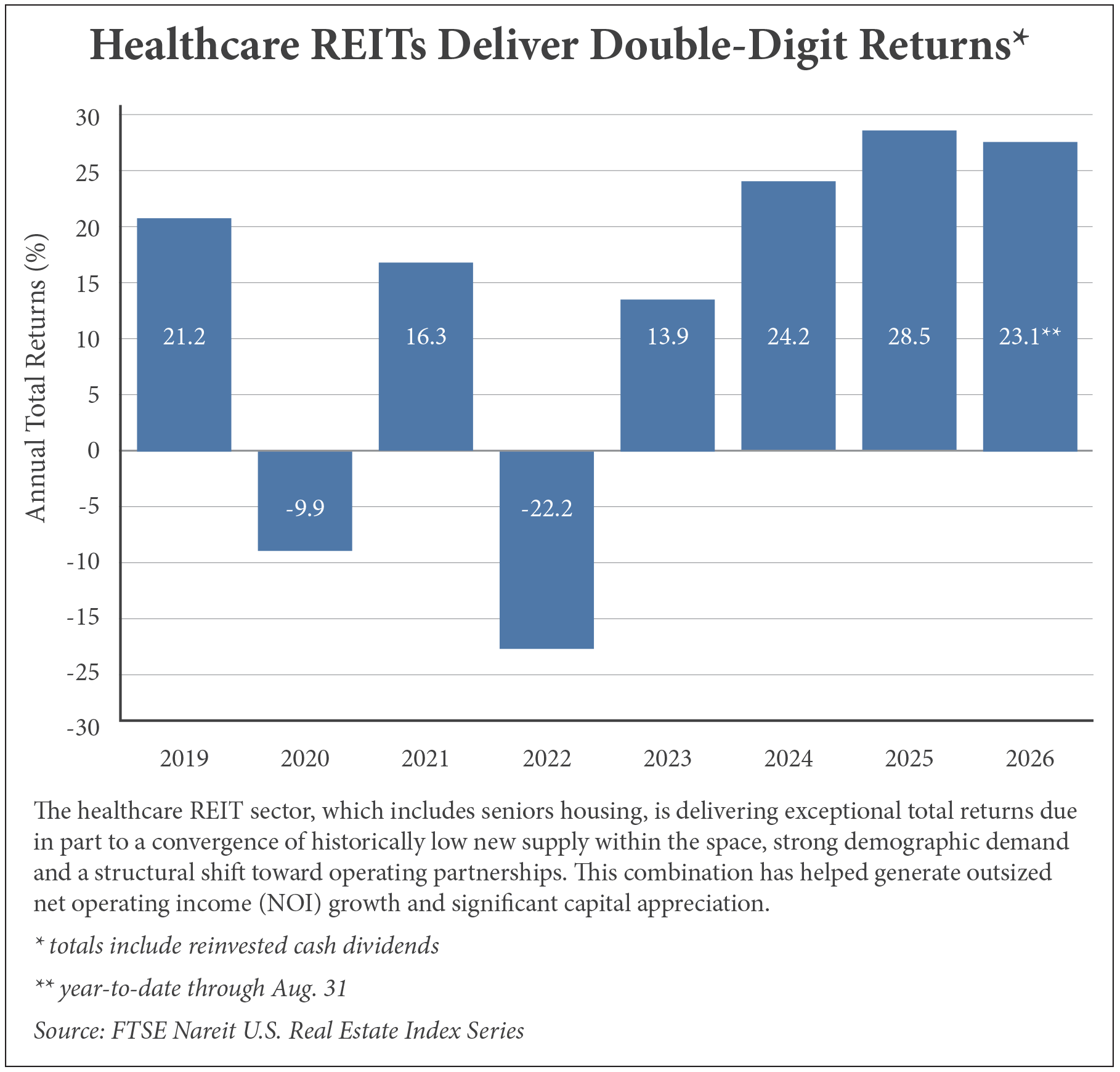
Healthcare is one of the top performing sectors on the FTSE Nareit U.S. Real Estate Index, with year-to-date total returns at 23.1 percent as of Aug. 31. Investors are taking notice of strong supply-demand dynamics driving performance in both seniors housing and skilled nursing.
“There’s a lot of opportunity in seniors housing right now, and it’s just a fantastic supply-demand backdrop for investors,” says Stroyeck.
Of the only three REIT initial public offerings (IPOs) year-to-date, two are in healthcare/seniors housing. Earlier this year, Janus Living Inc. (NYSE: JAN) raised more than $840
million with its spin-off from Healthpeak Properties Inc. (NYSE: DOC).
Headquartered in Denver, Janus Living is attracting investor attention as a pure-play seniors housing REIT, whereas other healthcare REITs invest across a mix of skilled nursing, medical office, life sciences properties or even hospitals. Janus is benefiting from the fact that 100 percent of its portfolio is in SHOP.
“Janus is very much an external growth story,” says Stroyeck. The company’s go-forward strategy is to dilute its CCRC (continuing care retirement community) portfolio over time with more traditional rental seniors housing assets.
The company has an ambitious target to acquire more than $2 billion this year. Janus also has a strong internal growth story and has increased guidance on both same-store net operating income (NOI) and earnings.
The tailwinds and outperformance of seniors housing is prompting more REITs to lean into seniors housing strategies. National Healthcare Properties Inc. (NASDAQ: NHP), based in New York City, is a diversified healthcare REIT that raised $462 million from its IPO in April and is planning to expand its seniors housing footprint.
Chiron Real Estate Inc. (NYSE: XRN), headquartered in Bethesda, Maryland, formerly known as Global Medical REIT Inc., recently rebranded and is growing heavily into seniors housing and selling out of many of its medical office assets.
Plenty of Liquidity
REITs clearly have the desire, and importantly, the capital to grow. In general, the sector is in a strong financial position with liquidity, healthy balance sheets and access to both equity and debt markets.
“Our balance sheet is about as strong as it’s ever been,” confirms Derek Bunker, chief financial officer at CareTrust REIT Inc. (NYSE: CTRE). CareTrust’s net debt-to-EBITDA was 1.0x in the second quarter, meaning its total debt equals one year of its core earnings before interest, taxes, depreciation and amortization.
That level is exceptionally low and well below its long-term target range of 4.0x to 5.0x. In addition, its overall liquidity sits at roughly $1.4 billion between cash, revolver availability and unsettled forward equity, with additional capacity under its ATM program behind that.
San Clemente, California-based CareTrust is using that capital to expand all three of its growth engines: skilled nursing, a care home portfolio in the United Kingdom (U.K.) and a growing SHOP platform.
Year-to-date through August, CareTrust had deployed roughly $735 million into U.S. triple-net skilled nursing and seniors housing, $397 million into U.K. care homes, $240 million into relationship-driven loans and $81 million into SHOP.
“We’ve deliberately run relatively low leverage to give ourselves maximum optionality as we grow in skilled nursing and seniors housing. That has supported a lot of growth over the past few years, and we believe it will support strong growth going forward,” says Bunker.
The REIT also has no scheduled debt maturities before 2028. “No near-term refinancing risk and plenty of dry powder means we can keep funding a reloading pipeline while maintaining underwriting discipline,” adds Bunker.
REITs have a cost of capital advantage over private equity buyers, largely because their stock is trading at premiums to NAV. For example, Green Street values Welltower’s underlying assets at a high 6 percent nominal cap rate, whereas the public market share price implies a cap rate of about 3 percent. Welltower can use that cost of capital advantage to continue to grow externally.
“That is very much a theme across all the seniors housing-focused REIT names,” says Stroyeck. All those companies trade at significant premiums to NAV, ranging from 20 percent at the low end to about 150 percent in the case of Welltower.
REITs are continuing to tap into those strong prices and are going to the market with new equity offerings. For example, American Healthcare REIT and Janus Living both conducted overnight issuances in August that collectively raised more than $1 billion.
“There’s still lots of capital being raised, and that’s going to continue to be a boon for balance sheets,” says Stroyeck.
Recycling Capital from Dispositions
Some healthcare REITs are also actively shedding non-core assets to eliminate near-term debt maturities and raise capital that can be deployed elsewhere.
For example, LTC Properties Inc. (NYSE: LTC) expects to generate $730 million this year from dispositions and loan payoffs, including the opportunistic sale of skilled nursing and other non-core assets.
Headquartered in Westlake Village in California, LTC is recycling that capital to fund its aggressive SHOP expansion, which is expected to include roughly $900 million in new investments this year.
National Health Investors Inc. (NYSE: NHI) reported that dispositions are likely to total $665 million this year. A big chunk of that capital comes from the $560 million sale of a large skilled nursing portfolio that closed July 1.

“Skilled nursing has always been part of our mix, but our focus has really been on growing the private pay seniors housing portfolio,” says Dana Hambly, senior vice president of finance at NHI, headquartered in Murfreesboro, Tennessee.
During the first half of the year, NHI closed on $212.4 million in SHOP assets and has an investment pipeline of roughly $420 million.
“The SHOP structures are prevalent in the industry, and we certainly view that as the growth engine of the company,” says Hambly.
NHI is also continuing to find opportunities in more traditional triple-net lease assets. “Going forward, as you see us redeploying capital, it could be in SHOP, or it could be in triple-net, but it will be in private pay seniors housing. There’s really nothing in our pipeline that’s skilled nursing,” he says.
Frenzy of Deal-Making
REITs are clearly in the midst of an active growth cycle. “It’s busier than it’s ever been in the history of the business. We’re literally drinking out of a fire hose,” says Rick Matros, president and CEO of Sabra Health Care REIT Inc. (NASDAQ: SBRA).
Last year, Tustin, California-based Sabra acquired $450 million in assets. As of August, the REIT has already closed or is under contract to buy $700 million in assets with a target of $1 billion in new investment this year.
“There’s just an incredible volume of SHOP opportunities out there,” says Matros. “Based on what we see and the feedback we get, we think it’s going to be this active probably through 2027. After that, who knows.”
External growth is coming largely from acquisitions as new construction remains expensive and difficult to pencil out. Sabra is buying a mix of assisted living, independent living and memory care assets, and most properties are less than 10 years old.

The company is still finding buying opportunities that are priced at a little more than 50 percent of replacement cost, according to Matros.
Welltower is clearly the 800-pound gorilla. The REIT acquired almost $20 billion in assets in 2025 and expects to achieve a similar volume in 2026.
However, a big chunk of that growth is coming from expansion in Canada and the U.K.
“We do expect to see some deceleration from Welltower next year just because these levels are hard to sustain. But we’re still expecting them to do roughly $12 billion of acquisition volume next year,” says Stroyeck.
Although a significant amount of public and private capital is chasing seniors housing, there are plenty of deals to go around.
Following a strong recovery from the pandemic, some owners are looking to sell stabilized assets. There also are vintage private equity funds that need to exit and monetize their assets.
“We’re still seeing a lot of opportunities where the yield exceeds our cost of capital, or we see a path to where it makes sense for us to do the deal given the growth,” says Hambly.
Historically, NHI has targeted annual investments in the $200 million to $400 million range. Last year, the company closed on just under $400 million. In its second-quarter earnings call on Aug. 11, management said that it would like to see its investment volume increase to between $500 million and $700 million per year.
NHI favors stabilized, middle-market properties in secondary markets. The REIT prefers assets that, on average, are about 10 years old.
Earlier this year, NHI acquired nine properties with 460 units in Kentucky, South Carolina and Tennessee for $105.5 million. The properties will be included in NHI’s SHOP platform and will be managed by Allegro Living Management, an affiliate of Spring Arbor Management, which is an existing relationship for NHI.
Pricing has increased in the past 12 months, particularly on SHOP deals.
However, higher prices also tend to weed out some potential buyers, notes Hambly. “We think we’re in a good place, and we don’t really see any hurdles to us attaining our investment goals,” he adds.
Across the healthcare REIT sector, the desire to grow seniors housing portfolios shows little signs of fading.
Backed by strong balance sheets, favorable capital markets and bullish operating fundamentals, REITs are well-positioned to remain a dominant player in the investment sales market.
REITs double down on their SHOP strategies to accelerate earnings growth
Seniors housing operating portfolio (SHOP) strategies are front and center as healthcare REITs aggressively pursue external growth.
“Those companies that have historically been triple net only are starting to get into the SHOP business because they’ve seen how much that’s benefited some of their peers’ valuations and earnings growth,” says Michael Stroyeck, head of U.S. healthcare research for Green Street.
According to Stroyeck, SHOP is expected to generate double-digit growth in net operating income (NOI) over the next few years, whereas triple-net structures are generating a growth rate around 2.5 percent from built-in rent escalators.
In the SHOP structure, the operator manages the community pursuant to a management agreement. The operator earns a management fee while allowing REITs to benefit from the operational result — a structure allowed under the provisions of the REIT Investment
Diversification and Empowerment Act.
Under traditional triple-net lease (NNN) structures, the operator is typically a tenant, paying rent and other operating costs associated with the property.
Although the NNN structure limits REITs’ exposure to market risks, such as higher operating costs and weaker occupancy, it also limits their ability to share in the upside of strong-performing properties.
“Transformational” is how Dave Boitano, chief investment officer at LTC Properties (NYSE: LTC), describes the REIT’s pivot toward SHOP. Since launching SHOP in May 2025, LTC has grown its portfolio from 13 to 43 communities with an average age of 10 years, with SHOP now representing 38 percent of the company’s annualized NOI.
“What’s particularly exciting is how quickly our SHOP platform has grown,” says Boitano. “By the end of the third quarter, LTC expects gross SHOP investments to exceed $1.3 billion. Increasing the portion of our portfolio dedicated to our SHOP platform positions LTC for potentially higher growth as compared to historic rates.
“About 80 percent of our SHOP growth has been external, which speaks not only to the opportunities we’re seeing in the market but also to the strength of the relationships we’ve built with our operating partners,” explains Boitano.
LTC expects to have closed approximately $700 million in SHOP acquisitions by the end of the third quarter.
Recent transactions include the $200 million acquisition of four SHOP communities in Minnesota. The communities total 453 independent living, assisted living and memory care units with an
average age of nine years. Lifespark Senior Living, an existing LTC SHOP operator, will assume operations.
“Every investment has to fit our strategy and meet our underwriting standards,” says Boitano. “We don’t feel pressured to do deals, but we’re prepared to move when we see the right opportunities.”
— Beth Mattson-Teig
This article originally appeared in the August-September 2026 issue of Seniors Housing Business magazine.