

By Sean Anderson, senior associate, Partners Real Estate
When Congress passed the No Surprises Act (NSA) in December 2020, the goal was straightforward: protect patients from the exorbitant, unpredictable bills that had become synonymous with emergency care and rein in some of the pricing power that out-of-network physicians and freestanding facilities had come to enjoy.
On paper, the law delivered. By requiring that out-of-network emergency treatment be billed at the same rate a patient would owe for in-network care, the NSA eliminated an estimated 10 million surprise bills in just the first nine months of 2023 and pushed down the overall cost of emergency room (ER) procedures across the board, according to the second annual report to Congress from the U.S. Department of Health and Human Services.

For patients, it was an unambiguous win. For the physician groups and real estate operators that had built business models around emergency medicine, however, the law landed as a direct hit to the bottom line. Out-of-network reimbursements initially fell by roughly 40 percent, according to an FTI Consulting analysis of the provider side of the law, and bankruptcy filings for healthcare operators hit their highest level in five years, tripling from 2021 to 2023 per data from Gibbins Advisors and reported by Healthcare Dive. Several organizations named the NSA, alongside rising interest rates and overleverage, as major factors for insolvency.
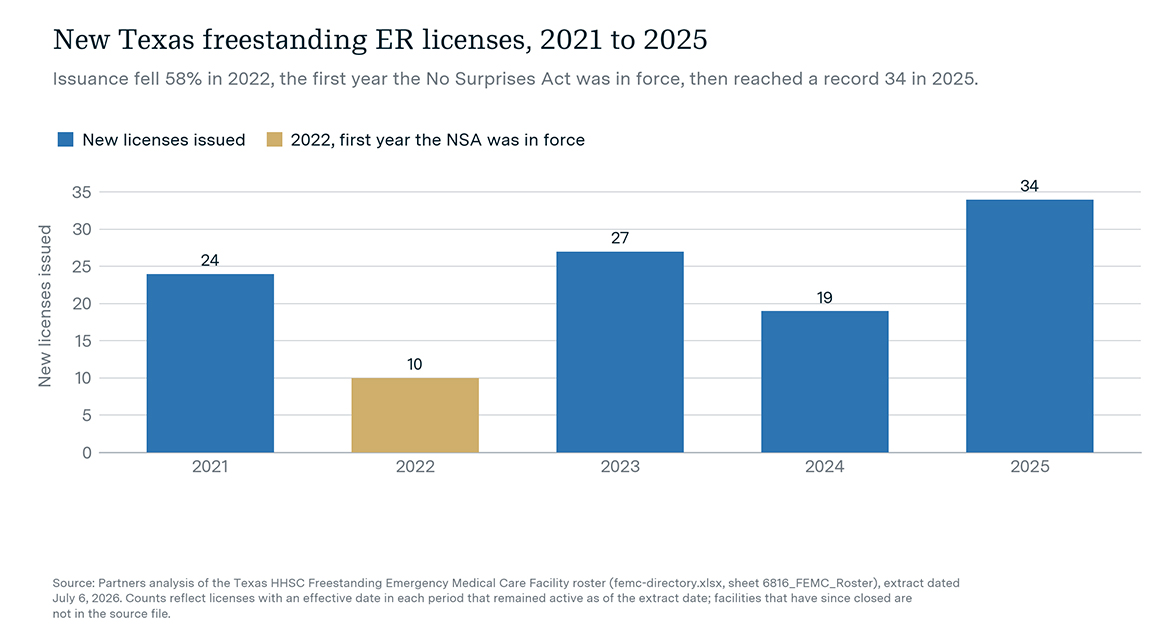
The real estate consequences of that reimbursement shock were immediate and visible across Texas and beyond. ER operators, facing thinner margins almost overnight, pulled back sharply on the ambulatory care and freestanding emergency department (FSED) pipelines that had defined the sector’s growth for the better part of a decade. Expansion plans were shelved, and facilities in tertiary markets where patient volumes and margins were already the thinnest were among the first to close.
For an asset class that had attracted significant capital on the strength of steady, recession-resistant demand, this was a meaningful recalibration. Medical operators and developers that had underwritten deals assuming pre-NSA reimbursement levels suddenly had to reassess whether the ambulatory and FSED model still supported the rents, build-out costs and long-term lease structures that had made these properties attractive in the first place.
The unexpected variable that has ultimately led to the resurgence of the FSED model is the arbitration mechanism buried inside the law itself. The NSA created a federal Independent Dispute Resolution (IDR) process intended to let physicians and insurers reconcile billing disagreements outside the courtroom. Regulators initially expected this arbitration mechanism to handle around 17,000 cases a year, as ProPublica has reported.
That estimate proved wildly off base. By 2025, arbitration filings had surged to roughly 2.5 million cases annually, and physicians have prevailed in an estimated 80 to 85 percent of those cases over insurers, according to IDR data tracked by Georgetown University’s Center on Health Insurance Reforms. In many instances, providers recovered reimbursements that substantially exceeded what they would have been paid before the law ever took effect. A Wall Street Journal analysis of federal data found that arbitration judgments tripled year-over-year, reaching $15 billion, a figure that reflects just how far the process drifted from its original design and how much leverage it ended up handing back to providers.
That shift did not go unnoticed by the physician groups and ER operators who had initially retreated from the market. Once it became clear that arbitration largely favored providers over insurers, and that ER facilities could recoup costs above pre-NSA levels through the dispute process rather than through direct payer negotiation, demand for new ER development resurged.
The FSED model, which looked structurally impaired in 2021 and 2022, has found a second wind with physicians and operators learning how to navigate the new arbitration processes and negotiating the landscape that the NSA has created. For real estate investors watching this space, that resurgence is a reminder that policy-driven disruptions to healthcare real estate rarely play out in a straight line; the mechanisms written into the fine print can matter as much as the headline reform itself.
Today, this activity has created a sector that has adapted to a rule it wasn’t originally built to expect, but one that remains far from settled. Freestanding emergency departments are — for now — recouping costs through the arbitration system that has proven unexpectedly favorable to providers, a dynamic that has quietly underwritten the return of investment appetite for ambulatory and ER-adjacent properties.
But insurers and their lobbying groups are actively pushing to restructure the arbitration process. AHIP, the insurance industry’s main trade association, has called the current dynamic a “gold rush” that policymakers need to end quickly, telling Politico that the billions of dollars in annual payouts are driving premium increases borne by the broader customer base.
Part of that pushback has already been codified. CMS finalized a rule overhauling Federal IDR operations on June 4, 2026, standardizing dispute communications, tightening eligibility screening and adding conflict-of-interest reviews for the certified entities that are deciding these cases. Most provisions went into effect on August 3, 2026.
Separately, as Reed Smith noted when the court granted rehearing, the Fifth Circuit is reconsidering en banc whether the government’s reimbursement calculation methodology itself should be thrown out entirely. Either development on its own could drastically reset the underlying economics of FSEDs. For anyone underwriting medical office or emergency care real estate today, the lesson of the last four years is that the reimbursement environment for emergency medicine is not a stable input. It is actively being rewritten.
For Texas commercial real estate, and despite the public policy whiplash, the FSED market continues its aggressive growth. Standalone emergency centers now account for roughly 25 percent of all emergency visits in the state, part of a national rise in freestanding emergency departments that has been building for more than a decade. Despite the regulatory uncertainty hanging over the arbitration process, the sector continues to expand. Our own review of the Texas Health and Human Services Commission’s freestanding emergency medical care facility roster shows the number of licensed ER facilities in the state increasing at an average of 8 percent annually.
Nowhere is that growth more visible than in high-population-growth suburbs surrounding the major metros of Houston, Dallas-Fort Worth, Austin and San Antonio. Suburbs with strong demographics have become the preferred targets for new FSED development. These markets offer exactly what operators and their real estate partners are underwriting today: long-term residential development pipelines, thinner competing emergency healthcare infrastructure from hospitals and favorable land economics that can absorb rising construction costs. In some cases, those costs can now reach up to $800 per square foot given the specialized MEP (mechanical, electrical and plumbing), imaging and life-safety systems these facilities require, per BSA Design’s 2026 hospital construction cost analysis.
For developers and landlords, the calculus has shifted from simply chasing population growth to underwriting policy risk alongside it. The result is favoring of build-to-suit and ground-lease structures with high-credit operators, shorter development timelines and rent structures flexible enough to absorb another round of reimbursement change.
The FSED has proven itself a resilient asset class through one major policy disruption; the next test for Texas medical investors will be whether that resilience holds if Washington narrows the arbitration advantage that made this current wave of growth possible.