

By Graham Smith, Multistudio
A national shift is underway, and it starts with how cities listen.
Across the country, communities and development teams are rethinking how reinvestment happens in legacy neighborhoods shaped by deep cultural identity but burdened by decades of underinvestment. These districts often hold irreplaceable history, yet for years they were sidelined by capital markets that prioritized scale, speed and uniformity over context and continuity.

Historically, redevelopment in these areas followed a familiar pattern: projects designed first and explained later. Too often, that sequence displaced cultural institutions, local businesses and social networks that gave neighborhoods their meaning. Today, rising expectations around equitable development and renewed interest in urban cores are forcing a different calculus.
Community engagement is no longer a step at the end of a project. It is a strategic input that shapes outcomes, reduces risk and strengthens long-term value.
Intentional reinvestment
Kansas City offers a timely example of how intentional process can align with market opportunity.
After years of downtown population growth, expanded transit infrastructure and rising global visibility ahead of the 2026 FIFA World Cup, long deferred reinvestment became feasible.
Local leaders recognized that this momentum created an opportunity to reinvest in the historic 18th & Vine District, long known as the birthplace of American jazz and a center of Black entrepreneurship, culture and innovation. Today, the district is seeing more than $400 million in combined public and private investment across roughly two square miles.
Community engagement
From the outset, leaders understood that success in 18th & Vine would depend not just on what was built, but how decisions were made.
One of the most common missteps in legacy neighborhoods is treating engagement as a series of public meetings designed to sell a plan. In 18th & Vine, a more durable model was adopted, one where engagement preceded design and informed decision making throughout the project lifecycle. Project teams walked the district block by block; collaborated with local businesses, artists and cultural historians; and grounded redevelopment decisions in lived experience rather than assumptions. These efforts signaled that reinvestment was not simply happening in the neighborhood, but with it.
A defining element of this framework was dedicated community engagement leadership. Pat Jordan, the project’s community engagement lead, helped organize stakeholder involvement and ensure the process remained consistent, respectful and accountable. In many redevelopment efforts, community input is diffuse and easily sidelined. A clearly defined engagement lead introduces responsibility both internally for project teams and externally for residents.
This approach reshaped how private and public design, development and community partners collaborated. In neighborhoods shaped by past displacement, that distinction matters. It requires showing up early, listening more than presenting and responding visibly to feedback.
For the commercial real estate industry, the takeaway is practical. Meaningful engagement reduces friction, supports entitlements, strengthens tenant and visitor appeal and contributes to long-term project durability.
Cultural stewardship
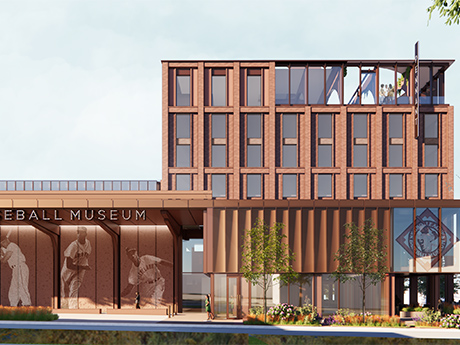
That community-centered approach is exemplified by the planned expansion of the Negro Leagues Baseball Museum and its new campus near 18th Street and Paseo. Designed in partnership with the museum, the City of Kansas City and Grayson Capital, Multistudio is honored to work alongside Pendulum and DRAW Architecture + Urban Design to deliver a project that reinforces the district’s identity while integrating with its historic context.
The adjacent 1914 YMCA building, where the Negro National League was founded in 1920, remains the district’s emotional anchor. Exterior preservation and interior accessibility upgrades ensure that irreplaceable history is protected while creating opportunities for future generations to engage with the space.
The campus also includes a Marriott Tribute Portfolio hotel honoring the history and heroes of the Negro Leagues; a new and expanded museum; a 480-stall public parking structure supporting residents, visitors and events; and a future multifamily phase that will introduce new residential activity into the district’s core.
While the campus spans two blocks, the design breaks down massing and preserves key landmarks to maintain the district’s rhythm.
One shared framework
Across 18th & Vine, reinvestment follows a consistent set of principles: protect cultural identity, strengthen existing institutions and add residential density to support year-round activity.
Beyond the 18th and Paseo campus, key projects include the 18th Street Pedestrian Mall, the 18th & Lydia Parking Garage, more than 1,000 new multifamily units including mixed-income developments, the restoration of the historic Boone Theater, enhancements to the Gem Theater and the Kansas City Royals Urban Youth Academy.
Together, these investments demonstrate a shift toward layered reinvestment, where housing, culture, adaptive reuse and infrastructure are planned as a system rather than as isolated projects.
A replicable blueprint
The experience at 18th & Vine offers a clear playbook for community integrated redevelopment built around starting engagement early and aligning developers, designers, civic partners and engagement leadership around shared roles and values.
Kansas City’s 18th & Vine demonstrates that growth and preservation are not opposing forces. When investment respects culture, history becomes an asset and community identity drives economic value.
As cities across the country confront the challenge of modernizing historic districts, 18th & Vine offers a clear blueprint: honor the people, the stories and the culture that define a place, and build with the community from the start.
Graham Smith is the director of city design at Multistudio. This article originally appeared in the January 2026 issue of Heartland Real Estate Business magazine.