

By Aghfar Arun, Bradford Allen
Indianapolis has a reputation as a convention town, but its hotel story has moved well beyond lanyards and name badges. A growing mix of sports, healthcare, corporate and leisure demand is now filling rooms year‑round — downtown and across the suburbs — turning the market into one of the Midwest’s most reliable hospitality overachievers.
Event boom downtown
Indianapolis experienced 8.1 million room nights of demand in the 12-month period ending at mid-year 2025, according to CoStar data. This is over 580,000 more than the market’s pre-COVID peak.

To meet this demand, the construction pipeline at mid-year included more than 1,500 hotel rooms, with another 3,402 rooms in the final planning stages and 3,220 rooms proposed.
According to Visit Indy, new projects slated for delivery in 2026 include a pair of adaptive reuse projects: The Kimpton will transform the historic Odd Fellows Building into a 167-key luxury hotel and the Motto Hotel will bring 116 rooms to the King Cole Building. The most notable project is Signia by Hilton, a 38-story hotel with 800 guest rooms developed alongside a 143,500-square-foot expansion of the Indiana Convention Center.
A snapshot of downtown Indianapolis, prepared last year by Downtown Indy Alliance, shows a hospitality market that is outpacing national averages. Citing data from CoStar and STR, the report shows an average 64.7 percent hotel occupancy beating out the U.S. average of 62.4 percent. Even more impressive are the area’s revenue per available room (RevPAR) and average daily rates.
The $135.20 RevPAR for downtown Indianapolis hotels was a 13 percent year-over-year increase and 35 percent ahead of the U.S. average of $99.96. Downtown Indianapolis’ daily rate averaged $209.11, representing a 12 percent year-over-year increase and beating out the national average by 30 percent.
Suburban surge
Beyond the core, the suburbs are also playing a role in the market’s overall stability. On the North Side, for example, high-end retail at Keystone Crossing and corporate hubs in places like Zionsville, Fishers and Carmel are fueling strong demand. This environment has allowed boutique properties such as Ironworks Hotel Indy and Hotel Carmichael to thrive.
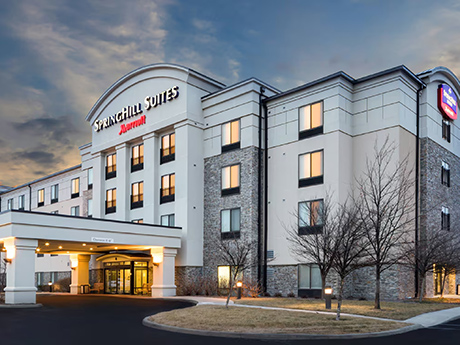
The North Side submarket is also attractive to corporate, extended-stay and youth sports-driven group travelers who desire access to mixed-use communities as an alternative to downtown. Exemplifying this trend is SpringHill Suites Indianapolis Fishers, a 130-room hotel my firm, Bradford Allen, acquired last year. As its name suggests, the select-service hotel is located in Fishers, a northeast suburb that has grown by 35 percent since 2010, according to U.S. Census data, with a current population of approximately 104,000.
One factor that made SpringHill Suites Fishers an attractive investment was its position within a vibrant, experience-driven district. The hotel is adjacent to the new Cadillac F1 headquarters being developed by Bradford Allen. The 400,000-square-foot facility, part of a larger 90-acre campus, will enhance foot traffic in the area and ultimately drive guest demand.
The hotel is also near the new Fishers Event Center, a 7,500-seat arena that draws a steady flow of visitors for concerts, basketball games and a wide range of community programming, from youth sports tournaments to graduation ceremonies and civic events.
Opened in 2007, SpringHill Suites Fishers underwent its most recent renovation in 2016. A comprehensive, multimillion-dollar transformation will bring the property in line with today’s guest expectations, featuring a sleek, minimalist design more often seen in urban hotels.
Slated for completion within the next 12 months, upgrades to the lobby, fitness center, guest rooms and public areas will reposition the hotel as a contemporary competitor in the suburban market. Bradford Allen will also fully activate the outdoor spaces, including an enhancement of the hotel’s connection to the Nickle Plate Trail, a five-mile-long rail-to-trail amenity that connects hotel guests with downtown Fishers.
Beating national figures
Nationally, the hotel sector appears to be slowly approaching pre-pandemic levels. The American Hotel & Lodging Association’s 2026 State of The Industry report forecasts a 1.7 percent increase in guest spending this year. Additionally, RevPAR is expected to rise by 0.9 percent in 2026, according to a recent PwC report.
While that may seem like a modest improvement, the projected growth in the upper upscale (2 percent), upscale (1.8 percent) and upper midscale (1 percent) segments represents a welcome turnaround after all saw RevPAR decline in 2025.
Indianapolis demonstrates how a rare downtown-suburban synergy can deliver year-round hotel stability that few U.S. markets match. The event core downtown handles peak demand from conventions and tournaments, while suburban areas provide reliable fill from healthcare, logistics, corporate offices and sports travel.
This balance across multiple demand generators — unlike event-only or leisure-dependent peers — lowers overall risk and supports consistent performance. As a model of post-pandemic evolution, Indy’s blend of urban excitement and suburban resilience positions it for sustainable growth relative to the national average. Operators here benefit from a diversified base that smooths out seasonal swings better than many peers.
As the national hospitality sector anticipates moderate growth, Indianapolis shows how a variety of downtown and suburban assets can together deliver reliable market-wide stability. Whether targeting suburban yield stability or downtown growth potential, the market offers tailored opportunities for every investment strategy.
Aghfar Arun is an executive director of hospitality with Bradford Allen. This article originally appeared in the February 2026 issue of Heartland Real Estate Business magazine.