

By Matthew Auchincloss
CHARLOTTE, N.C. — The multifamily build-to-rent (BTR) market in the Carolinas is the most competitive it’s ever been. According to Louis Smart, senior vice president at CBRE, more than 22,000 townhomes and single-family rental (SFR) units were delivered in the Carolinas over the past three years, and developers are jostling for position to handle it.
“We’re reacting as probably most of our peers are reacting: scratching and clawing through lease-up, being as creative as we can, spending money that we really don’t want to spend from a marketing and advertising perspective trying to differentiate the product as much as possible, leaning into the fact that we believe we’ve picked good locations,” adds Andy Lucas, principal at Beauxwright.
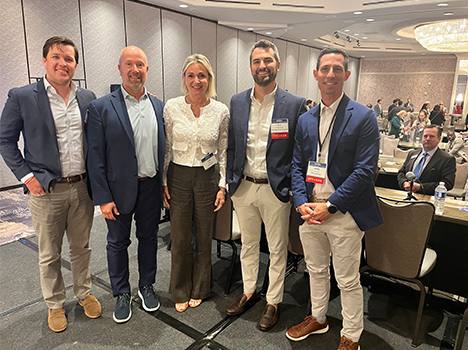
Lucas was a speaker on a panel titled, “Build-to-Rent in the Carolinas: Headwinds, Tailwinds and What Comes Next?” The panel was part of the lineup at InterFace Carolinas Multifamily, an information and networking conference that took place on May 21 at the Hilton Charlotte Uptown. Smart was the panel moderator.
Editor’s note: InterFace Conference Group, a division of France Media Inc., produces networking and educational conferences for commercial real estate executives. To sign up for email announcements about specific events, visit www.interfaceconferencegroup.com/subscribe.
Other panelists included Eric Friedman, director of BTR development at Crescent Communities; Ed Oprindick, president of SFRC (single-family rental communities) development at Mandrake; and Lisa Taylor, senior managing director of SFR and BTR with Greystar.
Panelists said that the BTR market has settled recently, but firms are still cautious about new developments. That hesitancy isn’t just due to the past three years, however. It’s also due to overarching economic factors, including the recently passed 21st Century ROAD to Housing bill, which was automatically ratified on Saturday, July 11, following a decision by President Donald Trump to neither sign nor veto the bill.
ROAD to Housing Is Paved with Good Intentions…for Whom?
The uncertainty surrounding the passage of the 21st Century ROAD to Housing Act was a focus of the panel, just as it has been a focus of the panelists’ business for months. In January, President Trump requested via a social media post that Congress act to limit corporations’ ability to purchase large amounts of single-family housing. In June, the 21st Century ROAD to Housing Act, which combined elements from the Senate and House versions of the bill, passed the House with bipartisan support. It became law on July 11.
The primary concern for the BTR developers on the panel was the provision in the Senate version, written in March, that would have forced the sale of single-family homes after seven years, including BTR and SFR homes. The rule was intended to limit mass institutional ownership of single-family homes, but the National Association of Home Builders (NAHB) and the Urban Land Institute (ULI) found it could shrink the supply of SFR housing by anywhere from 40,000 to 72,000 units per year.
The House version was ultimately modified to carve out several exceptions, including BTR developments, which left the panel feeling much more optimistic about the outcome of the bill.
For Lucas, the initial lack of specific carveouts for different property types (such as cottage-style versus townhomes) meant his company would have been forced to sell each individual unit of any large townhome projects within seven years. As a smaller firm, Beauxwright didn’t have the finances to heavily lobby against the bill, either, leaving them at the mercy of congressional rewrites.
“If we could have afforded to support lobbyists, we probably would have. But we needed [that money],” Lucas said. “A lot of industry representatives stepped up and really fought for this to change. [But] it was pretty scary.”
The stagnation of the market frustrated panelists the most. When the Senate version was passed in March, multiple large capital providers went pencils down, holding off on financing any additional work until the precise restrictions on who could own the properties long-term were clarified. Lucas said he received only receive 10 bids on a property he typically would have received 30 on, while Friedman had 30 percent of the bidders in a deal tell him they needed to see where the bill went first.
“Given how fast it’s changed, how rogue these waves have been, this makes no sense. That’s what really has frozen our capital partner and other partners. You just don’t know what the next turn will have or won’t have,” said Friedman of Crescent Communities. “You basically have to be as defensive as you can be, which is not the best way to be running your business.”
Other panelists had to adjust property designs and business plans. Oprindick and Mandrake shifted some designs into constructions that were more likely to be protected from the bill. The firm further altered course by investing more in land purchases rather than beginning construction, which they said they could still get financing for.
“What better time to buy land?” Oprindick remarked. “If the for-sale market is terrible and the build-to-rent [market is] on pause, [it’s a] perfect opportunity to acquire all kind of land positions. So we will just flip to one or the other.”
Using the Neighborhood as an Amenity
With the uncertainty and competitiveness in the market, BTR developers are battling to ensure their properties are meeting increasingly high renter expectations. The glut of options means that renters are being more discerning, finding BTR properties that precisely match their wants rather than settling.
Attached garages are increasingly becoming a requirement for renters rather than a bonus, according to the panelists. BTR developers generally dislike penciling attached garages into the plans as they are an inefficient use of land, but renters have shown so much interest in them that it often works on the return side.
“The industry is focusing on two-car side-by-side parking, which the resident really values, a true living experience that feels like a home,” Friedman said. “Tandem parking — we have a ton of it, done that exclusively, frankly, but it’s not favored. If you can stomach it and you can make the density work, that’s going to be a big shift that we’re seeing over the next year.”
The surrounding environment is another major factor that both renters and developers heavily weigh during site selection. For renters, proximity to restaurants and grocery stores is always a bonus, particularly coffee shops.
For developers, it shapes what amenities need to be installed in the property. Pools are generally non-negotiable despite the space they occupy — the heat of Carolina summers demands their inclusion — but a gym next door may eliminate the need to install one on the property. A local park nearby may negate the necessity of a small dog park specifically for the residents.
The type of amenity can also be tailored to the type of resident the property attracts.
“If you have a lot of single females, then you may want to consider a gate,” Taylor said. “They value that security more, and you could probably charge a premium or lease better.”
— Matthew Auchincloss