

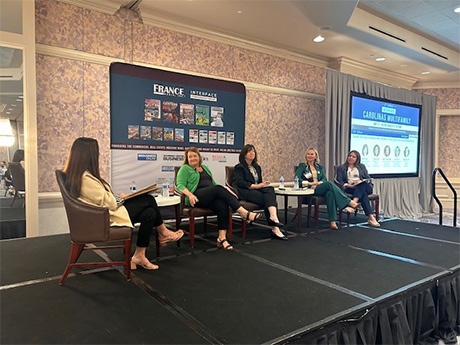
CHARLOTTE, N.C. — Midway through a panel discussion comprising apartment operators, moderator Stephanie Garris, director and head of North Carolina at property management firm Arqline, asked the panelists for one thing in multifamily operations that they wish they could stop doing tomorrow.
“Offering concessions,” said Dallas Green, regional vice president of RPM Living.
“Dallas stole my answer,” said Sherry Yarborough, director of multifamily management Southeast at Drucker & Falk.
Editor’s note: InterFace Conference Group, a division of France Media Inc., produces networking and educational conferences for commercial real estate executives. To sign up for email announcements about specific events, visit www.interfaceconferencegroup.com/subscribe.
The panelists were part of InterFace Carolinas Multifamily, an annual networking and information conference held on May 21 at the Hilton Charlotte Uptown. The conference, hosted by InterFace Conference Group and Southeast Real Estate Business, brought in 273 attendees.
Concessions often take the form of free rent for a set period, typically one or two months. Renters at newly delivered properties can get up to three months of free rent in some markets today, with longer rent-free periods reserved for those who sign longer term leases or for signing a lease within 24 to 48 hours of touring the property.
Yarborough said that concessions are simply the cost of doing business in 2026 for multifamily owners and operators.
“Obviously concessions aren’t helping the rent structure, but at this point, it’s what we have to do to start signing leases,” she said. “Lately we’ve really picked up both in traffic and leases, and we’re still offering concessions and gift cards — no cars yet. We’re offering what we have to to get the deal done. It’s a necessary evil at this time, but hopefully as markets change, concessions will start to fall off.”
Green added that she also “hates concessions” and that it’s incumbent for multifamily owners and operators to monitor the lease renewal process for renters who have enjoyed a high amount of concessions.
“We have to start planning for what we’re going to do to retain them or else our back door is going to be open and our expenses will rise,” said Green.
Concessions have commonly been used for new communities in oversupplied markets. During lease-up, developers will offer free rent and gift cards to outdo other apartment owners in the submarket. Kim McCall, regional vice president of Willow Bridge Property Co., said that it can be highly competitive in larger markets that are working through excess supply.
“For concessions in our bigger markets like Charlotte and Raleigh, it’s a bit of a blood bath,” said McCall.
Becky Ross, director of property management at RangeWater Real Estate, said that concessions are not just being used at newly delivered properties in order to expedite lease-up. They’re also being offered at Class B and C properties that were built 20 to 30 years ago.
“We have a couple deals on opposing ends of the spectrum,” said Ross. “One is almost 25 years old and the other is brand new, and they’re both offering pretty hefty concessions.”
Yarborough added that operators at Class B properties have been “offering the world with concessions,” which has had a trickle-up effect for Class A apartment properties that are taking longer to stabilize.
Investors weigh in
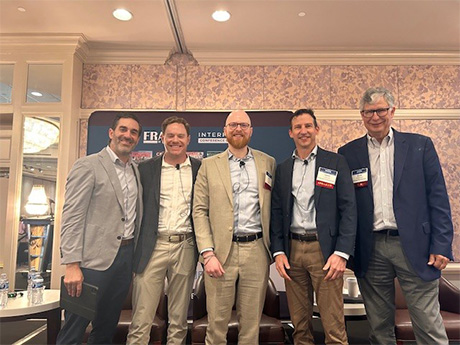
During the investment sales panel at InterFace Carolinas Multifamily, Will Farmer, managing director of investments at Kettler, made a wish of his own tied to concessions.
“We’ve got to get out of providing concessions,” said Farmer. “We’ve got to start being able to use concessions like they are supposed to be used — not as a ubiquitous part of the rent but more as an incentive or sweetener. That is all going to take more time.”
Morgan McClung, vice president of investments at ParkProperty Capital, concurred, estimating that it will take anywhere from 12 to 24 months for the U.S. multifamily market to get on more stable footing in terms of its overall supply-demand dynamic.
“It starts with reducing concessions,” said McClung. “It really boils down to a supply problem. There’s been a ton of units dumped in markets like Charlotte and Raleigh, and it’s going to take time to work through those and have pricing power again with real rent growth.”
Yardi Matrix reports that the U.S. multifamily sector’s advertised rents rose slightly in May ($1,767 per month on average) but remain relatively flat year-over year. Ross said that rents have been “all over the place” at RangeWater’s properties.
“Rents are not where we had budgeted them to be quite yet,” said Ross.
Operators on the panel said that for budgeting purposes, they’ve been operating with an occupancy assumption of 92 to 93 percent lately as opposed to the 95 percent threshold they used during the multifamily sector’s heyday post-pandemic.
Investors have been monitoring trends with occupancy and rental rates very closely. McClung said that once the market is stabilized and concessions have burned off, acquisition activity should pick up.
“I’m hopeful that with improved operations, a better sentiment around the acquisition market and some price capitulation from sellers, [deals] will start to snowball, but it will take a couple years,” said McClung.
He added that many buyers are wary of “catching a falling knife” in terms of acquiring multifamily properties that are experiencing flat or negative rent growth.
Outlook
Garris asked another rapid-fire question to the operations panelists: describe the overall multifamily sector in one word.
“Competitive,” said Yarborough.
“Improving,” said Ross.
“Volatile,” answered McCall.
“Reset,” said Green.
Overall, the speakers on the operations panel said that they are bullish on the multifamily sector’s demand picture moving forward because housing is a necessity and households are continuing to be priced out of homeownership.
“One hundred and fifty-seven people move to Charlotte every day, and they’re all going to need somewhere to live,” said Ross. “In the big scheme of things, what we’re experiencing today is more of a short-term blip.”
— John Nelson