

ATLANTA — Multifamily borrowers have a plethora of financing options at their beck and call, both from traditional debt sources and alternative platforms. With the competition among capital sources on the rise, sponsors are in an advantageous position.
“More lenders are chasing multifamily since they’ve taken three commercial real estate food groups off the table — office, retail and hospitality,” explains Shawn Townsend, president and chief investment officer at Ease Capital.
However, financing challenges remain. “But by and large the cost of debt capital has not gone down,” Townsend adds.
Editor’s note: InterFace Conference Group, a division of France Media Inc., produces networking and educational conferences for commercial real estate executives. To sign up for email announcements about specific events, visit www.interfaceconferencegroup.com/subscribe.
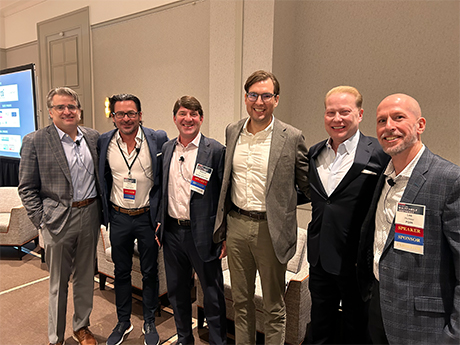
Townsend’s comments came during the capital markets panel at InterFace Multifamily Southeast, a two-day event held Dec. 1-2 at the Intercontinental Buckhead hotel in Atlanta. InterFace Conference Group and sister publications Multifamily & Affordable Housing Business and Southeast Real Estate Business hosted the networking and information conference. Stephen Farnsworth, senior managing director of real estate finance at Walker & Dunlop, moderated the session, which featured five lenders and financial intermediaries.
Farnsworth opened by touching on the ebbs and flows of multifamily origination volume over the past few years. In 2022, multifamily loan originations totaled $480.1 billion, according to data from the Mortgage Bankers Association (MBA). In 2023, loan volume dropped significantly to $246.2 billion, thanks to the rapid increase of interest rates by the Federal Reserve. There was a slight rebound in 2024 to $288.7 billion, and Farnsworth is estimating that 2025 volume will hover around $350 billion, which would represent a 21.2 percent increase year-over-year.
“For 2026, the MBA is projecting that multifamily loan originations will total $419 billion,” noted Farnsworth, indicating a 19.7 percent year-over-year increase.
“The four-year run rate is not getting back to the peak of what volume was in 2021 and 2022, but we’re getting closer to that number, which is a good sign,” he added. “There is a lot of liquidity in the debt market.”
Lenders in pursuit
Panelists outlined which capital providers are actively lending in the modern multifamily space. Chad Hagwood, senior managing director of Lument, said that banks are currently seeking to do deals but remaining selective and preferencing their best multifamily clients.
“The banks are competitive,” said Hagwood. “They’re making deals for the right sponsors.”
Townsend said in the recent past that banks have been limiting their exposure in the multifamily sector, which drove more business to smaller lenders and debt fund providers like Ease Capital.
The panelists agreed that life insurance companies are viewed as the most attractive source of capital. Townsend said that life insurance companies will be aggressive moving forward, particularly as global asset managers and private equity firms — including Blackstone, BlackRock, Ares Management and KKR — acquire life insurance companies.
“The big boys are buying up life insurance companies,” said Townsend. “They’re going to use that capital more aggressively than the old-school insurance players.”
“We are going to see more and more life companies place debt in 2026,” concurred Hagwood.
The panelists also discussed how borrowers are utilizing significant tranches of preferred equity to make their deals pencil out. Hagwood warned of the dangers of having minimal wiggle room in the underwriting if preferred equity is part of the capital stack.
“A lot of these deals that cross my desk with preferred equity, the math doesn’t math,” said Hagwood. “It’s all on a hope and a prayer, you really have to thread that needle because the deal isn’t going to generate any money. Borrowers tend to use preferred equity for a lifeline.”
Hagwood added that a lot of deals with preferred equity fall apart because the partners back out during the underwriting process.
Robbie Pinkas, senior vice president of originations at Pace Loan Group (PLG), was the sole lender on the panel who specializes in Commercial Property Assessed Clean Energy (C-PACE) financing. Pinkas said that borrowers are indeed utilizing C-PACE financing, even though the product is a “little different” from other capital sources.
“C-PACE is secured by a special assessment that’s recorded against the tax parcel and repaid via real estate taxes,” explained Pinkas. “We cap out at 35 percent of a project’s appraised stabilized value.”
Pinkas said that PLG lends in the multifamily space “less frequently than in other assets classes” but that borrowers enjoy the flexibility of C-PACE.
“We play well with anyone: small banks that need a participant, debt funds for projects looking to push leverage or if the borrower is working on a nuanced capital stack with tax credits or grants,” said Pinkas. “C-PACE is quite flexible, as long as the borrower qualifies.”
According to Pinkas, C-PACE lenders often come into a project during the construction or redevelopment phase for a “liquidity injection,” especially if there are hiccups in budgets or construction timelines and the borrower needs gap financing.
“For multifamily, we are focused on construction because we have to finance these [green] eligibility measures,” said Pinkas. “There is never going to be a situation where we can play in a stabilized asset.”
The largest source of liquidity for the multifamily sector remains Fannie Mae and Freddie Mac. Recently the Federal Housing Finance Agency (FHFA) — the conservator of the two government-sponsored enterprises (GSEs) — raised the lending caps for the two agencies to $88 billion apiece in 2026, which is an increase of 20.5 percent relative to 2025. With the lending caps increased, the panelists said that the agencies are poised to be even more competitive for multifamily business in 2026.
“The agencies have had extremely competitive terms and are hungry,” said Hagwood.
While Fannie Mae and Freddie Mac are the two giants in the arena, Hagwood said that the elephant in the room with the GSEs is their operational inefficiency, which he attributes to the mortgage fraud scandal at Fannie Mae. Earlier this year, Fannie Mae terminated more than 100 staffers for unethical conduct, including the facilitation of mortgage fraud.
“Inefficiency is a big problem in our business, and the [agencies’] inefficiency continues to be a severe source of frustration, not only for us lenders but for the borrower community as well,” said Hagwood. “The amount of paperwork is unbelievable.”
“Fannie Mae and Freddie Mac have fewer people than they did last year,” added Lee McNeer, executive director of agency originations at PGIM. “They’re processing more loans with more requirements, so it’s taking longer for them to get things done.”
McNeer said that the agencies are actively updating their floating-rate loan products and are continuing to offer best-in-class terms to borrowers. As a result, more agency financing is being executed.
“Our shop closed 160 agency loans last year,” said McNeer. “This year we’re on track to get close to 300 agency deals done.”
Demand differs depending on loan execution
The panelists agreed that the multifamily investment market is in a state of uncertainty as buyers and sellers are still struggling to come to a happy medium in terms of pricing.
“We haven’t recognized the price correction over this cycle,” said Townsend. “We haven’t pulled the Band-Aid off yet.”
Hagwood said that more borrowers are kicking the tires as they eye transactions; Lument is still predominantly executing refinance and bridge loans.
“Less than 25 percent of our business are acquisitions,” said Hagwood. “But it seems like the investment sales guys are a lot happier this year than last year.”
“Acquisitions represent 30 to 40 percent for us at PGIM,” added McNeer. “It has definitely picked up.”
McNeer also said that financing bridge-to-bridge loan products — as opposed to their bridge-to-permanent counterparts — used to be taboo in the lending community, but now it’s a “central core” of PGIM’s multifamily loan pipeline.
Demand is also picking up for financing value-add investments. A theme across multiple panels at InterFace Multifamily Southeast was how the definition of value-add has changed over the years. Previously, value-add referred to redeveloping Class B and C communities into properties that could command similar rents to newer, Class A properties.
Today, value-add refers to properties that are in lease-up, a period that speakers said can take two to three years. The longer lease-up timelines are starting to overlap with the timing of construction loans reaching maturation.
“Today’s value-add is not yesterday’s value-add,” said Townsend, adding that borrowers see the benefit in taking on the risk despite longer lease-up schedules. “There’s a delta between value and replacement cost, so there’s a little more of a cushion that offsets lease-up on new delivery, even in the face of heavy supply.”
Matt Turner, managing director of real estate at Revere Capital, said that the capital improvements that needed to be done to traditional value-add properties have been delayed, which represents a solid investment opportunity to buyers in 2026.
“The work that wasn’t done leaves a little meat on the bone for the next person buying the property,” said Turner.
— John Nelson